
同时评估应激性高血糖比值和血糖变异性预测冠心病患者死亡率:来自 MIMIC-IV 数据库的回顾性队列研究。
Simultaneous assessment of stress hyperglycemia ratio and glycemic variability to predict mortality in patients with coronary artery disease: a retrospective cohort study from the MIMIC-IV database.
机构信息
Department of Cardiology, China-Japan Friendship Hospital (Institute of Clinical Medical Sciences), Chinese Academy of Medical Sciences & Peking Union Medical College, Beijing, China.
Department of Cardiology, Beijing University of Chinese Medicine School of Traditional Chinese Medicine, Beijing, China.
出版信息
Cardiovasc Diabetol. 2024 Feb 9;23(1):61. doi: 10.1186/s12933-024-02146-w.
BACKGROUND
Stress hyperglycemia and glycemic variability (GV) can reflect dramatic increases and acute fluctuations in blood glucose, which are associated with adverse cardiovascular events. This study aimed to explore whether the combined assessment of the stress hyperglycemia ratio (SHR) and GV provides additional information for prognostic prediction in patients with coronary artery disease (CAD) hospitalized in the intensive care unit (ICU).
METHODS
Patients diagnosed with CAD from the Medical Information Mart for Intensive Care-IV database (version 2.2) between 2008 and 2019 were retrospectively included in the analysis. The primary endpoint was 1-year mortality, and the secondary endpoint was in-hospital mortality. Levels of SHR and GV were stratified into tertiles, with the highest tertile classified as high and the lower two tertiles classified as low. The associations of SHR, GV, and their combination with mortality were determined by logistic and Cox regression analyses.
RESULTS
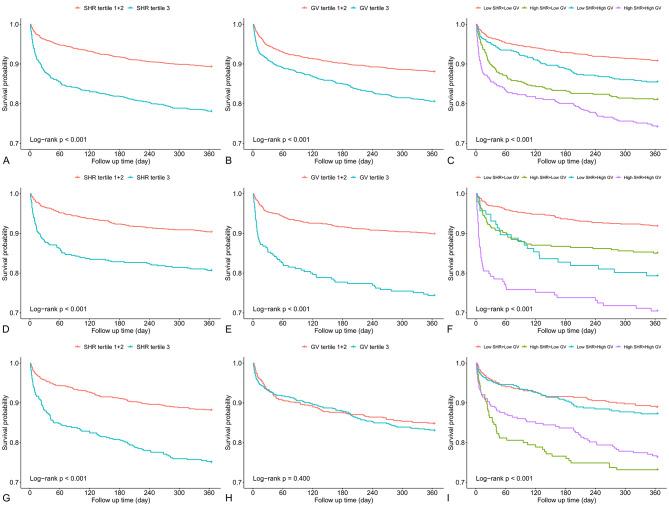
A total of 2789 patients were included, with a mean age of 69.6 years, and 30.1% were female. Overall, 138 (4.9%) patients died in the hospital, and 404 (14.5%) patients died at 1 year. The combination of SHR and GV was superior to SHR (in-hospital mortality: 0.710 vs. 0.689, p = 0.012; 1-year mortality: 0.644 vs. 0.615, p = 0.007) and GV (in-hospital mortality: 0.710 vs. 0.632, p = 0.004; 1-year mortality: 0.644 vs. 0.603, p < 0.001) alone for predicting mortality in the receiver operating characteristic analysis. In addition, nondiabetic patients with high SHR levels and high GV were associated with the greatest risk of both in-hospital mortality (odds ratio [OR] = 10.831, 95% confidence interval [CI] 4.494-26.105) and 1-year mortality (hazard ratio [HR] = 5.830, 95% CI 3.175-10.702). However, in the diabetic population, the highest risk of in-hospital mortality (OR = 4.221, 95% CI 1.542-11.558) and 1-year mortality (HR = 2.013, 95% CI 1.224-3.311) was observed in patients with high SHR levels but low GV.
CONCLUSIONS
The simultaneous evaluation of SHR and GV provides more information for risk stratification and prognostic prediction than SHR and GV alone, contributing to developing individualized strategies for glucose management in patients with CAD admitted to the ICU.
背景
应激性高血糖和血糖变异性(GV)可以反映血糖的急剧升高和急性波动,与不良心血管事件有关。本研究旨在探讨在重症监护病房(ICU)住院的冠心病(CAD)患者中,应激性高血糖比(SHR)和 GV 的联合评估是否能提供预后预测的额外信息。
方法
回顾性分析了 2008 年至 2019 年期间来自医疗信息市场重症监护-IV 数据库(版本 2.2)的 CAD 患者。主要终点是 1 年死亡率,次要终点是住院死亡率。SHR 和 GV 水平分为三分位,最高三分位为高,较低的两个三分位为低。通过逻辑和 Cox 回归分析确定 SHR、GV 及其组合与死亡率的关系。
结果
共纳入 2789 例患者,平均年龄 69.6 岁,30.1%为女性。总体而言,138 例(4.9%)患者在医院死亡,404 例(14.5%)患者在 1 年内死亡。SHR 和 GV 的联合评估优于 SHR(住院死亡率:0.710 比 0.689,p=0.012;1 年死亡率:0.644 比 0.615,p=0.007)和 GV(住院死亡率:0.710 比 0.632,p=0.004;1 年死亡率:0.644 比 0.603,p<0.001),在接受者操作特征分析中预测死亡率。此外,非糖尿病患者中 SHR 水平高和 GV 高的患者与住院死亡率(比值比[OR] 10.831,95%置信区间[CI] 4.494-26.105)和 1 年死亡率(风险比[HR] 5.830,95%CI 3.175-10.702)的风险增加最大相关。然而,在糖尿病患者中,SHR 水平高但 GV 水平低的患者住院死亡率(OR 4.221,95%CI 1.542-11.558)和 1 年死亡率(HR 2.013,95%CI 1.224-3.311)的风险最高。
结论
与 SHR 和 GV 单独评估相比,SHR 和 GV 的同时评估为风险分层和预后预测提供了更多信息,有助于为 ICU 住院的 CAD 患者制定个体化的血糖管理策略。




 Zotero 插件