Department of Endocrinology and Metabolism, Shanghai Clinical Center for Diabetes, Shanghai Diabetes Institute, Shanghai Key Laboratory of Diabetes Mellitus, Shanghai Jiao Tong University Affiliated Sixth People's Hospital, Shanghai, China.
Department of Pulmonary Medicine and Critical Care, Shanghai Jiao Tong University Affiliated Sixth People's Hospital, Shanghai, China.
Diabetes Care. 2021 Apr;44(4):976-982. doi: 10.2337/dc20-1448. Epub 2021 Feb 11.
Although elevated glucose levels are reported to be associated with adverse outcomes of coronavirus disease 2019 (COVID-19), the optimal range of glucose in patients with COVID-19 and diabetes remains unknown. This study aimed to investigate the threshold of glycemia and its association with the outcomes of COVID-19.
Glucose levels were assessed through intermittently scanned continuous glucose monitoring in 35 patients for an average period of 10.2 days. The percentages of time above range (TAR), time below range (TBR), time in range (TIR), and coefficient of variation (CV) were calculated. Composite adverse outcomes were defined as either the need for admission to the intensive care unit, need for mechanical ventilation, or morbidity with critical illness.
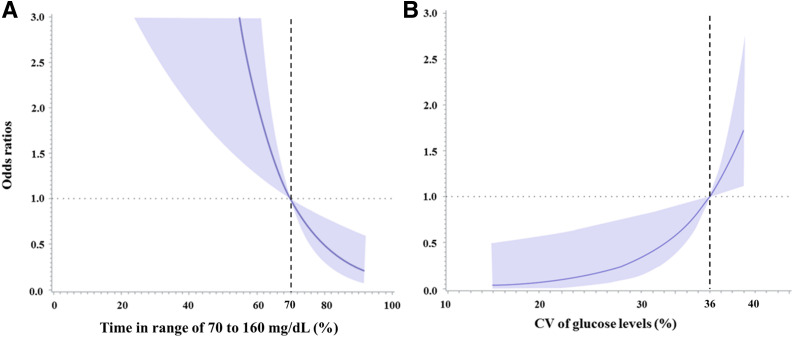
TARs using thresholds from 160 to 200 mg/dL were significantly associated with composite adverse outcomes after adjustment of covariates. Both TBR (<70 mg/dL) and TIR (70-160 mg/dL), but not mean sensor glucose level, were significantly associated with composite adverse outcomes and prolonged hospitalization. The multivariate-adjusted odds ratios of the CV of sensor glucose across tertiles for composite adverse outcomes of COVID-19 were 1.00, 1.18, and 25.2, respectively.
Patients with diabetes and COVID-19 have an increased risk of adverse outcomes with glucose levels >160 mg/dL and <70 mg/dL and a high CV. Therapies that improve these metrics of glycemic control may result in better prognoses for these patients.
尽管高血糖水平与 2019 年冠状病毒病(COVID-19)的不良结局相关,但 COVID-19 合并糖尿病患者的最佳血糖范围仍不清楚。本研究旨在探讨血糖阈值及其与 COVID-19 结局的关系。
通过间歇扫描连续血糖监测评估 35 例患者的血糖水平,平均监测 10.2 天。计算血糖超标时间百分比(TAR)、血糖不达标时间百分比(TBR)、血糖达标时间百分比(TIR)和变异系数(CV)。复合不良结局定义为需要入住重症监护病房、需要机械通气或危重病发病率。
调整协变量后,160-200mg/dL 阈值的 TARs 与复合不良结局显著相关。TBR(<70mg/dL)和 TIR(70-160mg/dL)均与复合不良结局和住院时间延长显著相关,但平均传感器血糖水平与复合不良结局和住院时间延长不相关。CV 传感器血糖水平分三分位时 COVID-19 复合不良结局的多变量校正比值比分别为 1.00、1.18 和 25.2。
COVID-19 合并糖尿病患者血糖水平>160mg/dL 和<70mg/dL 以及 CV 较高时,发生不良结局的风险增加。改善这些血糖控制指标的治疗方法可能会改善这些患者的预后。