Postgraduate Program in Rehabilitation Sciences (PPGCREAB), Health Sciences College of Trairi, Federal University of Rio Grande do Norte (UFRN/FACISA), Santa Cruz, RN, Brazil.
Brazilian Tendinopathy and Sports Injuries Research Group (BRATSI), Federal University of Rio Grande do Norte, Santa Cruz, RN, Brazil.
Sci Rep. 2024 Feb 9;14(1):3343. doi: 10.1038/s41598-024-53283-x.
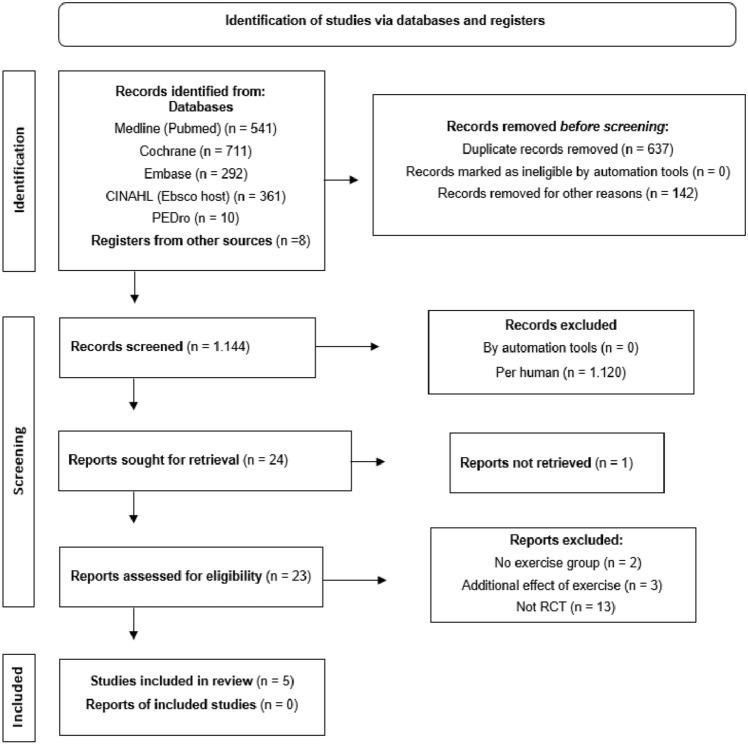
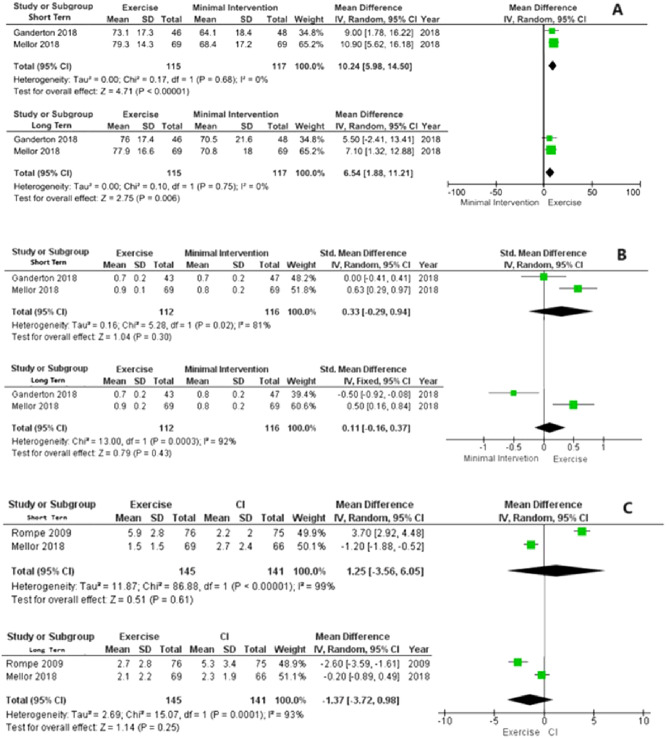
The objective of this review was to evaluate the effect of exercise on pain intensity, function, and quality of life in individuals with gluteal tendinopathy. Searches were carried out in PUBMED, EMBASE, CINAHL, Cochrane Library, and PEDro databases. Randomized or quasi-randomized controlled trials were included. Five studies met the eligibility criteria, comparing exercise-based interventions with minimal interventions and/or corticosteroid injections. Three studies, involving 383 participants, were included in the quantitative analysis. Meta-analyses showed that exercise is superior to minimal intervention for function in short-term [mean difference (MD) = 10.24; 95% confidence interval (95%CI) = 5.98, 14.50) and long-term (MD = 6.54; 95%CI = 1.88, 11.21]). However, no difference was observed for quality of life in the short [standardized mean difference (SMD) = 0.33; 95%CI = -0.29, 0.94] and long-term (SMD = 0.11; 95%CI = -0.16, 0.37). The effect of exercise was no different from that of corticosteroid injections for pain intensity in the short (MD = 1.25; 95%CI = -3.56, 6.05) and long-term (MD = -1.37; 95%CI = -3.72, 0.98]). In conclusion, exercise is superior to minimal interventions for function in the short- and long-term in individuals with gluteal tendinopathy. Exercise and corticosteroid injections had similar effects on pain intensity, however, exercise showed a higher treatment success rate when compared to corticosteroid injections in this population. The GRADE analysis revealed that the certainty of the evidence ranges from low to very low, therefore, large high-quality randomized controlled trials are recommended.PROSPERO registration number: CRD42021242853.
本综述的目的是评估运动对臀肌腱病患者疼痛强度、功能和生活质量的影响。在 PUBMED、EMBASE、CINAHL、Cochrane 图书馆和 PEDro 数据库中进行了检索。纳入了随机或准随机对照试验。有 5 项研究符合纳入标准,比较了基于运动的干预与最小干预和/或皮质类固醇注射。有 3 项研究(涉及 383 名参与者)纳入了定量分析。荟萃分析显示,运动在短期[平均差异(MD)= 10.24;95%置信区间(95%CI)= 5.98, 14.50]和长期[MD= 6.54;95%CI= 1.88, 11.21]对功能均优于最小干预。然而,在短期[标准化均数差(SMD)= 0.33;95%CI= -0.29, 0.94]和长期[SMD= 0.11;95%CI= -0.16, 0.37],运动对生活质量没有差异。在短期[MD= 1.25;95%CI= -3.56, 6.05]和长期[MD= -1.37;95%CI= -3.72, 0.98],运动与皮质类固醇注射对疼痛强度的效果无差异。总之,运动在短期和长期对臀肌腱病患者的功能优于最小干预。运动和皮质类固醇注射对疼痛强度的影响相似,但与皮质类固醇注射相比,运动在该人群中的治疗成功率更高。GRADE 分析显示,证据的确定性范围为低到极低,因此建议进行大型高质量的随机对照试验。PROSPERO 注册号:CRD42021242853。