Nijs Jo, Malfliet Anneleen, Roose Eva, Lahousse Astrid, Van Bogaert Wouter, Johansson Elin, Runge Nils, Goossens Zosia, Labie Céline, Bilterys Thomas, Van Campenhout Jente, Polli Andrea, Wyns Arne, Hendrix Jolien, Xiong Huan-Yu, Ahmed Ishtiaq, De Baets Liesbet, Huysmans Eva
Pain in Motion Research Group (PAIN), Department of Physiotherapy, Human Physiology and Anatomy, Faculty of Physical Education & Physiotherapy, Vrije Universiteit Brussel, 1090 Brussels, Belgium.
Chronic Pain Rehabilitation, Department of Physical Medicine and Physiotherapy, University Hospital Brussels, 1090 Brussels, Belgium.
J Clin Med. 2024 Jan 23;13(3):644. doi: 10.3390/jcm13030644.
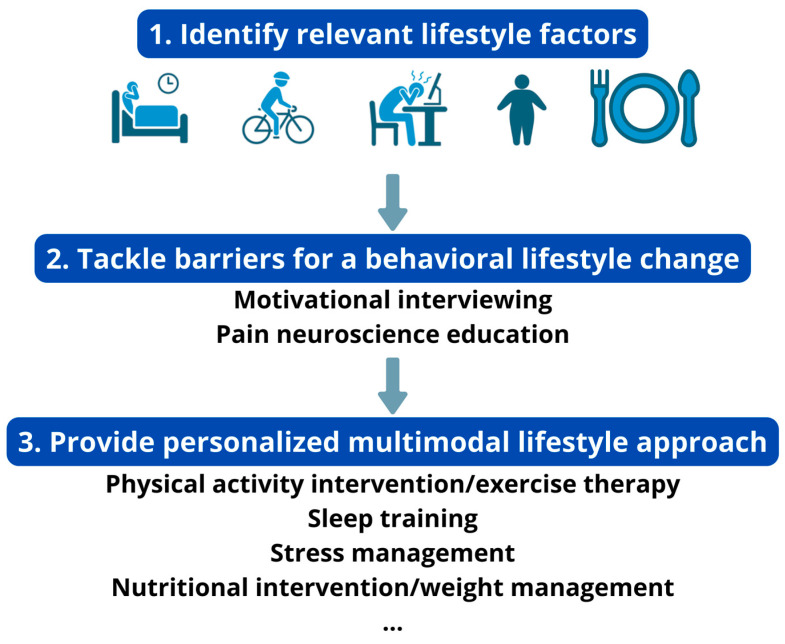
Chronic pain is the most prevalent disease worldwide, leading to substantial disability and socioeconomic burden. Therefore, it can be regarded as a public health disease and major challenge to scientists, clinicians and affected individuals. Behavioral lifestyle factors, such as, physical (in)activity, stress, poor sleep and an unhealthy diet are increasingly recognized as perpetuating factors for chronic pain. Yet, current management options for patients with chronic pain often do not address lifestyle factors in a personalized multimodal fashion. This state-of-the-art clinical perspective aims to address this gap by discussing how clinicians can simultaneously incorporate various lifestyle factors into a personalized multimodal lifestyle intervention for individuals with chronic pain. To do so the available evidence on (multimodal) lifestyle interventions targeting physical (in)activity, stress, sleep and nutritional factors, specifically, was reviewed and synthetized from a clinical point of view. First, advise is provided on how to design a personalized multimodal lifestyle approach for a specific patient. Subsequently, best-evidence recommendations on how to integrate physical (in)activity, stress, sleep and nutritional factors as treatment targets into a personalized multimodal lifestyle approach are outlined. Evidence supporting such a personalized multimodal lifestyle approach is growing, but further studies are needed.
慢性疼痛是全球最普遍的疾病,导致严重的残疾和社会经济负担。因此,它可被视为一种公共卫生疾病,对科学家、临床医生和患者构成重大挑战。行为生活方式因素,如身体活动(或缺乏活动)、压力、睡眠不足和不健康饮食,越来越被认为是慢性疼痛的持续因素。然而,目前针对慢性疼痛患者的管理方案往往未能以个性化的多模式方式解决生活方式因素。这篇前沿临床观点旨在通过讨论临床医生如何将各种生活方式因素同时纳入针对慢性疼痛患者的个性化多模式生活方式干预措施来弥补这一差距。为此,从临床角度对针对身体活动(或缺乏活动)、压力、睡眠和营养因素的(多模式)生活方式干预的现有证据进行了回顾和综合。首先,提供了关于如何为特定患者设计个性化多模式生活方式方法的建议。随后,概述了关于如何将身体活动(或缺乏活动)、压力、睡眠和营养因素作为治疗靶点纳入个性化多模式生活方式方法的最佳证据推荐。支持这种个性化多模式生活方式方法的证据正在增加,但仍需要进一步研究。