Goudman Lisa, De Smedt Ann, Jansen Julie, Billot Maxime, Roulaud Manuel, Rigoard Philippe, Moens Maarten
STIMULUS Research Group, Vrije Universiteit Brussel, Laarbeeklaan 103, 1090 Brussels, Belgium.
Cluster Neurosciences, Center for Neurosciences (C4N), Vrije Universiteit Brussel, Laarbeeklaan 103, 1090 Brussels, Belgium.
J Clin Med. 2024 Nov 26;13(23):7163. doi: 10.3390/jcm13237163.
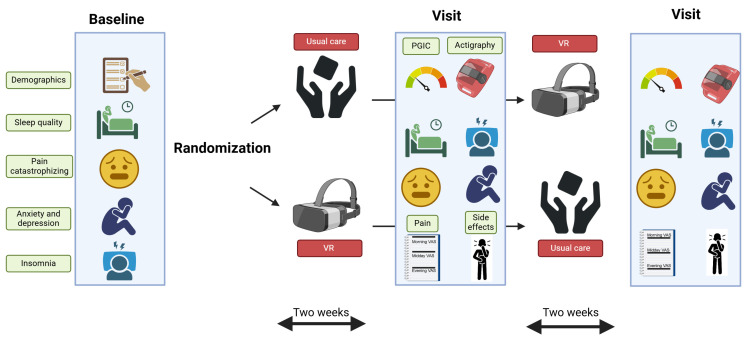
: Sleep disturbance is often observed in the context of chronic pain. We hypothesize that, by providing an immersive Virtual Reality (VR) experience with a serious game to chronic pain patients an hour before bedtime, attention can be diverted from the pain condition, consequently leading to improved sleep quality. The aim is to evaluate the efficacy of VR compared to usual care in reducing the number of awakenings during the night and increasing sleep efficiency in patients suffering from painful diabetic polyneuropathy (PDPN). : Eight patients with PDPN were randomized to either two weeks of VR or two weeks of usual care, followed by a cross-over. The primary outcome measurements were sleep efficiency and number of awakenings during the night. As secondary outcomes, self-reported sleep quality, insomnia, pain catastrophizing, anxiety, depression, pain intensity, side effects and impression of change were evaluated. : Data of seven patients were analysed. Actigraphy data, self-reported sleep quality, insomnia, pain catastrophizing, anxiety, depression and pain intensity scores did not differ between usual care and VR. As for impression of change, more patients improved after VR compared to usual care (V = 21, = 0.03). : A 2-week period of pain neuroscience education through VR did not result in increased sleep efficiency or fewer awakenings compared to usual care in patients with PDPN. These pilot results indicate that patients subjectively experience an improvement, yet this is not substantiated by either self-reported or objective measurements.
睡眠障碍在慢性疼痛的情况下经常被观察到。我们假设,通过在睡前一小时为慢性疼痛患者提供一款严肃游戏的沉浸式虚拟现实(VR)体验,可以将注意力从疼痛状况上转移开,从而提高睡眠质量。目的是评估与常规护理相比,VR在减少患有疼痛性糖尿病周围神经病变(PDPN)患者夜间觉醒次数和提高睡眠效率方面的疗效。
八名患有PDPN的患者被随机分为接受两周的VR治疗或两周的常规护理,随后进行交叉治疗。主要结局指标是睡眠效率和夜间觉醒次数。作为次要结局,评估了自我报告的睡眠质量、失眠、疼痛灾难化、焦虑、抑郁、疼痛强度、副作用和变化印象。
分析了七名患者的数据。活动记录仪数据、自我报告的睡眠质量、失眠、疼痛灾难化、焦虑、抑郁和疼痛强度评分在常规护理和VR之间没有差异。至于变化印象,与常规护理相比,更多患者在VR治疗后有所改善(V = 21,P = 0.03)。
与PDPN患者的常规护理相比,为期两周的通过VR进行的疼痛神经科学教育并没有提高睡眠效率或减少觉醒次数。这些初步结果表明,患者主观上感觉有改善,但自我报告或客观测量均未证实这一点。