Women, Mother, Children Department (DFME)-Urogynecology Unit, Vaud University Hospital Center (CHUV), Av. Pierre-Decker 2, 1011, Lausanne, Switzerland.
J Robot Surg. 2024 Feb 10;18(1):72. doi: 10.1007/s11701-023-01799-1.
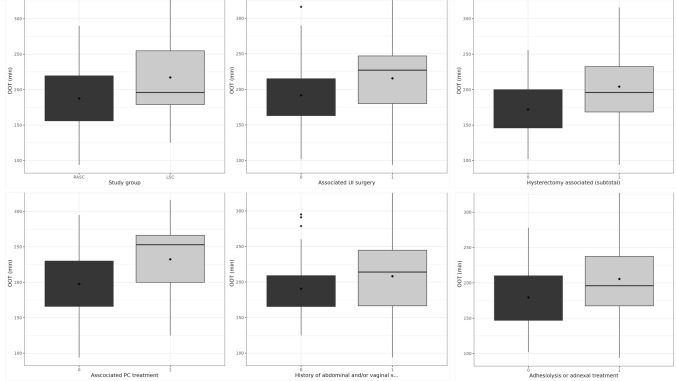
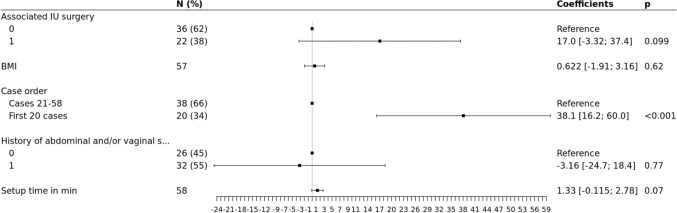
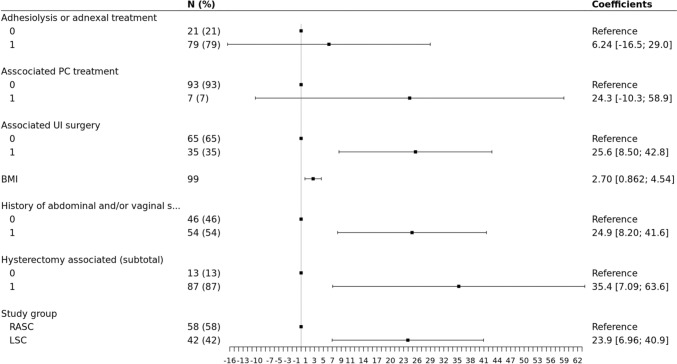
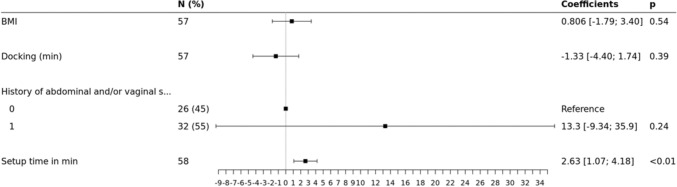
Minimally invasive abdominal sacrocolpopexy (SC) is the treatment of choice for symptomatic, high-grade, apical or multi-compartmental pelvic organ prolapse (POP), in terms of anatomical correction and treatment durability. Robot-assisted sacrocolpopexy (RASC) could be an attractive alternative to the gold standard laparoscopic sacrocolpopexy (LSC), for its ergonomic advantages in such a technically demanding procedure. However, it has not yet proven its superiority, consequently raising cost-effectiveness issues. Our primary objective was to assess if RASC can achieve better overall operative time (OOT) over LSC, with at least equivalent perioperative results. This was a single-center retrospective study including 100 patients (58 consecutive RASC cases and 42 LSC within the same time-period), with primary endpoint the OOT in both groups. Secondary results included complication rate, hospital stay, short-term anatomic results and OOT within and beyond the RASC learning curve. A multivariate linear regression was carried out for our primary outcome. The groups had comparable characteristics, except for BMI, which was lower in RASC group. The mean OOT was significantly lower in the RASC group (188 vs. 217 min, p ≤ 0.01), even after adjusting for possible confounders. Short-term anatomic results, complication rate, and blood loss were similar in the two groups. Mean hospital stay was significantly longer in the RASC group. Average RASC OOT was significantly shorter after the first 20 cases realized. This study demonstrated a significant reduction of OOT for RASC compared to LSC, with similar perioperative results, encouraging further use of the robotic technology for this indication.
经腹微创骶骨阴道固定术(SC)是治疗症状性、高级别、顶点或多部位盆腔器官脱垂(POP)的首选方法,从解剖矫正和治疗持久性方面来看。机器人辅助骶骨阴道固定术(RASC)在技术要求高的手术中具有其在人体工程学方面的优势,可能成为金标准腹腔镜骶骨阴道固定术(LSC)的一种有吸引力的替代方法。然而,它尚未证明其优越性,因此引发了成本效益问题。我们的主要目标是评估 RASC 是否可以在手术时间(OOT)上优于 LSC,且至少在围手术期结果方面等效。这是一项单中心回顾性研究,纳入了 100 名患者(58 例连续的 RASC 病例和同期的 42 例 LSC 病例),主要终点为两组的 OOT。次要结果包括并发症发生率、住院时间、短期解剖结果和 RASC 学习曲线内和之外的 OOT。我们的主要结果采用多元线性回归进行分析。两组患者的特征相似,除了 BMI,RASC 组的 BMI 较低。RASC 组的平均 OOT 明显更低(188 分钟比 217 分钟,p≤0.01),即使在调整了可能的混杂因素后也是如此。两组的短期解剖结果、并发症发生率和出血量相似。RASC 组的平均住院时间明显更长。前 20 例 RASC 手术平均 OOT 明显缩短。这项研究表明,与 LSC 相比,RASC 的 OOT 显著减少,且围手术期结果相似,鼓励进一步将机器人技术用于该适应证。