Beijing Center for Disease Prevention and Control, Beijing, People's Republic of China.
National Health Commission Key Laboratory of Food Safety Risk Assessment, Chinese Academy of Medical Science Research Unit (No.2019RU014), China National Center for Food Safety Risk Assessment, Beijing, People's Republic of China.
Emerg Microbes Infect. 2024 Dec;13(1):2307520. doi: 10.1080/22221751.2024.2307520. Epub 2024 Feb 11.
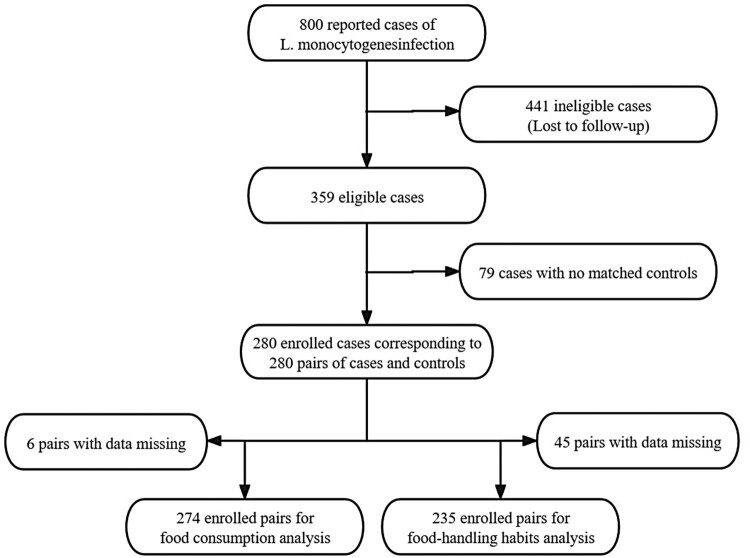
The prevalence of listeriosis in China has been increasing in recent years. Listeriosis primarily spreads through contaminated food. However, the resilient causative organism, , and its extended incubation period pose challenges in identifying risk factors associated with food consumption and food-handling habits. This study aimed to identify the risk factors associated with food consumption and food-handling habits for listeriosis in China. A matched case-control study (1:1 ratio) was conducted, which enrolled all eligible cases of listeriosis between 1 January 2013 and 31 December 2022 in China. Basic information and possible risk factors associated with food consumption and food-handling habits were collected. Overall, 359 patients were enrolled, including 208 perinatal and 151 non-perinatal cases. Univariate and multivariable logistic analyzes were performed for the perinatal group. For the perinatal and non-perinatal groups, ice cream and Chinese cold dishes were the high-risk foods for listeriosis (odds ratio (OR) 2.09 95% confidence interval (CI): 1.23-3.55; OR 3.17 95% CI: 1.29-7.81), respectively; consumption of leftovers and pet ownership were the high-risk food-handling habits (OR 1.92 95% CI: 1.03-3.59; OR 3.00 95% CI: 1.11-8.11), respectively. In both groups, separation of raw and cooked foods was a protective factor (OR 0.27 95% CI: 0.14-0.51; OR 0.35 95% CI: 0.14-0.89), while refrigerator cleaning reduced the infection risk by 64.94-70.41% only in the perinatal group. The identification of high-risk foods and food-handling habits for listeriosis is important for improving food safety guidelines for vulnerable populations.
近年来,中国李斯特菌病的患病率呈上升趋势。李斯特菌病主要通过污染食物传播。然而,这种具有弹性的病原体 ,以及其较长的潜伏期,给确定与食物消费和食品处理习惯相关的风险因素带来了挑战。本研究旨在确定与中国李斯特菌病食物消费和食品处理习惯相关的风险因素。采用病例对照研究(1:1 比例),纳入 2013 年 1 月 1 日至 2022 年 12 月 31 日期间中国所有符合条件的李斯特菌病病例。收集基本信息和与食物消费及食品处理习惯相关的可能风险因素。共有 359 名患者入组,包括 208 例围产期和 151 例非围产期病例。对围产期组进行单变量和多变量逻辑分析。对于围产期和非围产期组,冰淇淋和中式凉菜是李斯特菌病的高危食品(比值比(OR)2.09,95%置信区间(CI):1.23-3.55;OR 3.17,95%CI:1.29-7.81);食用剩菜和养宠物是高危食品处理习惯(OR 1.92,95%CI:1.03-3.59;OR 3.00,95%CI:1.11-8.11)。在两组中,生熟食品分开是保护因素(OR 0.27,95%CI:0.14-0.51;OR 0.35,95%CI:0.14-0.89),而仅在围产期组中,冰箱清洁可将感染风险降低 64.94%-70.41%。确定李斯特菌病的高危食品和食品处理习惯对于改善弱势群体的食品安全指南非常重要。