Institut de Chimie Moléculaire de l'Université de Bourgogne, ICMUB UMR CNRS 6302, Université Bourgogne, 21000, Dijon, France.
Service de Médecine Nucléaire, Centre Georges-François Leclerc, 21000, Dijon, France.
Sci Rep. 2024 Feb 12;14(1):3522. doi: 10.1038/s41598-024-53528-9.
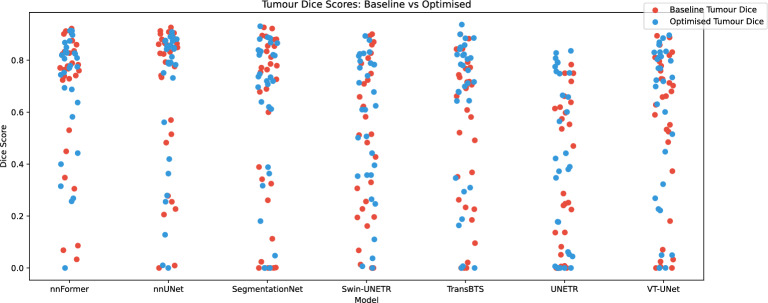
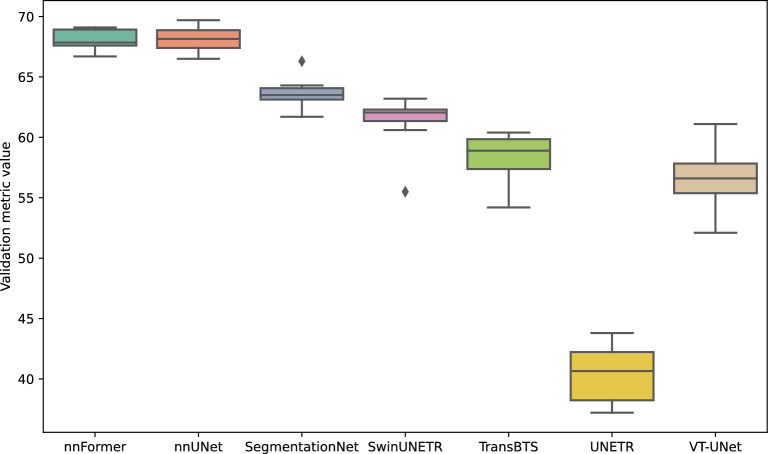
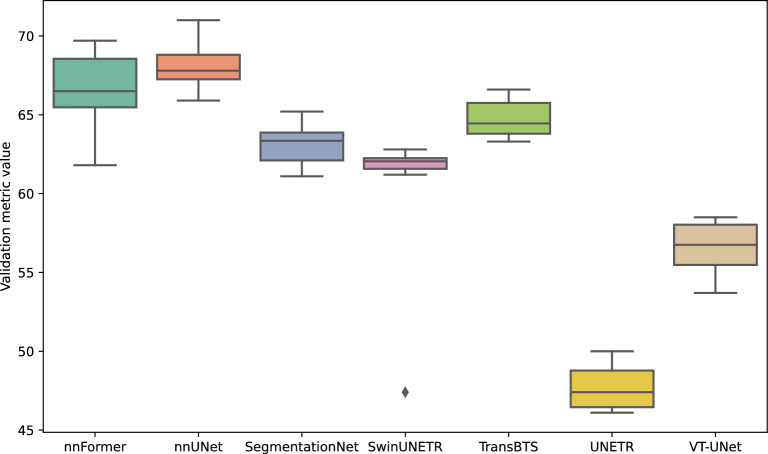
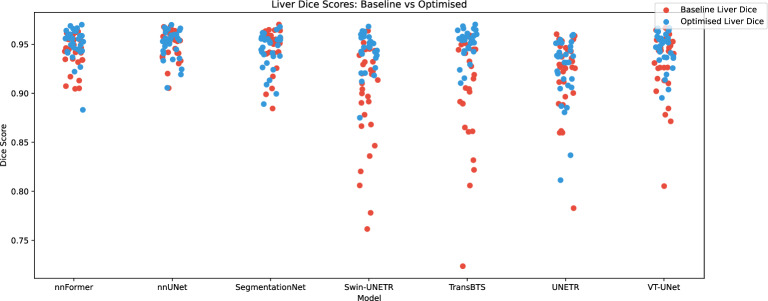
In medical imaging, accurate segmentation is crucial to improving diagnosis, treatment, or both. However, navigating the multitude of available architectures for automatic segmentation can be overwhelming, making it challenging to determine the appropriate type of architecture and tune the most crucial parameters during dataset optimisation. To address this problem, we examined and refined seven distinct architectures for segmenting the liver, as well as liver tumours, with a restricted training collection of 60 3D contrast-enhanced magnetic resonance images (CE-MRI) from the ATLAS dataset. Included in these architectures are convolutional neural networks (CNNs), transformers, and hybrid CNN/transformer architectures. Bayesian search techniques were used for hyperparameter tuning to hasten convergence to the optimal parameter mixes while also minimising the number of trained models. It was unexpected that hybrid models, which typically exhibit superior performance on larger datasets, would exhibit comparable performance to CNNs. The optimisation of parameters contributed to better segmentations, resulting in an average increase of 1.7% and 5.0% in liver and tumour segmentation Dice coefficients, respectively. In conclusion, the findings of this study indicate that hybrid CNN/transformer architectures may serve as a practical substitute for CNNs even in small datasets. This underscores the significance of hyperparameter optimisation.
在医学成像中,准确的分割对于改善诊断、治疗或两者都非常重要。然而,面对众多可用的自动分割架构,可能会让人不知所措,难以确定适当的架构类型,并在数据集优化过程中调整最关键的参数。为了解决这个问题,我们研究和改进了七种不同的架构,用于分割肝脏和肝脏肿瘤,使用来自 ATLAS 数据集的 60 个 3D 对比增强磁共振图像 (CE-MRI) 的受限训练集。这些架构包括卷积神经网络 (CNN)、变压器和混合 CNN/变压器架构。贝叶斯搜索技术用于超参数调整,以加快收敛到最佳参数组合的速度,同时最小化训练模型的数量。出乎意料的是,混合模型通常在更大的数据集上表现出更好的性能,但在与 CNN 相比时表现出相当的性能。参数的优化有助于更好的分割,导致肝脏和肿瘤分割的 Dice 系数分别平均增加 1.7%和 5.0%。总之,这项研究的结果表明,混合 CNN/变压器架构即使在小数据集上也可以作为 CNN 的实用替代品。这突显了超参数优化的重要性。