
OLFM2 通过 TGF-β/Smad 信号通路促进结直肠癌细胞的上皮-间质转化、迁移和侵袭。
OLFM2 promotes epithelial-mesenchymal transition, migration, and invasion in colorectal cancer through the TGF-β/Smad signaling pathway.
机构信息
Department of Gastroenterology, Affiliated Hospital of North Sichuan Medical College, Nanchong, China.
Department of Gastroenterology, Ziyang Yanjiang People's Hospital, Ziyang, China.
出版信息
BMC Cancer. 2024 Feb 13;24(1):204. doi: 10.1186/s12885-024-11925-3.
BACKGROUND
Colorectal cancer (CRC) is an aggressive tumor of the gastrointestinal tract, which is a major public health concern worldwide. Despite numerous studies, the precise mechanism of metastasis behind its progression remains elusive. As a member of the containing olfactomedin domains protein family, olfactomedin 2 (OLFM2) may play a role in tumor metastasis. It is highly expressed in colorectal cancer, and its role in the metastasis of CRC is still unclear. As such, this study seeks to explore the function of OLFM2 on CRC metastasis and its potential mechanisms.
METHODS
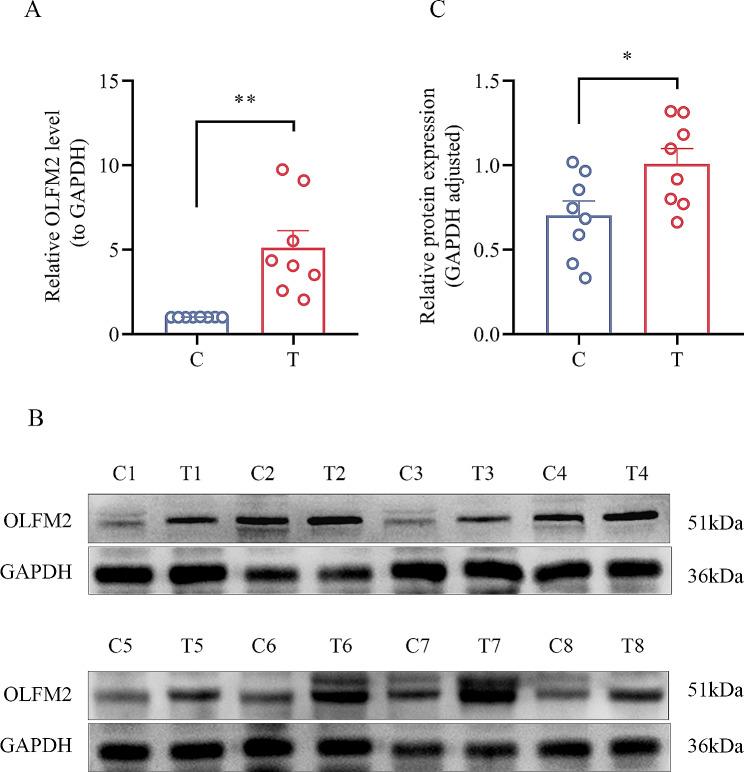
Real-time fluorescence quantitative PCR and western blotting were used to study the expression of OLFM2 in human CRC and adjacent normal tissues. Knockdown and overexpression OLFM2 cell lines were constructed using siRNA and overexpression plasmids to explore the role of OLFM2 in the migration and invasion of CRC through transwell, and wound healing experiments. Finally, the expression of epithelial-mesenchymal transition (EMT) -related proteins and TGF-β/Smad signaling pathway-related proteins was investigated using western blotting.
RESULTS
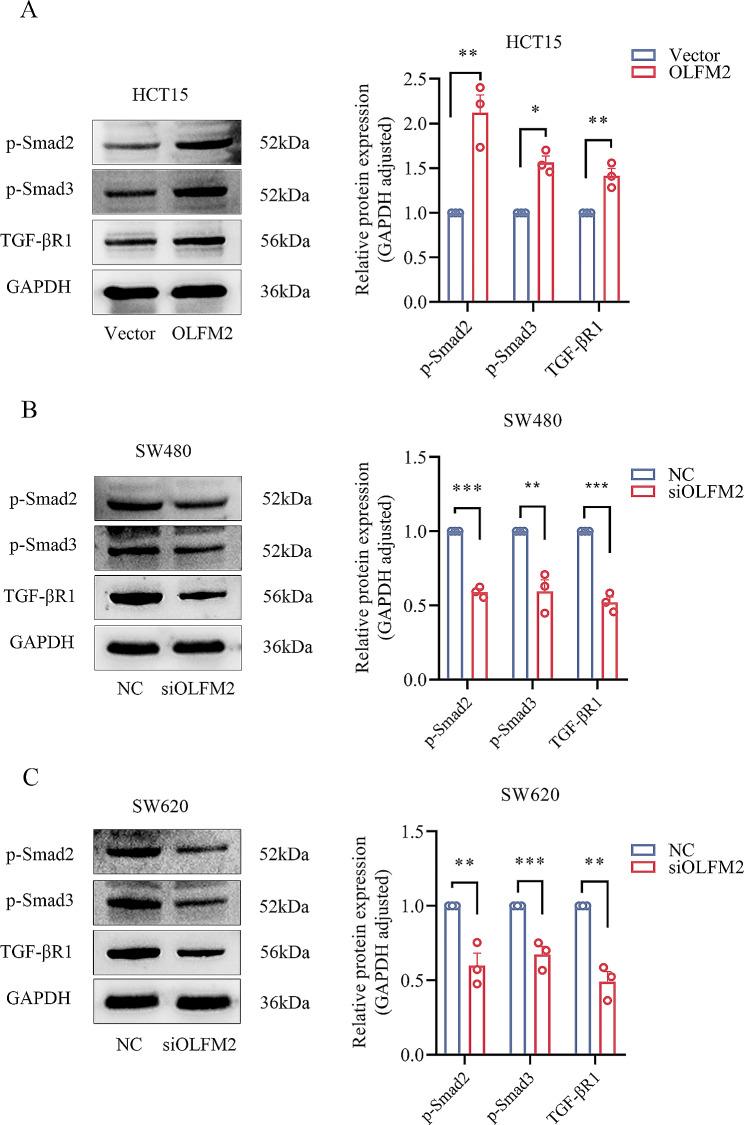
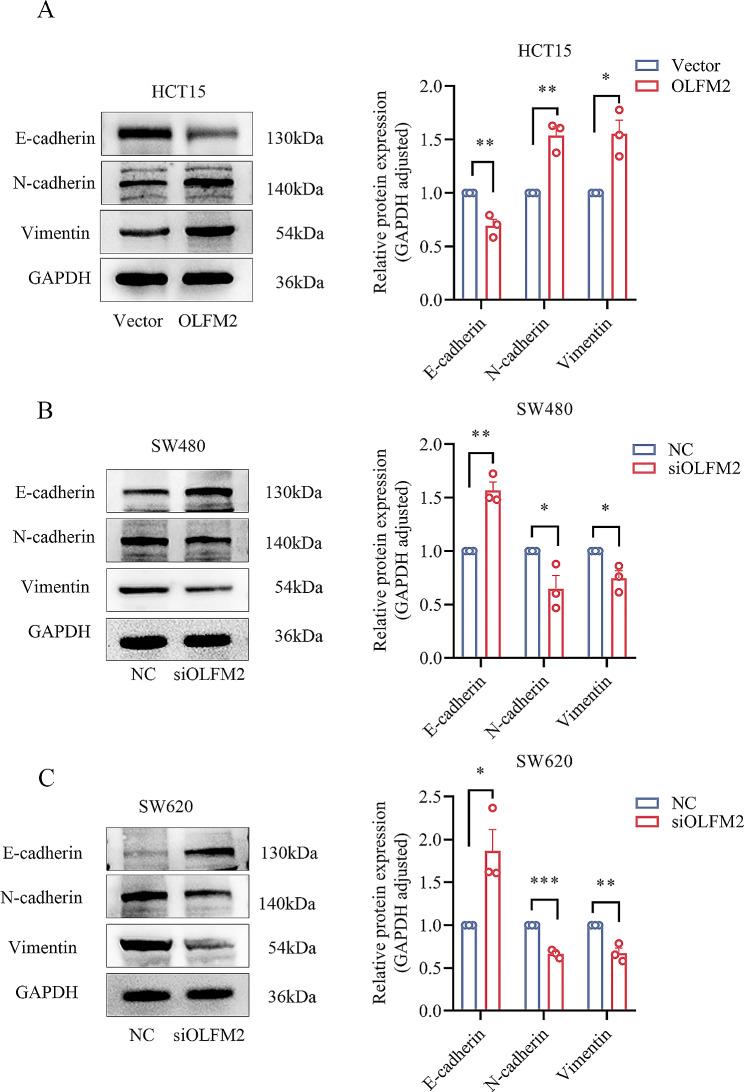
In this study, we observed an elevation of OLFM2 expression levels in CRC tissues. To investigate the function of OLFM2, we overexpressed and knocked down OLFM2. We discovered that OLFM2 knockdown inhibited migration and invasion of colon cancer cells. Furthermore, E-cadherin expression increased while N-cadherin and Vimentin expression were opposite. It is no surprise that overexpressing OLFM2 had the opposite effects. We also identified that OLFM2 knockdown resulted in reduced TGF-βR1 and downstream molecules p-Smad2 and p-Smad3, which are related to the TGF-β / Smad pathway. In contrast, overexpressing OLFM2 significantly boosted their expression levels.
CONCLUSION
The protein OLFM2 has been identified as a crucial determinant in the progression of CRC. Its mechanism of action involves the facilitation of EMT through the TGF-β/Smad signaling pathway. Given its pivotal role in CRC, OLFM2 has emerged as a promising diagnostic and therapeutic target for the disease. These results indicate the potential of OLFM2 as a valuable biomarker for CRC diagnosis and treatment and highlight the need for further research exploring its clinical significance.
背景
结直肠癌(CRC)是一种侵袭性的胃肠道肿瘤,是全球主要的公共卫生关注点。尽管进行了大量研究,但肿瘤进展背后的确切转移机制仍难以捉摸。作为含嗅素域蛋白家族的一员,嗅素 2(OLFM2)可能在肿瘤转移中发挥作用。它在结直肠癌中高表达,但其在 CRC 转移中的作用尚不清楚。因此,本研究旨在探讨 OLFM2 对 CRC 转移的功能及其潜在机制。
方法
采用实时荧光定量 PCR 和 Western blot 法研究 OLFM2 在人 CRC 及相邻正常组织中的表达。利用 siRNA 和过表达质粒构建 OLFM2 敲低和过表达细胞系,通过 Transwell 迁移和划痕愈合实验探讨 OLFM2 对 CRC 迁移和侵袭的作用。最后,采用 Western blot 法检测上皮间质转化(EMT)相关蛋白和 TGF-β/Smad 信号通路相关蛋白的表达。
结果
本研究观察到 CRC 组织中 OLFM2 表达水平升高。为了研究 OLFM2 的功能,我们过表达和敲低了 OLFM2。结果发现,OLFM2 敲低抑制了结肠癌细胞的迁移和侵袭。此外,E-钙黏蛋白表达增加,而 N-钙黏蛋白和波形蛋白表达则相反。过表达 OLFM2 则产生相反的效果。我们还发现,OLFM2 敲低导致 TGF-βR1 及其下游分子 p-Smad2 和 p-Smad3 减少,这些分子与 TGF-β/Smad 通路有关。相反,过表达 OLFM2 则显著提高了它们的表达水平。
结论
OLFM2 蛋白已被确定为 CRC 进展的关键决定因素。其作用机制涉及通过 TGF-β/Smad 信号通路促进 EMT。鉴于其在 CRC 中的重要作用,OLFM2 已成为该疾病有前途的诊断和治疗靶点。这些结果表明 OLFM2 作为 CRC 诊断和治疗的有价值的生物标志物的潜力,并强调需要进一步研究其临床意义。





 Zotero 插件