Ye Lan, Greten Stephan, Wegner Florian, Doll-Lee Johanna, Krey Lea, Heine Johanne, Gandor Florin, Vogel Annemarie, Berger Luise, Gruber Doreen, Levin Johannes, Katzdobler Sabrina, Peters Oliver, Dashti Eman, Priller Josef, Spruth Eike Jakob, Kühn Andrea A, Krause Patricia, Spottke Annika, Schneider Anja, Beyle Aline, Kimmich Okka, Donix Markus, Haussmann Robert, Brandt Moritz, Dinter Elisabeth, Wiltfang Jens, Schott Björn H, Zerr Inga, Bähr Mathias, Buerger Katharina, Janowitz Daniel, Perneczky Robert, Rauchmann Boris-Stephan, Weidinger Endy, Düzel Emrah, Glanz Wenzel, Teipel Stefan, Kilimann Ingo, Wurster Isabel, Brockmann Kathrin, Hoffmann Daniel C, Klockgether Thomas, Krause Olaf, Heck Johannes, Höglinger Günter U, Klietz Martin
Department of Neurology, Hannover Medical School, Carl-Neuberg-Str. 1, 30625, Hannover, Germany.
Neurologisches Fachkrankenhaus für Bewegungsstörungen/Parkinson, Kliniken Beelitz, 14547, Beelitz-Heilstätten, Germany.
J Neurol. 2024 May;271(5):2639-2648. doi: 10.1007/s00415-024-12207-5. Epub 2024 Feb 14.
Multiple system atrophy (MSA) is a complex and fatal neurodegenerative movement disorder. Understanding the comorbidities and drug therapy is crucial for MSA patients' safety and management.
To investigate the pattern of comorbidities and aspects of drug therapy in MSA patients.
Cross-sectional data of MSA patients according to Gilman et al. (2008) diagnostic criteria and control patients without neurodegenerative diseases (non-ND) were collected from German, multicenter cohorts. The prevalence of comorbidities according to WHO ICD-10 classification and drugs administered according to WHO ATC system were analyzed. Potential drug-drug interactions were identified using AiDKlinik®.
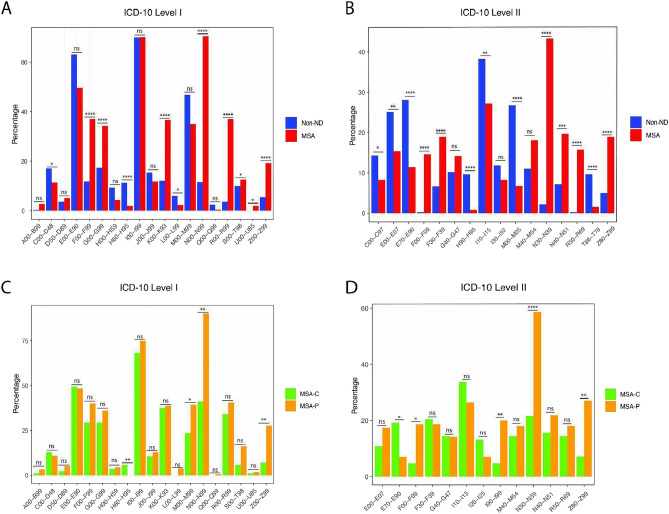
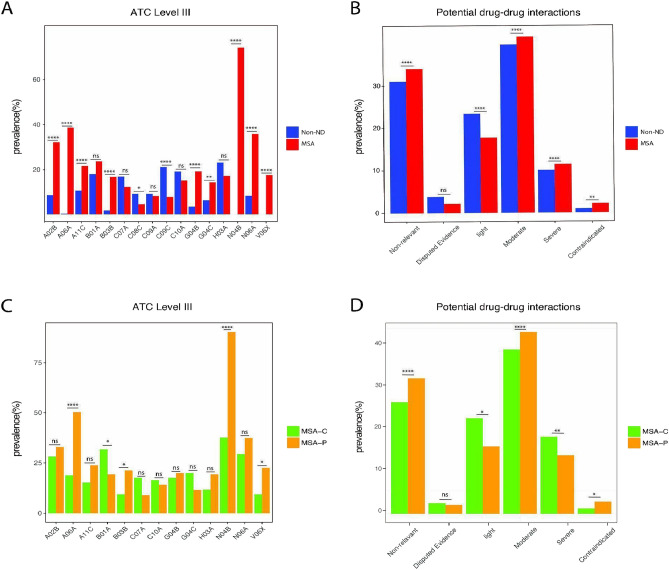
The analysis included 254 MSA and 363 age- and sex-matched non-ND control patients. MSA patients exhibited a significantly higher burden of comorbidities, in particular diseases of the genitourinary system. Also, more medications were prescribed MSA patients, resulting in a higher prevalence of polypharmacy. Importantly, the risk of potential drug-drug interactions, including severe interactions and contraindicated combinations, was elevated in MSA patients. When comparing MSA-P and MSA-C subtypes, MSA-P patients suffered more frequently from diseases of the genitourinary system and diseases of the musculoskeletal system and connective tissue.
MSA patients face a substantial burden of comorbidities, notably in the genitourinary system. This, coupled with increased polypharmacy and potential drug interactions, highlights the complexity of managing MSA patients. Clinicians should carefully consider these factors when devising treatment strategies for MSA patients.
多系统萎缩(MSA)是一种复杂且致命的神经退行性运动障碍。了解合并症和药物治疗对于MSA患者的安全和管理至关重要。
研究MSA患者的合并症模式和药物治疗方面。
根据吉尔曼等人(2008年)的诊断标准收集MSA患者的横断面数据,并从德国多中心队列中收集无神经退行性疾病的对照患者(非ND)的数据。分析了根据世界卫生组织ICD-10分类的合并症患病率以及根据世界卫生组织ATC系统使用的药物。使用AiDKlinik®识别潜在的药物相互作用。
分析包括254例MSA患者和363例年龄和性别匹配的非ND对照患者。MSA患者的合并症负担明显更高,尤其是泌尿生殖系统疾病。此外,给MSA患者开的药更多,导致多药合用的患病率更高。重要的是,MSA患者中潜在药物相互作用的风险增加,包括严重相互作用和禁忌组合。比较MSA-P和MSA-C亚型时,MSA-P患者更常患有泌尿生殖系统疾病以及肌肉骨骼系统和结缔组织疾病。
MSA患者面临着巨大的合并症负担,尤其是在泌尿生殖系统方面。这与多药合用增加和潜在药物相互作用一起,凸显了管理MSA患者的复杂性。临床医生在为MSA患者制定治疗策略时应仔细考虑这些因素。