Herraiz-Adillo Ángel, Ahlqvist Viktor H, Higueras-Fresnillo Sara, Hedman Kristofer, Hagström Emil, Fortuin-de Smidt Melony, Daka Bledar, Lenander Cecilia, Berglind Daniel, Östgren Carl Johan, Rådholm Karin, Ortega Francisco B, Henriksson Pontus
Department of Health, Medicine and Caring Sciences, Linköping University, Linköping, Sweden.
Department of Global Public Health, Karolinska Institutet, Stockholm, Sweden.
Br J Sports Med. 2024 Feb 14;58(8):411-20. doi: 10.1136/bjsports-2023-107663.
To examine the associations between physical fitness in male adolescents and coronary and carotid atherosclerosis in middle age.
This population-based cohort study linked physical fitness data from the Swedish Military Conscription Register during adolescence to atherosclerosis data from the Swedish CArdioPulmonary bioImage Study in middle age. Cardiorespiratory fitness was assessed using a maximal cycle-ergometer test, and knee extension muscular strength was evaluated through an isometric dynamometer. Coronary atherosclerosis was evaluated via Coronary Computed Tomography Angiography (CCTA) stenosis and Coronary Artery Calcium (CAC) scores, while carotid plaques were evaluated by ultrasound. The associations were analysed using multinomial logistic regression, adjusted (marginal) prevalences and restricted cubic splines.
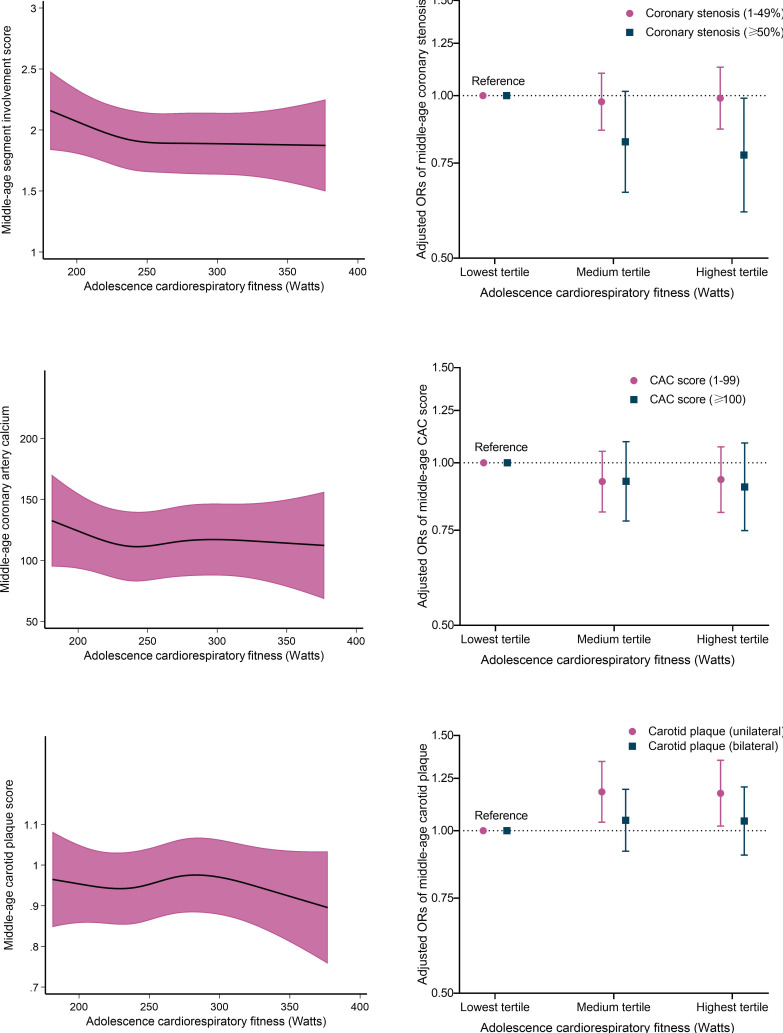
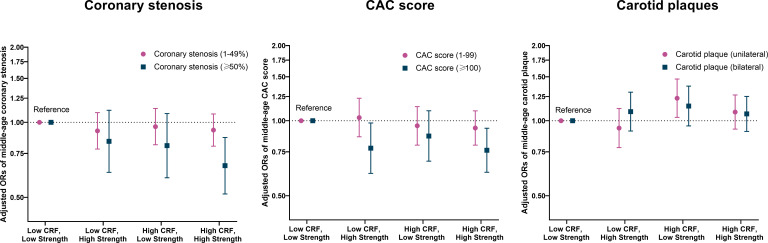
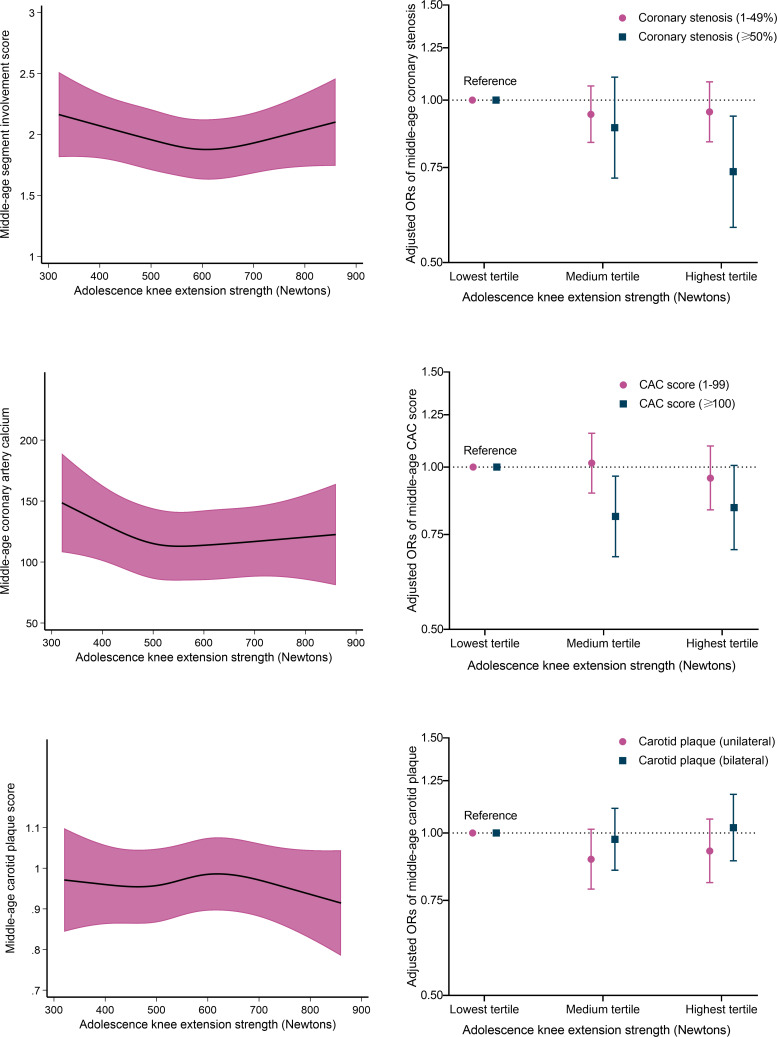
The analysis included 8986 male adolescents (mean age 18.3 years) with a mean follow-up of 38.2 years. Physical fitness showed a reversed J-shaped association with CCTA stenosis and CAC, but no consistent association was observed for carotid plaques. After adjustments, compared with adolescents in the lowest tertile of cardiorespiratory fitness and muscular strength, those in the highest tertile had 22% (OR 0.78; 95% CI 0.61 to 0.99) and 26% (OR 0.74; 95% CI 0.58 to 0.93) lower ORs for severe (≥50%) coronary stenosis, respectively. The highest physical fitness group (high cardiorespiratory fitness and muscular strength) had 33% (OR 0.67; 95% CI 0.52 to 0.87) lower OR for severe coronary stenosis compared with those with the lowest physical fitness.
This study supports that a combination of high cardiorespiratory fitness and high muscular strength in adolescence is associated with lower coronary atherosclerosis, particularly severe coronary stenosis, almost 40 years later.
研究男性青少年的身体素质与中年时冠状动脉和颈动脉粥样硬化之间的关联。
这项基于人群的队列研究将青少年时期瑞典义务兵役登记册中的身体素质数据与中年时瑞典心肺生物图像研究中的动脉粥样硬化数据相联系。使用最大运动功率测试评估心肺适能,通过等长测力计评估膝关节伸展肌力。通过冠状动脉计算机断层扫描血管造影(CCTA)狭窄和冠状动脉钙化(CAC)评分评估冠状动脉粥样硬化,通过超声评估颈动脉斑块。使用多项逻辑回归、调整(边际)患病率和受限立方样条分析关联。
分析纳入了8986名男性青少年(平均年龄18.3岁),平均随访38.2年。身体素质与CCTA狭窄和CAC呈倒J形关联,但未观察到与颈动脉斑块有一致关联。调整后,与心肺适能和肌肉力量处于最低三分位数的青少年相比,处于最高三分位数的青少年发生严重(≥50%)冠状动脉狭窄的比值比分别低22%(比值比0.78;95%置信区间0.61至0.99)和26%(比值比0.74;95%置信区间0.58至0.93)。与身体素质最低的组相比,身体素质最高的组(高心肺适能和高肌肉力量)发生严重冠状动脉狭窄的比值比低33%(比值比0.67;95%置信区间0.52至0.87)。
本研究支持青少年时期高心肺适能和高肌肉力量相结合与近40年后较低的冠状动脉粥样硬化,尤其是严重冠状动脉狭窄相关。