Key Laboratory of Saline-alkali Vegetation Ecology Restoration (Northeast Forestry University), Ministry of Education, Harbin 150040, China; Heilongjiang Key Laboratory of Plant Bioactive Substance Biosynthesis and Utilization, Northeast Forestry University, Harbin 150040, China.
Amity Institute of Genome Engineering, Amity University, Noida, UP India 201313, India.
Plant Commun. 2024 Apr 8;5(4):100845. doi: 10.1016/j.xplc.2024.100845. Epub 2024 Feb 13.
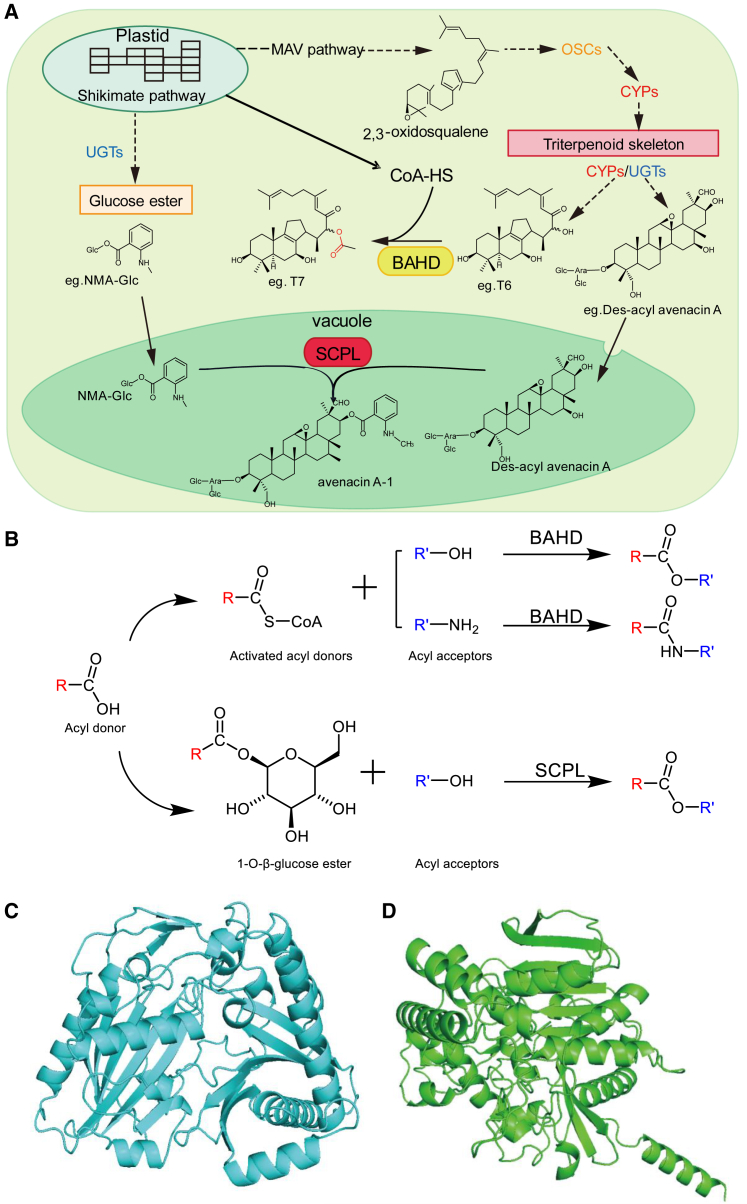
Triterpene esters comprise a class of secondary metabolites that are synthesized by decorating triterpene skeletons with a series of oxidation, glycosylation, and acylation modifications. Many triterpene esters with important bioactivities have been isolated and identified, including those with applications in the pesticide, pharmaceutical, and cosmetic industries. They also play essential roles in plant defense against pests, diseases, physical damage (as part of the cuticle), and regulation of root microorganisms. However, there has been no recent summary of the biosynthetic pathways and biological functions of plant triterpene esters. Here, we classify triterpene esters into five categories based on their skeletons and find that C-3 oxidation may have a significant effect on triterpenoid acylation. Fatty acid and aromatic moieties are common ligands present in triterpene esters. We further analyze triterpene ester synthesis-related acyltransferases (TEsACTs) in the triterpene biosynthetic pathway. Using an evolutionary classification of BAHD acyltransferases (BAHD-ATs) and serine carboxypeptidase-like acyltransferases (SCPL-ATs) in Arabidopsis thaliana and Oryza sativa, we classify 18 TEsACTs with identified functions from 11 species. All the triterpene-skeleton-related TEsACTs belong to BAHD-AT clades IIIa and I, and the only identified TEsACT from the SCPL-AT family belongs to the CP-I subfamily. This comprehensive review of the biosynthetic pathways and bioactivities of triterpene esters provides a foundation for further study of their bioactivities and applications in industry, agricultural production, and human health.
三萜酯类化合物是由萜类骨架通过一系列氧化、糖基化和酰化修饰而合成的一类次生代谢产物。许多具有重要生物活性的三萜酯类化合物已被分离和鉴定,包括在农药、制药和化妆品行业中应用的化合物。它们在植物抵御害虫、疾病、物理损伤(作为角质层的一部分)和调节根微生物方面也发挥着重要作用。然而,目前还没有关于植物三萜酯类化合物生物合成途径和生物功能的最新总结。在这里,我们根据三萜酯类化合物的骨架将其分为五类,发现 C-3 氧化可能对三萜酰化有显著影响。脂肪酸和芳香基团是三萜酯类化合物中常见的配体。我们进一步分析了三萜生物合成途径中与三萜酯合成相关的酰基转移酶(TEsACTs)。使用拟南芥和水稻中 BAHD 酰基转移酶(BAHD-ATs)和丝氨酸羧肽酶样酰基转移酶(SCPL-ATs)的进化分类,我们从 11 个物种中分类出 18 个具有已知功能的 TEsACTs。所有与三萜骨架相关的 TEsACTs 都属于 BAHD-AT 类群 IIIa 和 I,而从 SCPL-AT 家族中唯一鉴定出的 TEsACT 属于 CP-I 亚家族。对三萜酯类化合物生物合成途径和生物活性的全面综述为进一步研究其生物活性及其在工业、农业生产和人类健康中的应用提供了基础。