Department of Hematology, University Hospital of Salamanca (CAUSA/IBSAL) and Center for Biomedical Research in Network of Cancer (CIBERONC), Salamanca.
Cancer Center Clínica Universidad de Navarra, CIMA; IDISNA; CIBERONC, Pamplona.
Haematologica. 2024 Jul 1;109(7):2219-2228. doi: 10.3324/haematol.2023.284089.
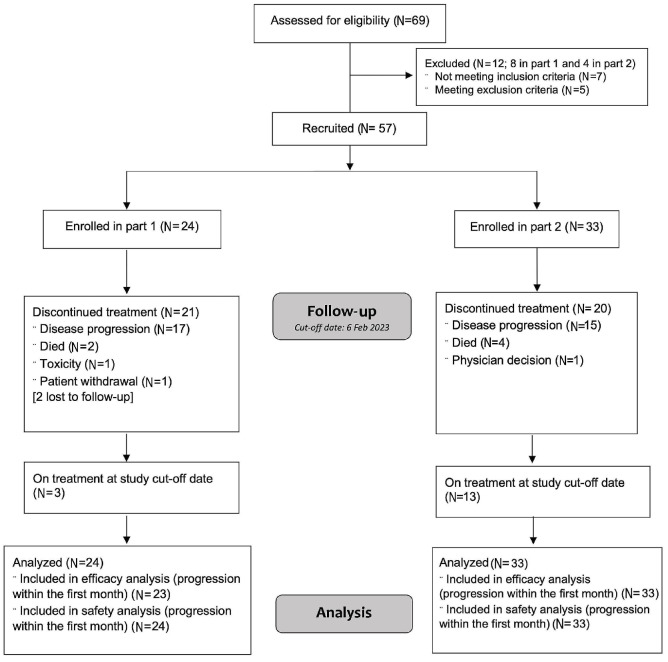
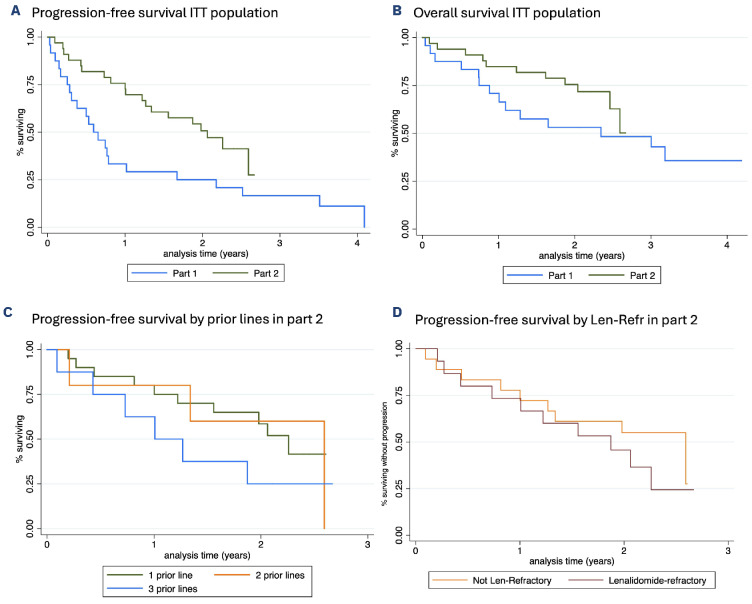
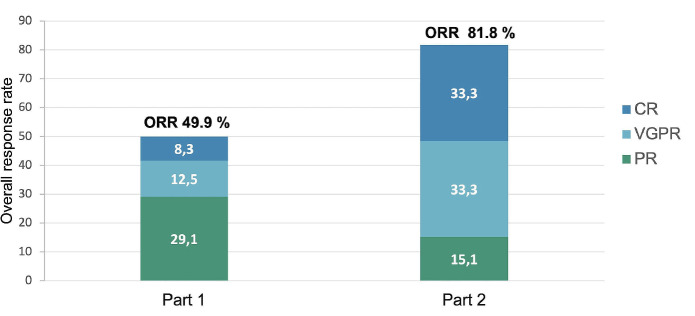
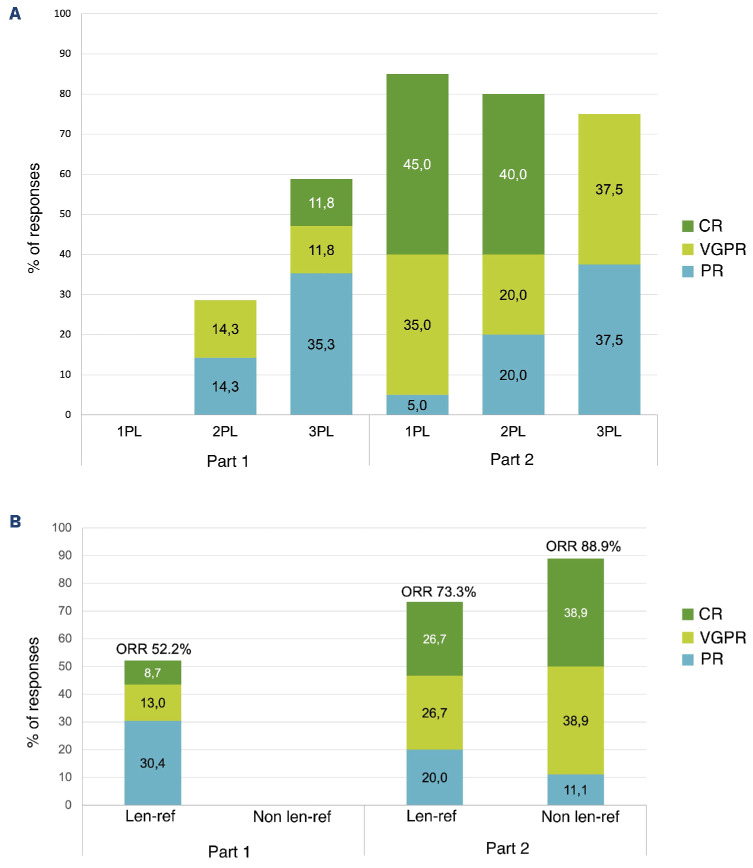
The treatment landscape for multiple myeloma has significantly evolved in the last decade. Notwithstanding, a large proportion of patients continue to relapse and novel combinations continue to be needed. In this phase II study, selinexor, a first-in-class inhibitor of exportin-1 was evaluated in combination with standard daratumumab-bortezomib-dexamethasone (DVd), for the treatment of relapsed and refractory multiple myeloma (RRMM). The aim of the trial was to assess the efficacy and safety of the combination of selinexor with DVd (S-DVd). A total of 57 patients were enrolled in the two parts of the study. Part 1 enrolled a heavily pretreated population with at least three prior lines (PL) of therapy and part 2 enrolled an early relapse population with at least one PL of therapy. The primary endpoint was complete response (CR) rate in part 2 and overall response rate (ORR) in part 1. In the latter, 24 patients were treated with a median of three PL. Overall response rate (ORR) was 50% with two CR. Median progression- free survival (PFS) was 7 months. In part 2, 33 patients were enrolled, with a median of one PL. ORR was 82% and CR or better was 33%. Median PFS was 24 months. In lenalidomide-refractory patients, a median PFS of 22.1 months was observed. Thrombocytopenia was the most common hematological adverse event (69%; grade 3-4: 34%) and nausea, the most frequent non-hematological adverse event (38%; grade 3-4: 6%). Sixty-two percent of the patients required dose modifications. In summary, although the primary endpoint of the study was not met, the combination of S-DVd showed encouraging clinical efficacy with a generally manageable safety profile representing a potential option for the treatment of RRMM patients.
在过去的十年中,多发性骨髓瘤的治疗格局发生了重大变化。尽管如此,仍有很大一部分患者会复发,因此需要新的联合治疗方案。在这项 II 期研究中,评估了 Selinexor(一种新型的核输出蛋白 1 抑制剂)联合标准 Daratumumab-硼替佐米-地塞米松(DVd)治疗复发/难治性多发性骨髓瘤(RRMM)的疗效和安全性。该试验的目的是评估 Selinexor 联合 DVd(S-DVd)的疗效和安全性。该研究共纳入了 57 例患者,分为两部分。第一部分纳入了既往接受过至少三种治疗方案(PL)的患者;第二部分纳入了既往接受过至少一种 PL 治疗且疾病早期复发的患者。第二部分的主要终点是完全缓解(CR)率,第一部分的主要终点是总体缓解率(ORR)。在第二部分中,33 例患者接受了中位数为 1PL 的治疗。ORR 为 82%,CR 或更好为 33%。中位无进展生存期(PFS)为 24 个月。在 lenalidomide 耐药患者中,观察到中位 PFS 为 22.1 个月。血小板减少是最常见的血液学不良事件(69%;3-4 级:34%),恶心是最常见的非血液学不良事件(38%;3-4 级:6%)。62%的患者需要调整剂量。总之,尽管该研究的主要终点未达到,但 S-DVd 联合方案显示出令人鼓舞的临床疗效,且安全性特征总体可控,为 RRMM 患者的治疗提供了一种潜在选择。