Department of Psychiatry and Human Behavior, Alpert Medical School, Brown University.
Brown Center for the Study of Children at Risk, Alpert Medical School, Brown University.
Dev Psychol. 2024 Sep;60(9):1606-1619. doi: 10.1037/dev0001709. Epub 2024 Feb 15.
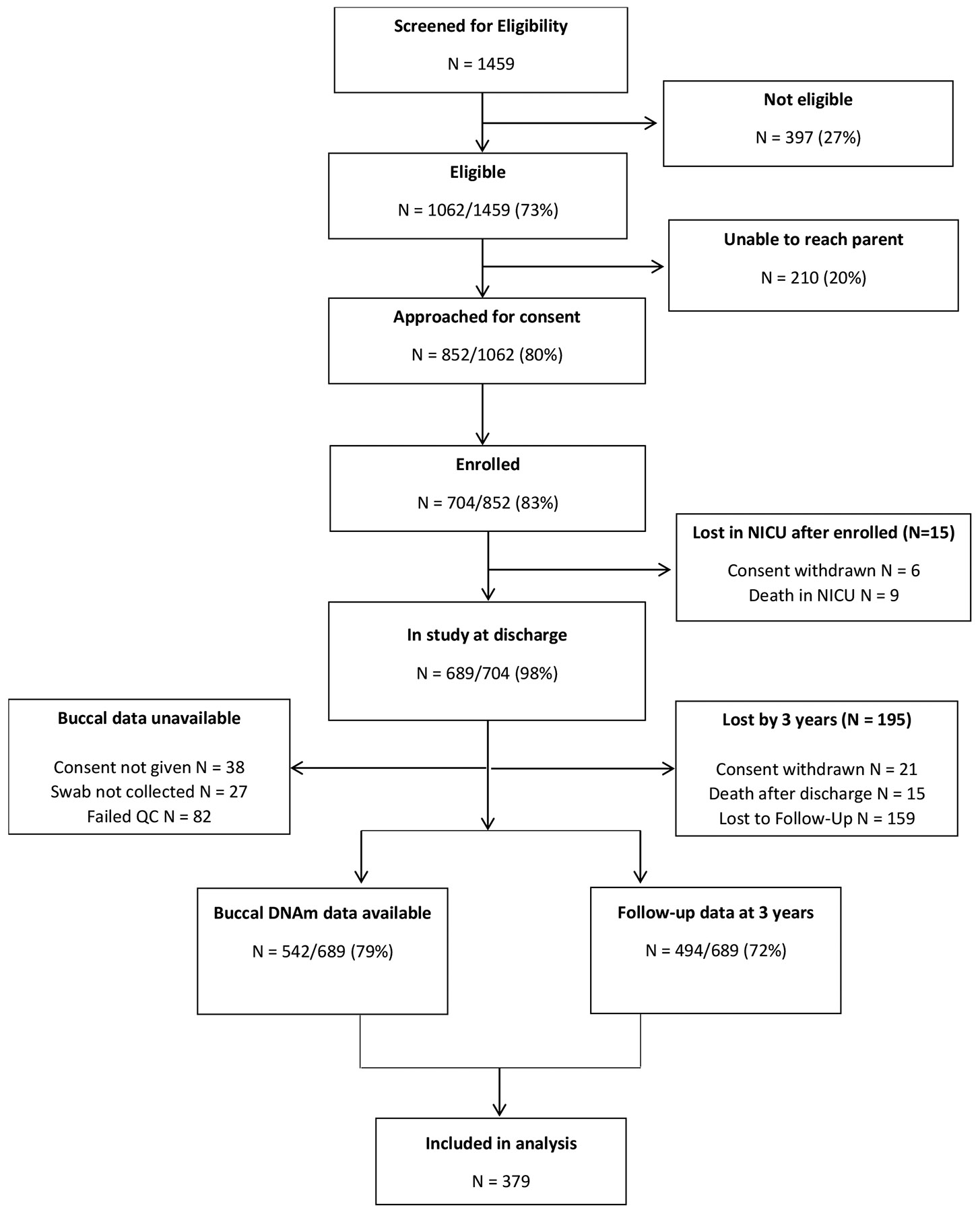
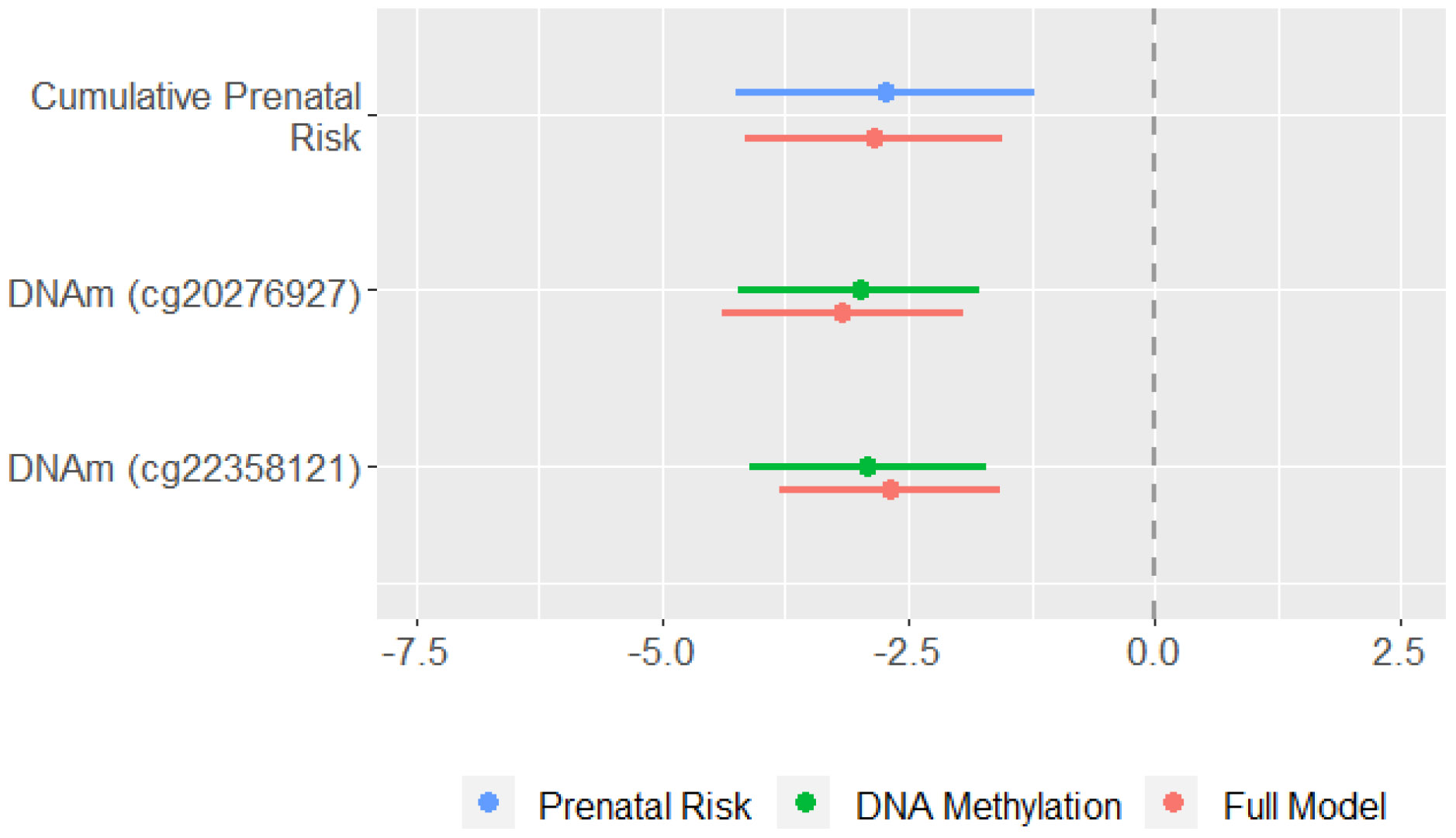
Children born less than 30 weeks gestational age (GA) are at high risk for neurodevelopmental delay compared to term peers. Prenatal risk factors and neonatal epigenetics could help identify preterm children at highest risk for poor cognitive outcomes. We aimed to understand the associations among cumulative prenatal risk, neonatal DNA methylation, and child cognitive ability at age 3 years, including whether DNA methylation mediates the association between prenatal risk and cognitive ability. We studied 379 neonates (54% male) born less than 30 weeks GA who had DNA methylation measured at neonatal intensive care unit discharge along with 3-year follow-up data. Cumulative prenatal risk was calculated from 24 risk factors obtained from maternal report and medical record and epigenome-wide neonatal DNA methylation was assayed from buccal swabs. At 3-year follow-up, child cognitive ability was assessed using the (third edition). Cumulative prenatal risk and DNA methylation at two cytosine-phosphate-guanines (CpGs) were uniquely associated with child cognitive ability. Using high-dimensional mediation analysis, we also identified differential methylation of 309 CpGs that mediated the association between cumulative prenatal risk and child cognitive ability. Many of the associated CpGs were located in genes () that have previously been associated with prenatal exposures and/or neurodevelopmental phenotypes. Our findings suggest a role for both prenatal risk factors and DNA methylation in explaining outcomes for children born preterm and suggest we should further study DNA methylation as a potential mechanism underlying the association between prenatal risk and child neurodevelopment. (PsycInfo Database Record (c) 2024 APA, all rights reserved).
与足月出生的同龄人相比,胎龄小于 30 周的儿童有发生神经发育迟缓的高风险。产前风险因素和新生儿表观遗传学可以帮助识别极有可能出现认知结局不良的早产儿。我们旨在了解累积产前风险、新生儿 DNA 甲基化与 3 岁儿童认知能力之间的关联,包括 DNA 甲基化是否介导了产前风险与认知能力之间的关联。我们研究了 379 名胎龄小于 30 周的新生儿(54%为男性),这些新生儿在新生儿重症监护病房出院时进行了 DNA 甲基化测量,并进行了 3 年的随访。累积产前风险是根据从母亲报告和病历中获得的 24 个风险因素计算得出的,而新生儿全基因组 DNA 甲基化则是从口腔拭子中检测出来的。在 3 岁的随访中,使用来评估儿童的认知能力。累积产前风险和两个胞嘧啶-磷酸-鸟嘌呤(CpG)的 DNA 甲基化与儿童认知能力呈独特相关。通过高维中介分析,我们还发现了 309 个 CpG 的差异甲基化,这些 CpG 介导了累积产前风险与儿童认知能力之间的关联。许多相关的 CpG 位于先前与产前暴露和/或神经发育表型相关的基因()中。我们的研究结果表明,产前风险因素和 DNA 甲基化在解释早产儿的结局方面都起着作用,并表明我们应该进一步研究 DNA 甲基化作为产前风险与儿童神经发育之间关联的潜在机制。(PsycInfo 数据库记录(c)2024 APA,保留所有权利)。