Science Department, Jackson College, Jackson, Michigan, United States of America.
University of Michigan Biological Station, Pellston, Michigan, United States of America.
PLoS One. 2024 Feb 15;19(2):e0288948. doi: 10.1371/journal.pone.0288948. eCollection 2024.
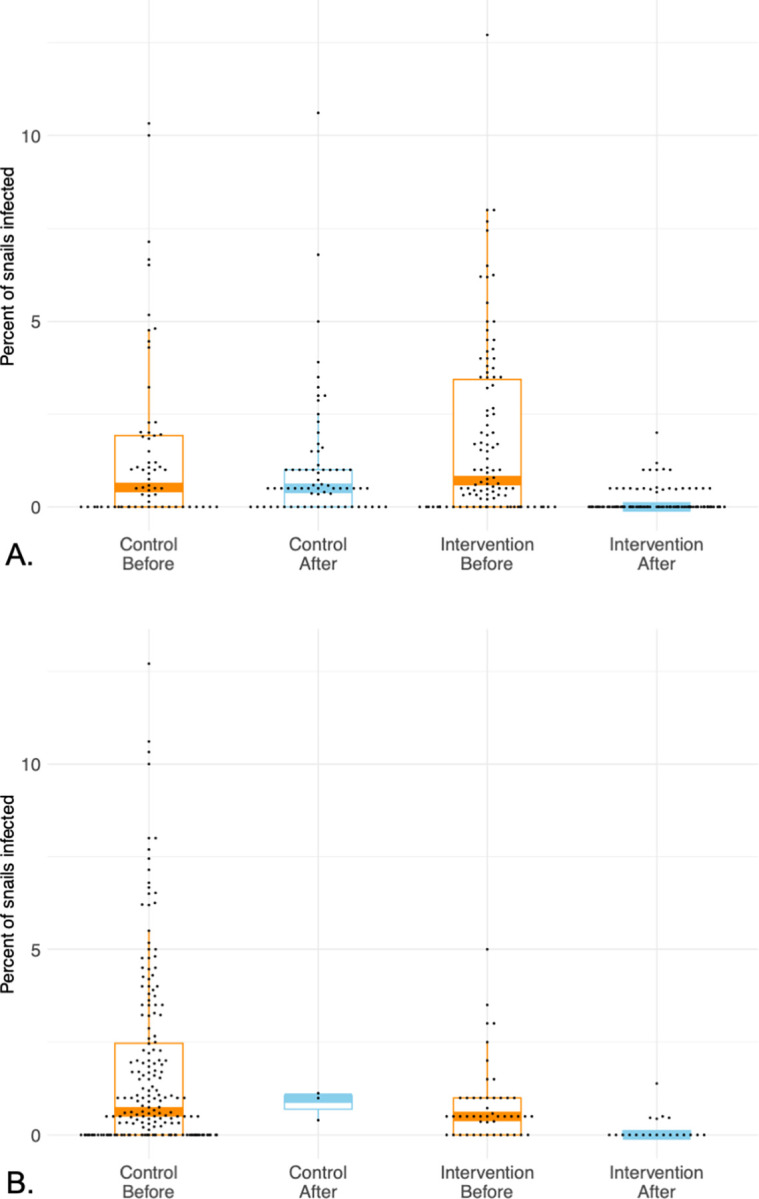
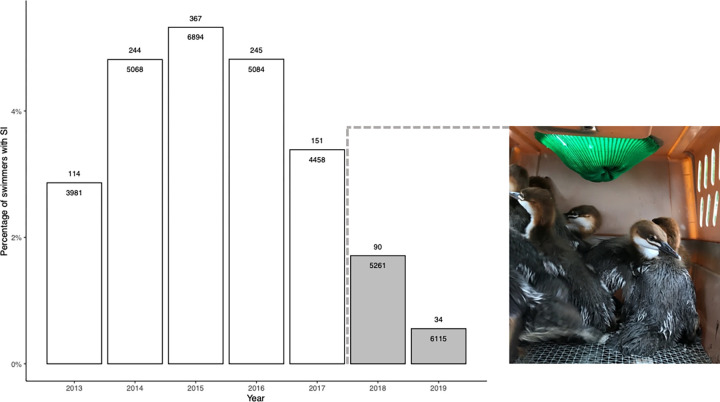
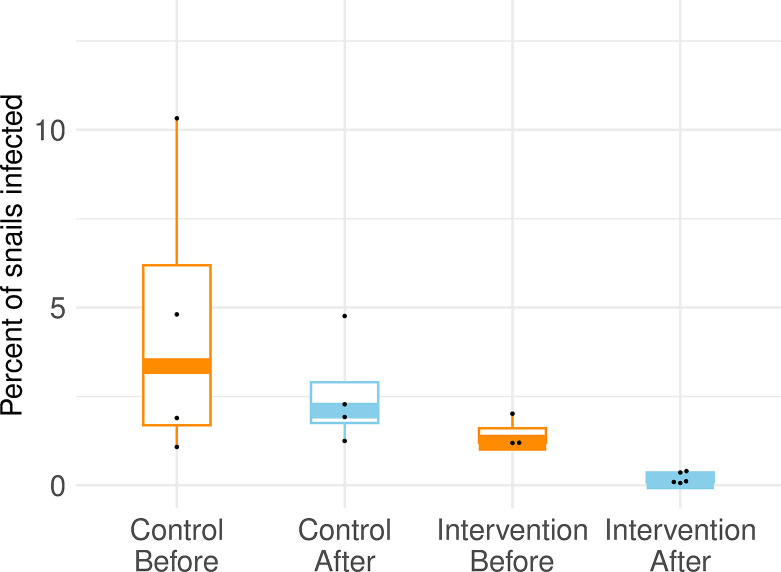
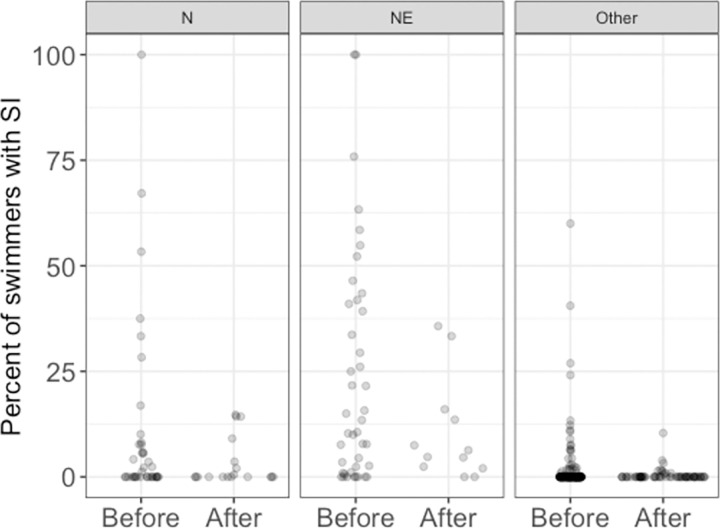
Swimmer's itch (SI) is a dermatitis in humans caused by cercariae of avian and mammalian schistosomes which emerge from infected snails on a daily basis. Mitigation methods for SI have long been sought with little success. Copper sulfate application to the water to kill the snail hosts is the historically employed method, but is localized, temporary, and harmful to many aquatic species. Here, we test an alternative method to control Trichobilharzia stagnicolae, a species well-known to cause SI in northern Michigan and elsewhere in North America. Summer relocation of broods of the only known vertebrate host, common merganser (Mergus merganser), greatly reduced snail infection prevalence the following year on two large, geographically separated lakes in northern Michigan. Subsequent years of host relocation achieved and maintained snail infection prevalence at ~0.05%, more than an order of magnitude lower than pre-intervention. A Before-After-Control-Intervention (BACI) study design using multiple-year snail infection data from two intervention lakes and three control lakes demonstrates that dramatic lake-wide reduction of an avian schistosome can be achieved and is not due to natural fluctuations in the parasite populations. The relevance of reducing snail infection prevalence is demonstrated by a large seven-year data set of SI incidence in swimmers at a high-use beach, which showed a substantial reduction in SI cases in two successive years after relocation began. In addition, data from another Michigan lake where vertebrate-host based intervention occurred in the 1980's are analyzed statistically and show a remarkably similar pattern of reduction in snail infection prevalence. Together, these results demonstrate a highly effective SI mitigation strategy that avoids the use of environmentally suspect chemicals and removes incentive for lethal host removal. Biologically, the results strongly suggest that T. stagnicolae is reliant on the yearly hatch of ducklings to maintain populations at high levels on a lake and that the role of migratory hosts in the spring and fall is much less significant.
游泳者痒病(SI)是一种人类皮炎,由每天从受感染的蜗牛中出现的鸟类和哺乳动物血吸虫的尾蚴引起。长期以来,人们一直在寻找缓解 SI 的方法,但收效甚微。硫酸铜应用于水中以杀死蜗牛宿主是历史上采用的方法,但这种方法具有局部性、临时性,并且对许多水生物种有害。在这里,我们测试了一种替代方法来控制 Trichobilharzia stagnicolae,这种物种在北密歇根州和北美的其他地方众所周知会引起 SI。夏季将唯一已知的脊椎动物宿主普通秋沙鸭(Mergus merganser)的雏鸟迁移,大大降低了次年两个大的、地理上分离的密歇根湖中的蜗牛感染率。随后几年的宿主迁移实现并维持了蜗牛感染率在~0.05%,比干预前降低了一个数量级以上。在两个干预湖和三个对照湖的多年蜗牛感染数据中使用前后对照干预(BACI)设计表明,可以实现对鸟类血吸虫的大规模全湖范围减少,而且这不是由于寄生虫种群的自然波动所致。在一个高使用率海滩上对游泳者进行的七年 SI 发病率的大型数据集表明,在迁移开始后的两年内,SI 病例数量大幅减少,这证明了降低蜗牛感染率的相关性。此外,还对另一个密歇根湖中 20 世纪 80 年代发生基于脊椎动物宿主的干预的数据进行了统计分析,结果表明蜗牛感染率的降低模式非常相似。总之,这些结果表明了一种非常有效的 SI 缓解策略,它避免了使用环境可疑的化学物质,并消除了对致死宿主清除的激励。从生物学角度来看,结果强烈表明 T. stagnicolae 依赖于每年孵化的小鸭来维持湖中高种群水平,而春季和秋季迁徙宿主的作用要小得多。