Center for Infectious Disease Control, National Institute for Public Health and the Environment (RIVM), Bilthoven, the Netherlands.
Julius Center for Health Sciences and Primary Care, University Medical Center Utrecht, Utrecht University, Utrecht, the Netherlands.
BMC Med. 2024 Feb 16;22(1):69. doi: 10.1186/s12916-024-03277-3.
New 15- and 20-valent pneumococcal vaccines (PCV15, PCV20) are available for both children and adults, while PCV21 for adults is in development. However, their cost-effectiveness for older adults, taking into account indirect protection and serotype replacement from a switch to PCV15 and PCV20 in childhood vaccination, remains unexamined.
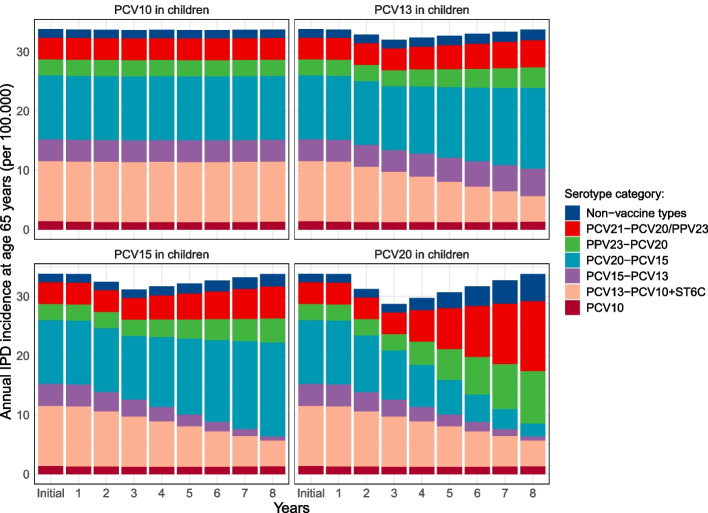
We used a static model for the Netherlands to assess the cost-effectiveness of different strategies with 23-valent pneumococcal polysaccharide vaccine (PPV23), PCV15, PCV20, and PCV21 for a 65-year-old cohort from a societal perspective, over a 15-year time horizon. Childhood vaccination was varied from PCV10 to PCV13, PCV15, and PCV20. Indirect protection was assumed to reduce the incidence of vaccine serotypes in older adults by 80% (except for serotype 3, no effect), completely offset by an increase in non-vaccine serotype incidence due to serotype replacement.
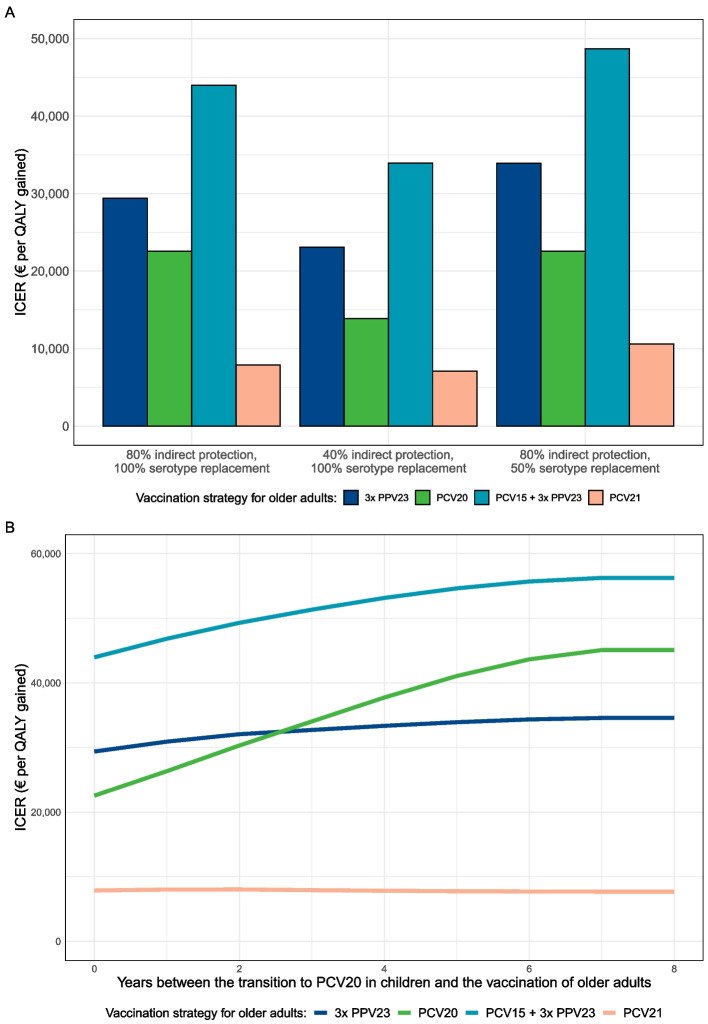
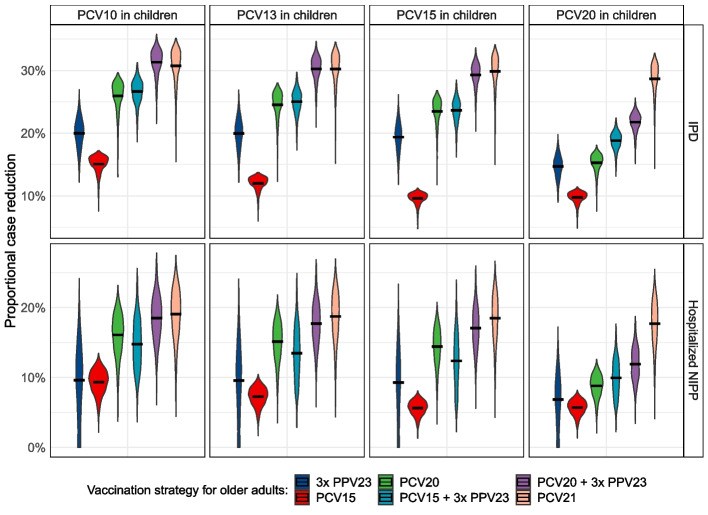
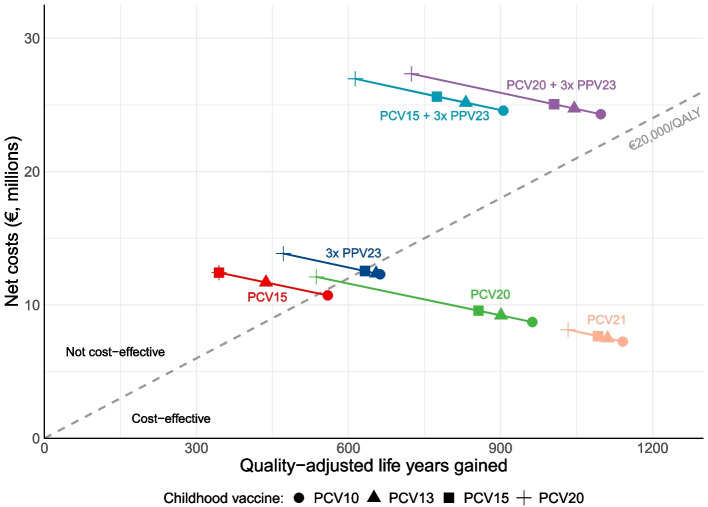
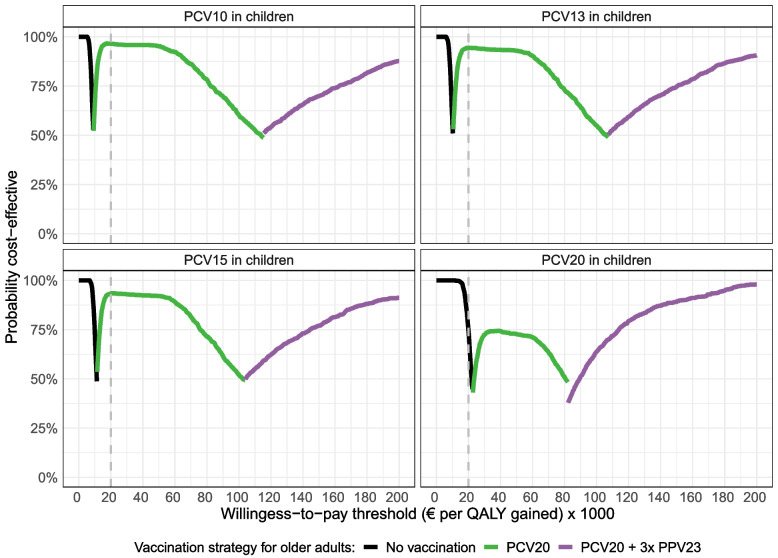
Indirect effects from childhood vaccination reduced the cost-effectiveness of vaccination of older adults, depending on the serotype overlap between the vaccines. With PCV10, PCV13, or PCV15 in children, PCV20 was more effective and less costly for older adults than PPV23 and PCV15. PCV20 costs approximately €10,000 per quality-adjusted life year (QALY) gained compared to no pneumococcal vaccination, which falls below the conventional Dutch €20,000/QALY gained threshold. However, with PCV20 in children, PCV20 was no longer considered cost-effective for older adults, costing €22,550/QALY gained. As indirect effects progressed over time, the cost-effectiveness of PCV20 for older adults further diminished for newly vaccinated cohorts. PPV23 was more cost-effective than PCV20 for cohorts vaccinated 3 years after the switch to PCV20 in children. PCV21 offered the most QALY gains, and its cost-effectiveness was minimally affected by indirect effects due to its coverage of 11 different serotypes compared to PCV20.
For long-term cost-effectiveness in the Netherlands, the pneumococcal vaccine for older adults should either include invasive serotypes not covered by childhood vaccination or become more affordable than its current pricing for individual use.
新的 15 价和 20 价肺炎球菌疫苗(PCV15、PCV20)可用于儿童和成人,而用于成人的 PCV21 正在开发中。然而,考虑到儿童接种疫苗后从 PCV15 和 PCV20 转换为疫苗所带来的间接保护和血清型替代,对于老年人而言,这些疫苗的成本效益仍未得到检验。
我们使用荷兰的静态模型,从社会角度评估了 23 价肺炎球菌多糖疫苗(PPV23)、PCV15、PCV20 和 PCV21 对 65 岁队列的不同策略的成本效益,时间范围为 15 年。儿童疫苗接种的范围从 PCV10 到 PCV13、PCV15 和 PCV20 不等。假设间接保护可将老年人中疫苗血清型的发病率降低 80%(除血清型 3 外,无效果),完全被由于血清型替代导致的非疫苗血清型发病率增加所抵消。
儿童疫苗接种的间接效应取决于疫苗之间的血清型重叠,从而降低了老年人接种疫苗的成本效益。对于使用 PCV10、PCV13 或 PCV15 进行儿童免疫接种,PCV20 对老年人的效果优于 PPV23 和 PCV15,且费用更低。与不进行肺炎球菌接种相比,PCV20 每获得一个质量调整生命年(QALY)的成本约为 10000 欧元,低于荷兰传统的 20000 欧元/QALY 获得阈值。然而,在儿童中使用 PCV20 后,PCV20 对老年人不再具有成本效益,每获得一个 QALY 的成本为 22550 欧元。随着间接效应随时间的推移而进展,新接种疫苗的队列中,PCV20 对老年人的成本效益进一步降低。对于在儿童中改用 PCV20 3 年后接种疫苗的队列,PPV23 比 PCV20 更具成本效益。PCV21 提供了最多的 QALY 获益,由于其涵盖了 11 种不同的血清型,与 PCV20 相比,其间接效应的成本效益受到的影响最小。
在荷兰,为了长期成本效益,老年人的肺炎球菌疫苗要么应包含儿童疫苗接种未涵盖的侵袭性血清型,要么应比目前的个人使用价格更具可负担性。