State Key Laboratory of Genetic Engineering, Collaborative Innovation Center for Genetics and Development, School of Life Sciences, Fudan University, Shanghai 200438, China.
Shanghai Engineering Research Center of Industrial Microorganisms, Shanghai 200438, China.
Plant Cell. 2024 May 29;36(6):2238-2252. doi: 10.1093/plcell/koae052.
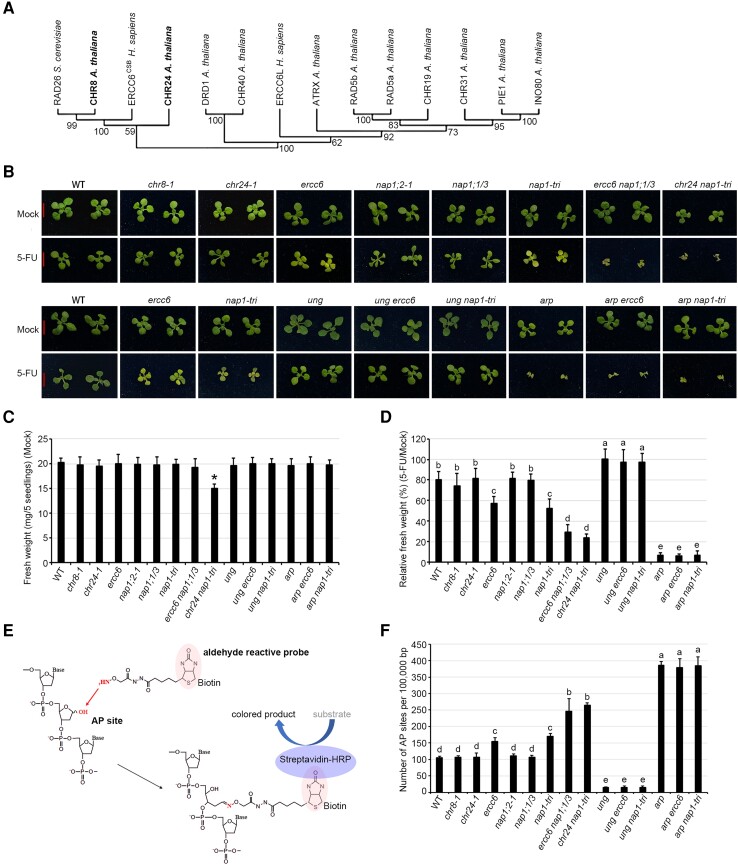
During base excision repair (BER), the apurinic or apyrimidinic (AP) site serves as an intermediate product following base excision. In plants, APE-redox protein (ARP) represents the major AP site of cleavage activity. Despite the well-established understanding that the nucleosomal structure acts as a barrier to various DNA-templated processes, the regulatory mechanisms underlying BER at the chromatin level remain elusive, especially in plants. In this study, we identified plant chromatin remodeler Excision Repair Cross-Complementing protein group 6 (ERCC6) and histone chaperone Nucleosome Assembly Protein 1 (NAP1) as interacting proteins with ARP. The catalytic ATPase domain of ERCC6 facilitates its interaction with both ARP and NAP1. Additionally, ERCC6 and NAP1 synergistically contribute to nucleosome sliding and exposure of hindered endonuclease cleavage sites. Loss-of-function mutations in Arabidopsis (Arabidopsis thaliana) ERCC6 or NAP1 resulted in arp-dependent plant hypersensitivity to 5-fluorouracil, a toxic agent inducing BER, and the accumulation of AP sites. Furthermore, similar protein interactions are also found in yeast cells, suggesting a conserved recruitment mechanism employed by the AP endonuclease to overcome chromatin barriers during BER progression.
在碱基切除修复(BER)过程中,无嘌呤或无嘧啶(AP)位点是碱基切除后的中间产物。在植物中,AP 核酸内切酶-氧化还原蛋白(ARP)代表主要的 AP 位点切割活性。尽管人们已经充分认识到核小体结构是各种依赖于 DNA 的过程的障碍,但 BER 在染色质水平上的调控机制仍然难以捉摸,尤其是在植物中。在这项研究中,我们鉴定了植物染色质重塑因子切除修复交叉互补蛋白 6(ERCC6)和核小体组装蛋白 1(NAP1)是与 ARP 相互作用的蛋白。ERCC6 的催化 ATP 酶结构域促进了其与 ARP 和 NAP1 的相互作用。此外,ERCC6 和 NAP1 协同促进核小体滑动和受阻内切核酸酶切割位点的暴露。拟南芥(Arabidopsis thaliana)ERCC6 或 NAP1 的功能丧失突变导致 arp 依赖性植物对 5-氟尿嘧啶(一种诱导 BER 的有毒试剂)的敏感性增加,以及 AP 位点的积累。此外,在酵母细胞中也发现了类似的蛋白质相互作用,这表明 AP 核酸内切酶在 BER 过程中采用了一种保守的募集机制来克服染色质障碍。