Department of Physical Education, Universidade Federal do Maranhão, São Luís, Brazil.
Postgraduate Program in Rehabilitation Sciences, Universidade Nove de Julho, São Paulo, Brazil.
BMC Musculoskelet Disord. 2024 Feb 17;25(1):151. doi: 10.1186/s12891-024-07268-6.
To date, there are no studies in the literature that define the internal structure of the Tampa Scale for Kinesiophobia (TSK) in patients with chronic neck pain based on factorial analysis. As such, we aimed to verify and identify the best structure of the Brazilian version of the TSK in patients with chronic neck pain.
We included Brazilian participants aged ≥18 years, both sexes, with self-reported neck pain for more than 3 months and pain intensity ≥3 on the Numerical Pain Rating Scale (NPRS). Dimensionality and number of TSK items were assessed using confirmatory factor analysis (CFA). We tested the following internal structures: structure 1 (1 domain and 17 items), structure 2 (1 domain and 11 items), structure 3 (2 domains and 11 items), and structure 4 (2 domains and 9 items). We used the Pain-Related Catastrophizing Thoughts Scale (PCTS) and the NPRS for construct validity. In addition, we assessed test-retest reliability for the seven-day interval using intraclass correlation coefficient (ICC), Cronbach's alpha to assess internal consistency, and ceiling and floor effects.
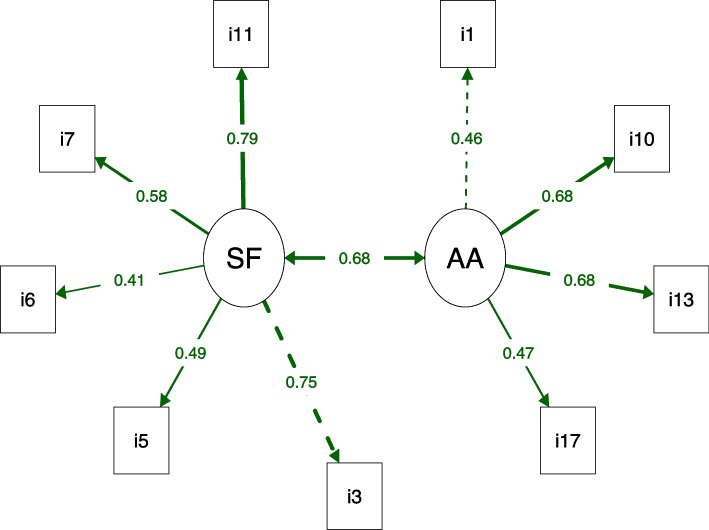
The study sample included of 335 patients. Most were women (77.6%), young adults (~ 34 years), single (48.4%), with complete primary education (57.3%), physically inactive (66.6%), with a mean pain duration of 46 months and a mean pain intensity of ~ 5 points on the NPRS. Redundancy was found in the following items: item 1 with item 2 (modification indices = 21.419) and item 13 with item 15 (modification indices = 13.641). Subsequently, based on these paired analyses, the items with the lowest factor loadings (items 2 and 15) were excluded. As such, TSK structure 4 was composed of two domains ("somatic focus" and "activity avoidance") and 9 items, which showed adequate fit indices and lower AIC and SABIC values. We observed significant values (p < 0.05) with a correlation magnitude greater than 0.142 to 0.657 between the two domains of the TSK-neck and the other instruments (PCTS and NPRS). We found excellent reliability (ICC ≥ 0.96) and adequate internal consistency (Cronbach's alpha ≥0.98) of the TSK-neck. Finally, ceiling and floor effects were not observed.
The TSK-neck structure with two domains (somatic focus and activity avoidance) and nine items is the most appropriate for patients with chronic neck pain.
迄今为止,尚无文献研究基于因子分析来确定慢性颈痛患者的 Tampa 运动恐惧量表(TSK)的内部结构。因此,我们旨在验证和确定慢性颈痛患者巴西版 TSK 的最佳结构。
我们纳入了年龄≥18 岁、无论性别、报告有颈痛病史超过 3 个月且数字疼痛评分量表(NPRS)疼痛强度≥3 的巴西参与者。使用验证性因子分析(CFA)评估 TSK 项目的维度和数量。我们测试了以下内部结构:结构 1(1 个域和 17 个项目)、结构 2(1 个域和 11 个项目)、结构 3(2 个域和 11 个项目)和结构 4(2 个域和 9 个项目)。我们使用疼痛相关灾难化思维量表(PCTS)和 NPRS 评估结构效度。此外,我们使用组内相关系数(ICC)评估了 7 天间隔的测试-重测信度,使用 Cronbach's alpha 评估内部一致性,以及天花板和地板效应。
研究样本包括 335 名患者。大多数是女性(77.6%)、年轻成年人(~34 岁)、单身(48.4%)、完成了小学教育(57.3%)、不活跃(66.6%),平均疼痛持续时间为 46 个月,NPRS 平均疼痛强度约为 5 分。以下项目存在冗余:项目 1 与项目 2(修正指数=21.419)和项目 13 与项目 15(修正指数=13.641)。随后,基于这些配对分析,剔除了具有最低因子负荷的项目(项目 2 和项目 15)。因此,TSK 结构 4 由两个域(“躯体焦点”和“活动回避”)和 9 个项目组成,该结构具有较好的拟合指数,AIC 和 SABIC 值较低。我们观察到 TSK-neck 的两个域与其他仪器(PCTS 和 NPRS)之间存在显著值(p<0.05),相关幅度大于 0.142 至 0.657。我们发现 TSK-neck 的可靠性(ICC≥0.96)和内部一致性(Cronbach's alpha≥0.98)均较高。最后,未观察到天花板和地板效应。
慢性颈痛患者 TSK-neck 的两个域(躯体焦点和活动回避)和 9 个项目的结构最合适。