Washida Kazuo, Saito Satoshi, Tanaka Tomotaka, Nakaoku Yuriko, Ishiyama Hiroyuki, Abe Soichiro, Kuroda Takehito, Nakazawa Shinsaku, Kakuta Chikage, Omae Katsuhiro, Tanaka Kenta, Minami Manabu, Morita Yoshiaki, Fukuda Tetsuya, Shindo Akihiro, Maki Takakuni, Kitamura Kazuo, Tomimoto Hidekazu, Aso Toshihiko, Ihara Masafumi
Department of Neurology, National Cerebral and Cardiovascular Center, Suita, Japan.
Department of Preventive Medicine and Epidemiology, National Cerebral and Cardiovascular Center, Suita, Japan.
Cereb Circ Cogn Behav. 2024 Feb 6;6:100211. doi: 10.1016/j.cccb.2024.100211. eCollection 2024.
Cerebral autosomal dominant arteriopathy with subcortical infarcts and leukoencephalopathy (CADASIL), the most common form of hereditary cerebral small vessel disease (SVD), currently lacks disease-modifying treatments. Adrenomedullin (AM), a vasoactive peptide with angiogenic, vasodilatory, anti-inflammatory, and anti-oxidative properties, shows potential effects on the neuro-glial-vascular unit.
The AdrenoMedullin for CADASIL (AMCAD) study aims to assess the efficacy and safety of AM in patients with CADASIL.
Overall, 60 patients will be recruited.
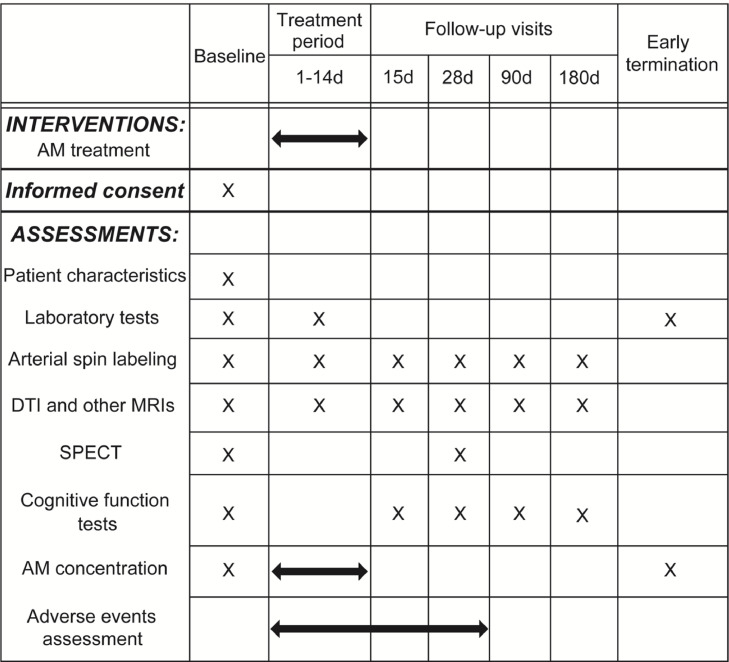
The AMCAD is a multicenter, investigator-initiated, single-arm phase II trial. Patients with a confirmed CADASIL diagnosis, based on genetic testing, will receive an 8-h AM treatment (15 ng/kg/min) for 14 days following a baseline assessment (from day 1 to day 14). Follow-up evaluations will be performed on days 15, 28, 90, and 180.
The primary endpoint is the cerebral blood flow change rate in the frontal cortex, evaluated using arterial spin labeling magnetic resonance imaging, from baseline to day 28. Summary statistics, 95% confidence intervals, and a one-sample -test will be used for analysis.
The AMCAD study aims to represent the therapeutic potential of AM in patients with CADASIL, addressing an unmet medical need in this challenging condition.
jRCT 2,051,210,117 (https://jrct.niph.go.jp/en-latest-detail/jRCT2051210117).
大脑常染色体显性遗传性动脉病伴皮质下梗死和白质脑病(CADASIL)是遗传性脑小血管病(SVD)最常见的形式,目前缺乏改善病情的治疗方法。肾上腺髓质素(AM)是一种具有血管生成、血管舒张、抗炎和抗氧化特性的血管活性肽,对神经-胶质-血管单元显示出潜在作用。
CADASIL的肾上腺髓质素研究(AMCAD)旨在评估AM对CADASIL患者的疗效和安全性。
总共将招募60名患者。
AMCAD是一项多中心、研究者发起的单臂II期试验。基于基因检测确诊为CADASIL的患者,在基线评估后(从第1天到第14天)将接受为期14天的8小时AM治疗(15纳克/千克/分钟)。将在第15、28、90和180天进行随访评估。
主要终点是使用动脉自旋标记磁共振成像评估的从基线到第28天额叶皮质的脑血流变化率。将使用汇总统计、95%置信区间和单样本检验进行分析。
AMCAD研究旨在展现AM对CADASIL患者的治疗潜力,满足这种具有挑战性疾病中未被满足的医疗需求。
jRCT 2,051,210,117(https://jrct.niph.go.jp/en-latest-detail/jRCT2051210117)。