Yoshimoto Takeshi, Saito Satoshi, Omae Katsuhiro, Tanaka Kenta, Kita Toshihiro, Kitamura Kazuo, Fukuma Kazuki, Washida Kazuo, Abe Soichiro, Ishiyama Hiroyuki, Yamaguchi Eriko, Yamagami Hiroshi, Nagatsuka Kazuyuki, Tsuji Masahiro, Minami Manabu, Yamamoto Haruko, Hattori Yorito, Tanaka Tomotaka, Ihara Masafumi
Department of Neurology, National Cerebral and Cardiovascular Center, 6-1 Kishibe-Shimmachi, Suita 564-8565, Japan.
Department of Data Science, National Cerebral and Cardiovascular Center, 6-1 Kishibe-Shimmachi, Suita 564-8565, Japan.
EClinicalMedicine. 2024 Nov 13;77:102901. doi: 10.1016/j.eclinm.2024.102901. eCollection 2024 Nov.
Adrenomedullin has angiogenic and vasoprotective effects in acute ischemic stroke (AIS). This investigator-initiated trial aimed to evaluate the safety, efficacy, and optimal administration of adrenomedullin in treating AIS.
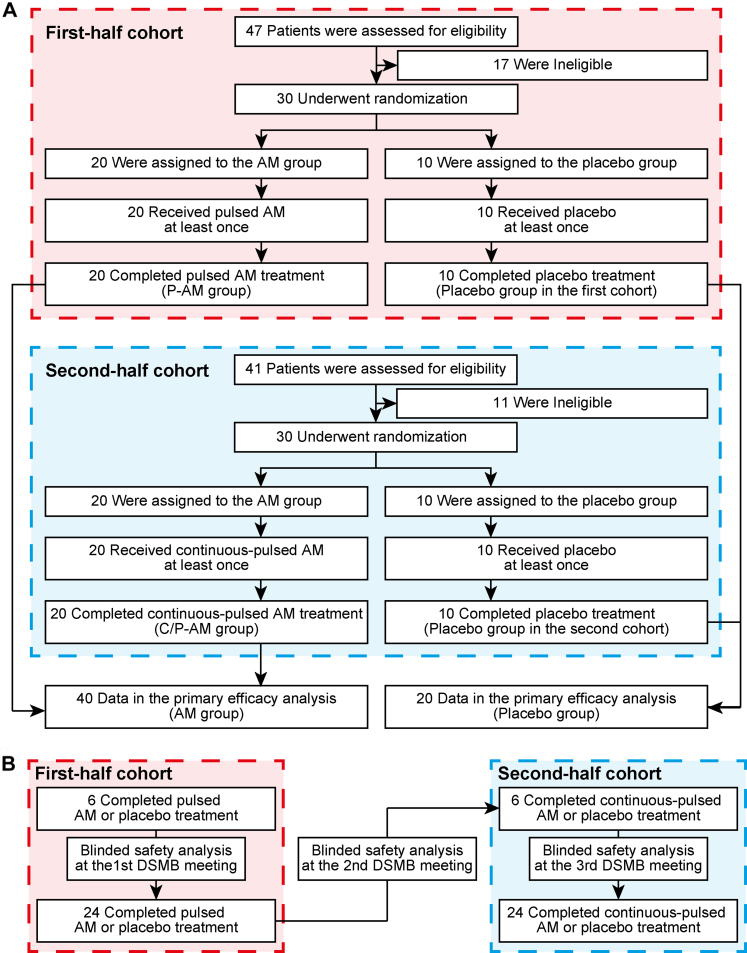
In this single-center, multi-cohort, double-blinded, randomized, placebo-controlled, Phase II trial, patients with AIS received pulsed adrenomedullin (9 ng/kg/min for 8 h daily over 7 days) or placebo in the first-half cohort, and continuous-pulsed adrenomedullin (9 ng/kg/min for 72 h during the first 3 days and 8 h daily between Day 4-7) or placebo in the second-half cohort. We included male and female patients aged 20-90 years with newly confirmed ischemic lesions on diffusion-weighted magnetic resonance imaging, and for whom protocol treatment could be initiated within 24 h of symptom onset. The primary safety endpoint was the occurrence of intervention-related severe adverse events. For the primary efficacy endpoint, the least square means and 95% confidence intervals of National Institutes of Health Stroke Scale (NIHSS) scores up to 7 days post-intervention initiation were calculated using generalized estimating equation models. This trial was registered at Japan Registry of Clinical Trials, jRCT2051190092.
Between January 16, 2020, and November 14, 2021, 60 patients were enrolled (median [interquartile range] age, 75 [66-81] years; NIHSS score, 3 [2-4]; 21 [35.0%] females). Neither intervention-related serious adverse events nor severe adverse events were observed in patients receiving adrenomedullin. No life-threatening adverse events or deaths were reported. The least square means (95% confidence intervals) of the changes in NIHSS scores from pre-treatment to Day 7 were -0.76 (-1.43 to -0.09) in the adrenomedullin group (-1.08 [-2.17 to 0.00] in the pulsed adrenomedullin group and -0.42 [-1.12 to 0.29] in the continuous-pulsed adrenomedullin group) and -1.08 (-2.11 to -0.05) in the placebo group.
Adrenomedullin was well tolerated in patients with non-severe, non-embolic AIS, although its beneficial effects were not demonstrated. It is necessary to show the efficacy of adrenomedullin in further clinical trials.
Japan Agency for Medical Research and Development.
肾上腺髓质素在急性缺血性卒中(AIS)中具有血管生成和血管保护作用。这项由研究者发起的试验旨在评估肾上腺髓质素治疗AIS的安全性、有效性及最佳给药方式。
在这项单中心、多队列、双盲、随机、安慰剂对照的II期试验中,AIS患者在上半队列中接受脉冲式肾上腺髓质素治疗(每天9 ng/kg/min,持续8小时,共7天)或安慰剂,在下半队列中接受持续脉冲式肾上腺髓质素治疗(前3天每天9 ng/kg/min,持续72小时,第4至7天每天8小时)或安慰剂。我们纳入了年龄在20 - 90岁之间、在扩散加权磁共振成像上新确诊有缺血性病变且在症状发作后24小时内可开始方案治疗的男性和女性患者。主要安全终点是干预相关严重不良事件的发生情况。对于主要疗效终点,使用广义估计方程模型计算干预开始后7天内美国国立卫生研究院卒中量表(NIHSS)评分的最小二乘均值和95%置信区间。该试验在日本临床试验注册中心注册,注册号为jRCT2051190092。
在2020年1月16日至2021年11月14日期间,共纳入60例患者(年龄中位数[四分位间距]为75[66 - 81]岁;NIHSS评分为3[2 - 4];女性21例[35.0%])。接受肾上腺髓质素治疗的患者未观察到干预相关严重不良事件或严重不良事件。未报告危及生命的不良事件或死亡。肾上腺髓质素组从治疗前到第7天NIHSS评分变化的最小二乘均值(95%置信区间)为 -0.76(-1.43至 -0.09)(脉冲式肾上腺髓质素组为 -1.08[-2.17至0.00],持续脉冲式肾上腺髓质素组为 -0.42[-1.12至0.29]),安慰剂组为 -1.08(-2.11至 -0.05)。
肾上腺髓质素在非严重、非栓塞性AIS患者中耐受性良好,但其有益效果未得到证实。有必要在进一步的临床试验中证明肾上腺髓质素的疗效。
日本医学研究与开发机构。