Guillen-Guio Beatriz, Paynton Megan L, Allen Richard J, Chin Daniel P W, Donoghue Lauren J, Stockwell Amy, Leavy Olivia C, Hernandez-Beeftink Tamara, Reynolds Carl, Cullinan Paul, Martinez Fernando, Booth Helen L, Fahy William A, Hall Ian P, Hart Simon P, Hill Mike R, Hirani Nik, Hubbard Richard B, McAnulty Robin J, Millar Ann B, Navaratnam Vidya, Oballa Eunice, Parfrey Helen, Saini Gauri, Sayers Ian, Tobin Martin D, Whyte Moira K B, Adegunsoye Ayodeji, Kaminski Naftali, Ma Shwu-Fan, Strek Mary E, Zhang Yingze, Fingerlin Tasha E, Molina-Molina Maria, Neighbors Margaret, Sheng X Rebecca, Oldham Justin M, Maher Toby M, Molyneaux Philip L, Flores Carlos, Noth Imre, Schwartz David A, Yaspan Brian L, Jenkins R Gisli, Wain Louise V, Hollox Edward J
Department of Population Health Sciences, University of Leicester, Leicester, UK.
NIHR Leicester Biomedical Research Centre, Leicester, UK.
ERJ Open Res. 2024 Feb 19;10(1). doi: 10.1183/23120541.00553-2023. eCollection 2024 Jan.
Idiopathic pulmonary fibrosis (IPF) is a chronic interstitial pneumonia marked by progressive lung fibrosis and a poor prognosis. Recent studies have highlighted the potential role of infection in the pathogenesis of IPF, and a prior association of the gene with idiopathic fibrotic interstitial pneumonia (including IPF) has been reported. Owing to the important role that the human leukocyte antigen (HLA) region plays in the immune response, here we evaluated if HLA genetic variation was associated specifically with IPF risk.
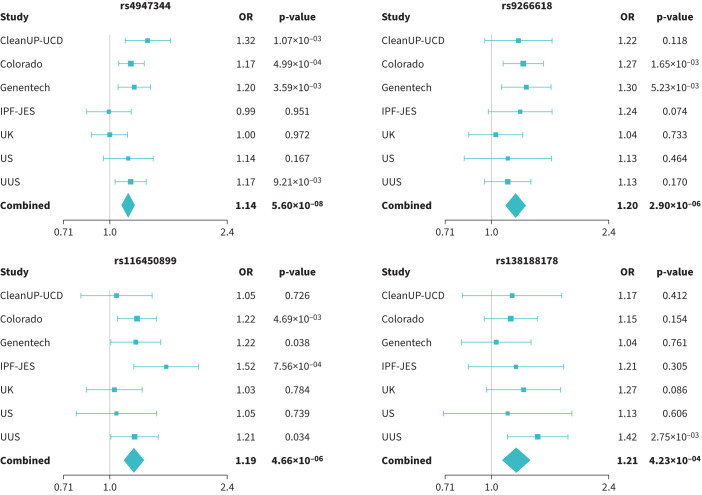
We performed a meta-analysis of associations of the HLA region with IPF risk in individuals of European ancestry from seven independent case-control studies of IPF (comprising 5159 cases and 27 459 controls, including a prior study of fibrotic interstitial pneumonia). Single nucleotide polymorphisms, classical HLA alleles and amino acids were analysed and signals meeting a region-wide association threshold of p<4.5×10 and a posterior probability of replication >90% were considered significant. We sought to replicate the previously reported association in the subset of studies independent of the original report.
The meta-analysis of all seven studies identified four significant independent single nucleotide polymorphisms associated with IPF risk. However, none met the posterior probability for replication criterion. The association was not replicated in the independent IPF studies.
Variation in the HLA region was not consistently associated with risk in studies of IPF. However, this does not preclude the possibility that other genomic regions linked to the immune response may be involved in the aetiology of IPF.
特发性肺纤维化(IPF)是一种以进行性肺纤维化为特征且预后不良的慢性间质性肺炎。近期研究强调了感染在IPF发病机制中的潜在作用,并且已有报道称该基因与特发性纤维化间质性肺炎(包括IPF)存在先前关联。由于人类白细胞抗原(HLA)区域在免疫反应中发挥重要作用,我们在此评估HLA基因变异是否与IPF风险存在特异性关联。
我们对来自七项IPF独立病例对照研究(包括5159例病例和27459例对照,其中一项先前的纤维化间质性肺炎研究)的欧洲血统个体中HLA区域与IPF风险的关联进行了荟萃分析。分析了单核苷酸多态性、经典HLA等位基因和氨基酸,满足全区域关联阈值p<4.5×10且复制后验概率>90%的信号被视为显著。我们试图在独立于原始报告的研究子集中重复先前报道的关联。
所有七项研究的荟萃分析确定了四个与IPF风险相关的显著独立单核苷酸多态性。然而,没有一个满足复制标准的后验概率。在独立的IPF研究中未重复该关联。
在IPF研究中,HLA区域的变异与风险并非始终相关。然而,这并不排除与免疫反应相关的其他基因组区域可能参与IPF病因学的可能性。