Municipal Non-profit Enterprise City Children's Clinical Hospital #6 of Dnipro City Council, Dnipro, Ukraine.
Baylor College of Medicine/The Children's Hospital of San Antonio, San Antonio, Texas, USA.
Ann Clin Transl Neurol. 2024 Mar;11(3):768-779. doi: 10.1002/acn3.52004. Epub 2024 Feb 20.
Primary objective was to evaluate efficacy of lacosamide administered concomitantly with 1-3 antiseizure medications in young children with uncontrolled focal (partial-onset) seizures.
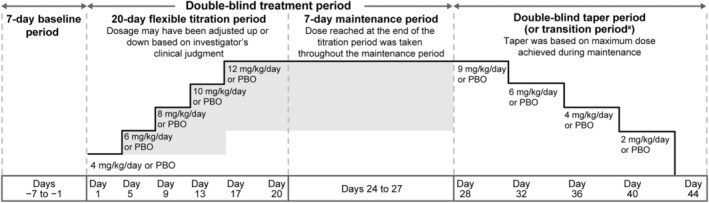
Double-blind, parallel-group trial (SP0967: NCT02477839/2013-000717-20) conducted between June 2015 and May 2020 at hospitals and clinics in 25 countries. Patients (aged ≥1 month to <4 years) with uncontrolled focal seizures were randomized 1:1 to adjunctive lacosamide or placebo using an interactive voice/web response system and stratified by age. After a 20-day titration period, patients who reached target-dose range (8-12 mg/kg/day) entered a 7-day maintenance period. Region-specific primary efficacy variables were based on ≤72-h video-electroencephalograms: change in average daily frequency (ADF) of electrographic focal seizures as measured on end-of-maintenance video-electroencephalogram versus end-of-baseline video-electroencephalogram (United States); 50% responder rate (≥50% reduction in ADF of focal seizures) during maintenance (European Union).
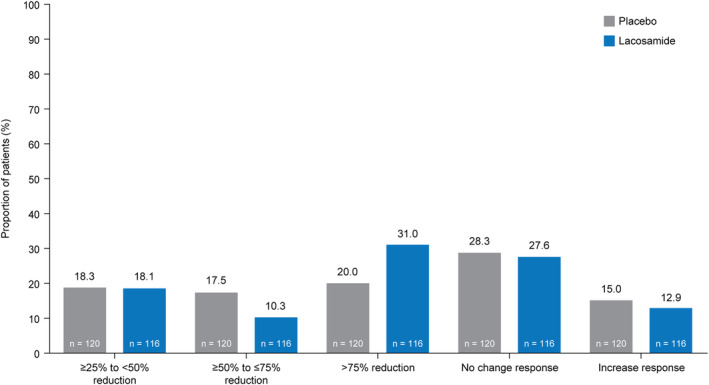
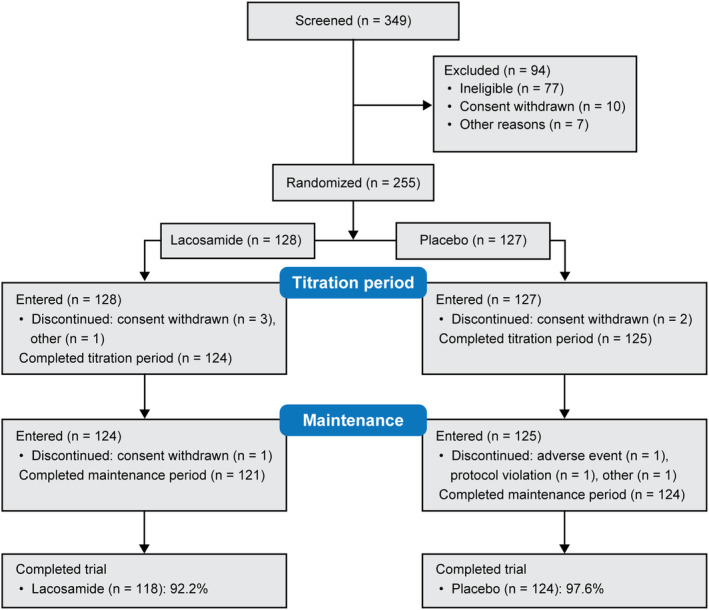
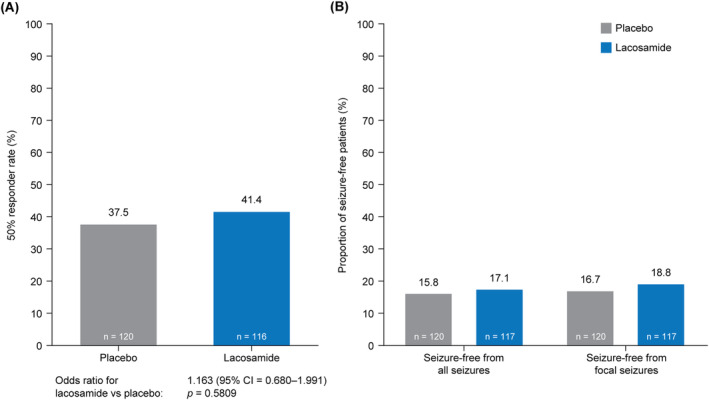
In total, 255 patients were randomized (lacosamide/placebo: 128/127) and received ≥1 trial medication dose. Percentage reduction in ADF of focal seizures for lacosamide (116 patients) versus placebo (120 patients) was 3.2% (95% confidence interval = -13.6 to 17.5, p = 0.69). 50% responder rate was 41.4% for lacosamide (116 patients), 37.5% for placebo (120 patients) (p = 0.58). Treatment-emergent adverse events were reported by 44.5% of lacosamide-treated patients (placebo 51.2%).
Adjunctive lacosamide did not show superior efficacy versus placebo in young children with focal seizures. However, efficacy variables were potentially affected by high variability and low reliability between readers in video-electroencephalogram interpretation. Lacosamide was generally well tolerated; safety profile was acceptable and consistent with that in adults and children aged ≥4 years.
主要目的是评估拉科酰胺与 1-3 种抗癫痫药物联合应用于未控制局灶性(部分发作)癫痫的幼儿的疗效。
这是一项在 2015 年 6 月至 2020 年 5 月期间在 25 个国家的医院和诊所进行的双盲、平行分组试验(SP0967:NCT02477839/2013-000717-20)。年龄在 1 个月至<4 岁之间、伴有未控制局灶性发作的患者按 1:1 随机接受辅助拉科酰胺或安慰剂治疗,采用交互式语音/网络应答系统进行分层,且按年龄分层。在 20 天的滴定期后,达到目标剂量范围(8-12mg/kg/天)的患者进入为期 7 天的维持期。基于≤72 小时视频脑电图的区域特定主要疗效变量为:维持期末视频脑电图与基线期末视频脑电图相比,平均每日发作频率(ADF)的变化(美国);维持期间 50%应答率(局灶性发作 ADF 减少≥50%)(欧盟)。
共有 255 名患者被随机分配(拉科酰胺/安慰剂:128/127),并接受了至少 1 次试验药物剂量。拉科酰胺(116 例)与安慰剂(120 例)相比,局灶性癫痫 ADF 的减少百分比为 3.2%(95%置信区间:-13.6 至 17.5,p=0.69)。拉科酰胺的 50%应答率为 41.4%(116 例),安慰剂为 37.5%(120 例)(p=0.58)。拉科酰胺治疗组有 44.5%(116 例)的患者出现治疗时出现的不良事件,安慰剂组有 51.2%(120 例)(p=0.58)。
在伴有局灶性癫痫发作的幼儿中,辅助拉科酰胺与安慰剂相比,并未显示出更好的疗效。然而,在视频脑电图解读中,由于读者之间的高度变异性和低可靠性,疗效变量可能受到影响。拉科酰胺总体上耐受良好,安全性与成人和≥4 岁儿童一致。