CSL Behring, King of Prussia, PA, USA.
Association des Patients Immunodeficients du Québec, Québec, Canada.
BMC Immunol. 2024 Feb 20;25(1):18. doi: 10.1186/s12865-024-00608-0.
Here, the perspective of patients with primary and secondary immunodeficiency receiving subcutaneous immunoglobulin (SCIg) via introductory smaller size pre-filled syringes (PFS) or vials were compared.
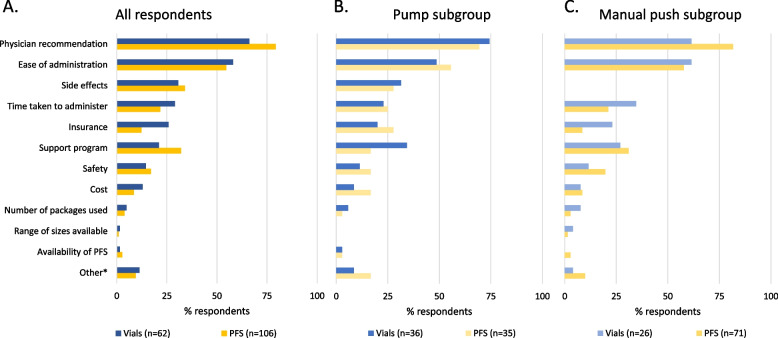
An online survey was conducted in Canada by the Association des Patients Immunodéficients du Québec (APIQ) (10/2020-03/2021). Survey questions included: reasons for choosing SCIg packaging and administration methods, training experiences, infusion characteristics, and switching methods. The survey captured structured patient-reported outcomes: treatment satisfaction and its sub-domains, symptom state, general health perception, and physical and mental function. Respondents using PFS were compared with vial users, overall and stratified by their administration method (pump or manual push).
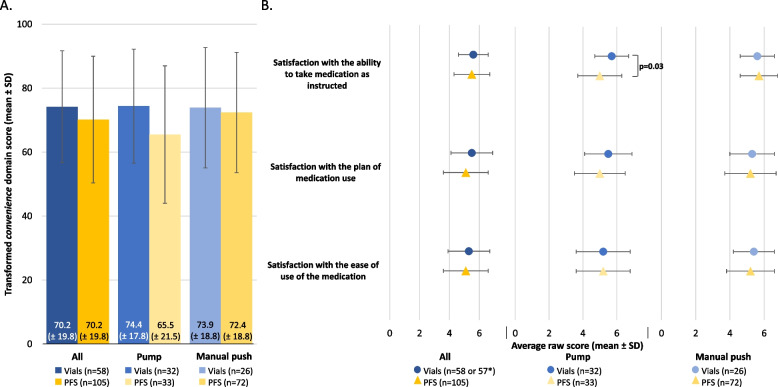
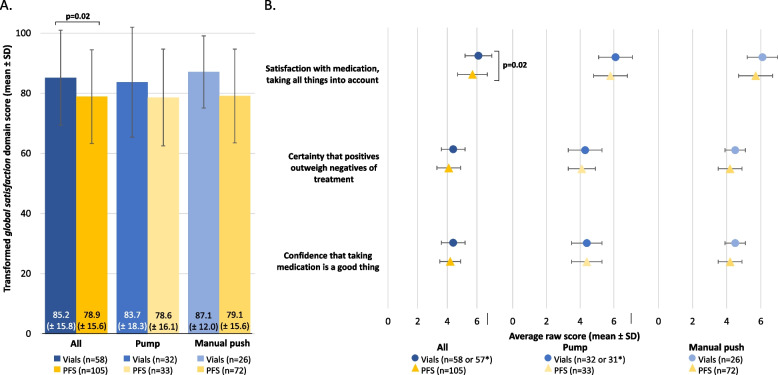
Of the 132 total respondents, 66 respondents used vials, with 38 using a pump and 28 using manual push. PFS (5 and 10 mL sizes) were being used by 120 respondents, with 38 using a pump and 82 using manual push. PFS users were associated with a 17% lower median (interquartile range) SCIg dose (10 [8, 12] vs. 12 [9, 16] g/week, respectively), a significantly shorter infusion preparation time (15 [10, 20] vs. 15 [10, 30] mins, respectively), and a trend for shorter length of infusion (60 [35, 90] vs. 70 [48, 90] mins, respectively) compared with those on vials. Patient-reported treatment satisfaction scores were overall similar between vial and PFS users (including on the domains of effectiveness and convenience), except for a higher score for vials over PFS on the domain of global satisfaction (p=0.02).
Consistent with prescribing that reflects a recognition of less wastage, PFS users were associated with a significantly lower SCIg dose compared with vial users. PFS users were also associated with shorter pre-infusion times, reflecting simpler administration mechanics compared with vial users. Higher global satisfaction with treatment among vial users compared with PFS users was consistent with users being limited to smaller PFS size options in Canada during the study period. Patient experience on PFS is expected to improve with the introduction of larger PFS sizes. Overall, treatment satisfaction for SCIg remains consistently high with the introduction of PFS packaging compared with vials.
本研究对比了原发性和继发性免疫缺陷患者使用预充式小容量注射器(PFS)或小瓶皮下免疫球蛋白(SCIg)的情况。
2020 年 10 月至 2021 年 3 月,由魁北克免疫缺陷患者协会(APIQ)在加拿大进行了一项在线调查。调查问卷包括:选择 SCIg 包装和管理方法的原因、培训经历、输注特点和更换方法。调查还收集了患者报告的治疗满意度及其各维度、症状状态、总体健康感知、身体和精神功能等方面的情况。使用 PFS 和小瓶的患者进行了总体比较,并按其给药方式(泵或手动推注)进行了分层比较。
在 132 名受访者中,66 名使用小瓶,其中 38 名使用泵,28 名使用手动推注。120 名受访者使用 PFS(5 和 10ml 规格),其中 38 名使用泵,82 名使用手动推注。与使用小瓶的患者相比,使用 PFS 的患者的中位(四分位间距)SCIg 剂量低 17%(分别为 10[8,12]g/周和 12[9,16]g/周),输注准备时间短 15 分钟(分别为 15[10,20]分钟和 15[10,30]分钟),输注时间也有缩短趋势(分别为 60[35,90]分钟和 70[48,90]分钟)。与小瓶组相比,PFS 组患者的总体治疗满意度评分相似(包括有效性和便利性两个维度),但小瓶组在总体满意度维度上的评分高于 PFS 组(p=0.02)。
与反映减少浪费的处方一致,与小瓶组相比,PFS 组患者的 SCIg 剂量明显较低。与小瓶组相比,PFS 组患者的预输注时间也较短,这反映了其给药机制更简单。与 PFS 组相比,小瓶组患者对治疗的总体满意度更高,这与研究期间加拿大 PFS 规格有限有关。随着更大规格 PFS 的推出,PFS 组患者的治疗体验有望得到改善。总体而言,与小瓶相比,PFS 包装在引入后仍能保持较高的 SCIg 治疗满意度。