Digestive Disease Center, CHA Bundang Medical Center, CHA University School of Medicine, Seongnam, South Korea.
Division of Gastroenterology, Department of Internal Medicine, Faculty of Medicine, Tokat Gaziosmanpaşa University, Tokat, Turkey.
Sci Rep. 2024 Feb 20;14(1):4172. doi: 10.1038/s41598-024-54716-3.
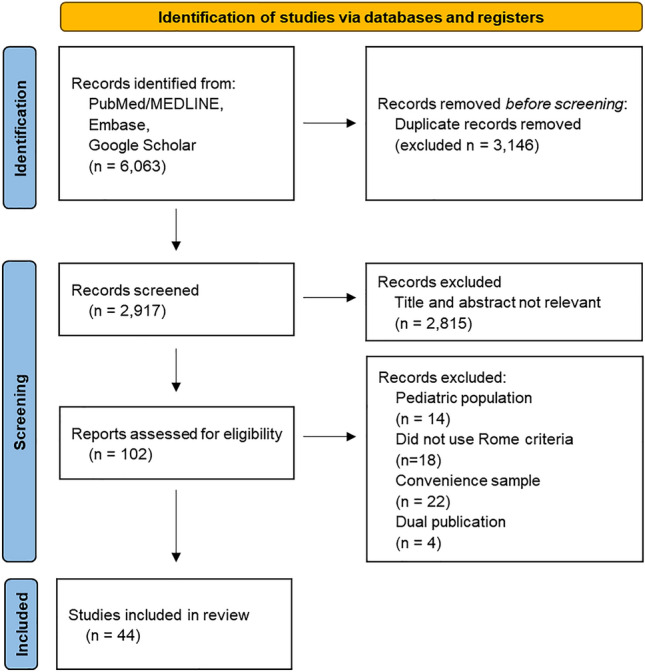
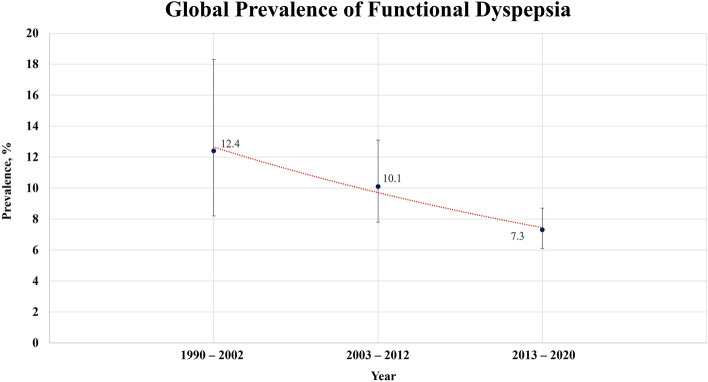
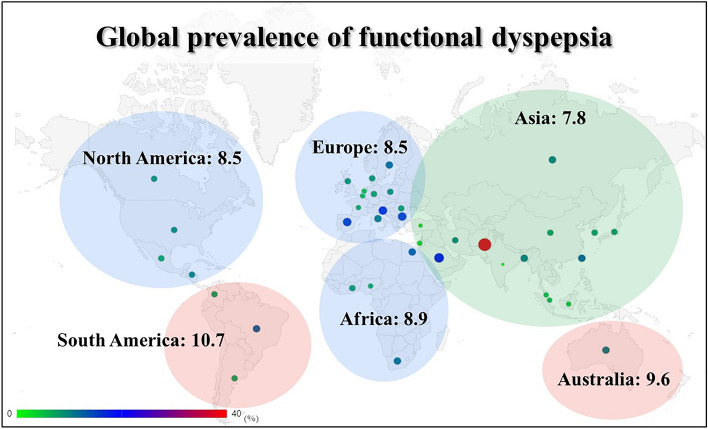
Although functional dyspepsia (FD) is a common functional gastroduodenal disorder with a high socioeconomic burden, little is known about its global prevalence. Thus, we performed a comprehensive study to estimate long-term trends in the prevalence of FD. We searched PubMed/MEDLINE, Embase, and Google Scholar from 1990 to 2022 for population-based studies that reported the prevalence of FD in adults (≥ 18 years old) according to Rome I, II, III, or IV criteria. The prevalence of FD was extracted from included studies to obtain pooled prevalence with 95% confidence intervals (CI) and 95% prediction intervals. Subgroup analysis was performed according to certain characteristics, including geographic region. A total of 44 studies met the eligibility criteria, including 256,915 participants from 40 countries across six continents. The overall global pooled prevalence of FD was 8.4% (95% CI 7.4-.9.5). The prevalence was the highest in Rome I (11.9%; 95% CI 5.1-25.4) and lowest in Rome IV (6.8%; 95% CI 5.8-7.9). Developing countries showed a higher prevalence than developed countries (9.1% versus 8.0%), and prevalence was higher in women, irrespective of the definition used (9.0% versus 7.0%). The pooled prevalence gradually decreased from 1990 to 2020 (12.4% [8.2-18.3] in 1990-2002 versus 7.3% [6.1-8.7] in 2013-2020). The prevalence of FD differs by country, economic status, geographical region, and sex, and the global prevalence has been gradually declining. Despite the heterogeneity of sample population, our study estimates the current global burden of FD and provides information to heath care policy decisions.
功能性消化不良(FD)是一种常见的功能性胃肠疾病,具有较高的社会经济负担,但全球患病率知之甚少。因此,我们进行了一项全面研究,以估计 FD 的长期患病率趋势。我们从 1990 年至 2022 年在 PubMed/MEDLINE、Embase 和 Google Scholar 中搜索了根据罗马 I、II、III 或 IV 标准报告成人(≥18 岁)FD 患病率的基于人群的研究。从纳入的研究中提取 FD 的患病率,以获得合并的患病率及其 95%置信区间(CI)和 95%预测区间。根据某些特征(包括地理位置)进行了亚组分析。共有 44 项研究符合入选标准,包括来自六大洲 40 个国家的 256915 名参与者。FD 的全球总体 pooled 患病率为 8.4%(95%CI 7.4-9.5)。罗马 I 期患病率最高(11.9%;95%CI 5.1-25.4),罗马 IV 期患病率最低(6.8%;95%CI 5.8-7.9)。发展中国家的患病率高于发达国家(9.1%比 8.0%),无论使用何种定义,女性的患病率均较高(9.0%比 7.0%)。从 1990 年到 2020 年,患病率逐渐下降(1990-2002 年为 12.4%[8.2-18.3],2013-2020 年为 7.3%[6.1-8.7])。FD 的患病率因国家、经济状况、地理位置和性别而异,全球患病率呈逐渐下降趋势。尽管样本人群存在异质性,但我们的研究估计了当前全球 FD 的负担,并为医疗保健政策决策提供了信息。