
冷冻贮藏期间三疣梭子蟹腹部和螯足肌肉的理化特性及微生物群落组成变化
Changes in the physicochemical characteristics and microbial community compositions of the abdomen and cheliped muscles in swimming crab () during frozen storage.
作者信息
Dong Ruyi, Wu Yingru, Du Qi, Lu Rui, Benjakul Soottawat, Zhang Bin, Shui Shanshan
机构信息
Key Laboratory of Health Risk Factors for Seafood of Zhejiang Province, College of Food Science and Pharmacy, Zhejiang Ocean University, PR China.
Nutrition and Bromatology Group, Department of Analytical and Food Chemistry, Faculty of Sciences, University of Vigo, Ourense, Spain.
出版信息
Food Chem X. 2024 Feb 10;21:101210. doi: 10.1016/j.fochx.2024.101210. eCollection 2024 Mar 30.
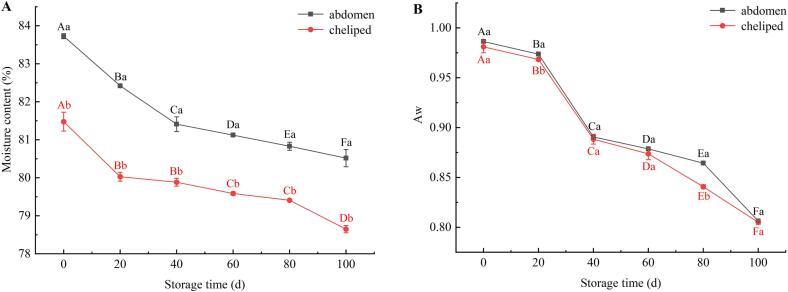
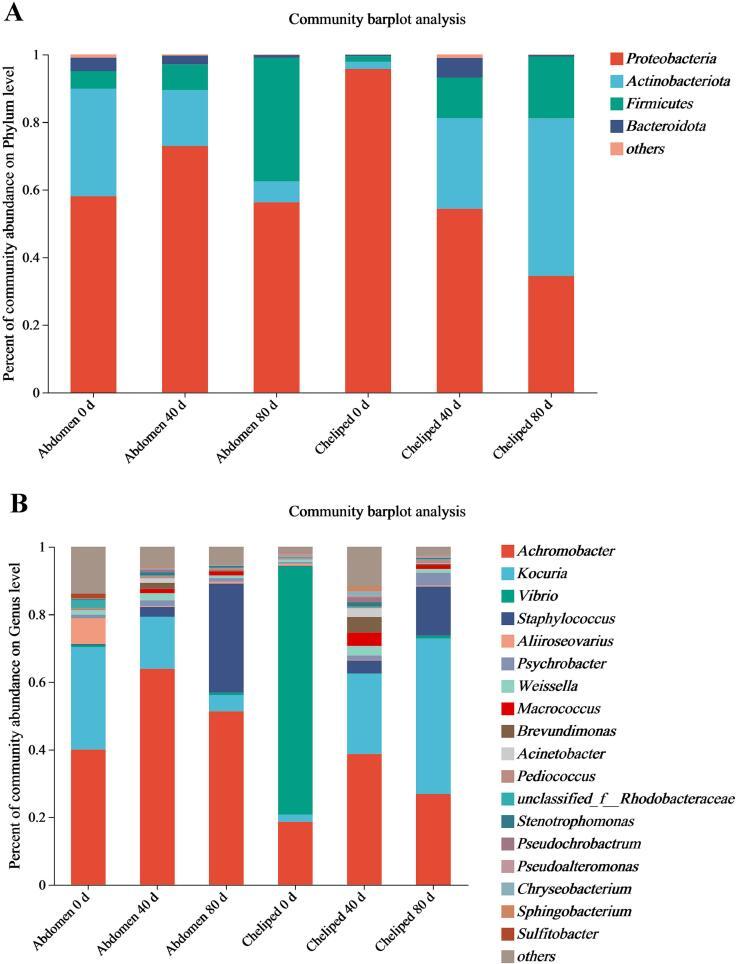
The physicochemical indexes and microbial diversity were investigated to compare the altered quality properties of the abdomen and cheliped muscle in swimming crab () during 100 days of frozen storage at -20℃. Over the extended duration of frozen storage, the sensory evaluation, moisture content, water activity (Aw), and water-holding capacity (WHC) in the abdomen and cheliped muscles of swimming crab decreased, while the pH, total volatile basic nitrogen (TVB-N), and trimethylamine (TMA) increased. The increase and decrease rates of these indicators were smaller in the abdomen than those in the cheliped muscle. High-throughput sequencing results indicated a reduction in the microbial richness and diversity in the abdomen and cheliped muscles of the swimming crab as frozen storage time extended. , , and , , , and were the dominant phylum and genus in both muscle tissues, respectively. Furthermore, the correlation analysis between the composition of the microbiota and physiochemical properties revealed that the growths of , , and were closely related to the physiochemical factors. The study provides a theoretical reference for quality deterioration and develops new products of different parts in the swimming crab during frozen storage.
研究了理化指标和微生物多样性,以比较在-20℃下冷冻储存100天期间,三疣梭子蟹腹部和螯足肌肉质量特性的变化。在延长的冷冻储存期间,三疣梭子蟹腹部和螯足肌肉的感官评价、水分含量、水分活度(Aw)和持水能力(WHC)下降,而pH值、总挥发性盐基氮(TVB-N)和三甲胺(TMA)升高。这些指标在腹部的增减速率小于螯足肌肉。高通量测序结果表明,随着冷冻储存时间的延长,三疣梭子蟹腹部和螯足肌肉中的微生物丰富度和多样性降低。变形菌门、厚壁菌门、拟杆菌门以及不动杆菌属、芽孢杆菌属、假单胞菌属分别是两种肌肉组织中的优势菌门和优势菌属。此外,微生物群组成与理化性质之间的相关性分析表明,不动杆菌属、芽孢杆菌属、假单胞菌属和拟杆菌门的生长与理化因素密切相关。该研究为冷冻储存期间三疣梭子蟹质量劣变及不同部位新产品开发提供了理论参考。




 Zotero 插件