Orthopaedics and Traumatology Department, Faculty of Medicine, Selcuk University, Konya, Turkey.
Department of Pharmacology, Faculty of Medicine, Suleyman Demirel University, Isparta, Turkey.
BMC Musculoskelet Disord. 2024 Feb 21;25(1):164. doi: 10.1186/s12891-024-07200-y.
Knee osteoarthritis is severe progressive and most commonly diagnosed articular disease and its incidence is increasing around the world depending on age. This pathologic condition which limits daily activity of patients can be characterized by degeneration of cartilage and inflammation. Although non-steroidal anti-inflammatory (NSAII) agents and other analgesics are routinely used treatment options, the potential effects of intraarticular injections including hyaluronic acid (HA) have also been demonstrated by various studies. However, few studies compare the efficacy of a single high molecular weight (HMW) high dose and a triple HMW low dose. This study aimed to compare the efficacy of single high molecular weight (HMW) high dose (2 mL / 60 mg) and triple HMW low dose (2 mL /30 mg) intra-articular injection of HA in knee osteoarthritis (OA) patients by evaluating function and pain parameters during 12 months.
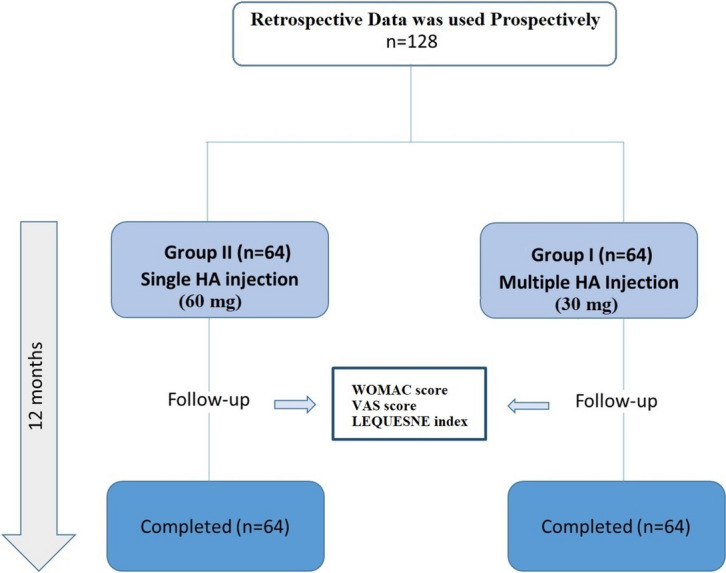
This is a single-center, retrospective clinical study that included and involved 128 patients. Group I (n=64) patients received triple 30 mg HA injections (SEMICAL®) with one-week intervals, while Group II (n=64) patients received a single 60 mg HA injection (SEMICAL®). Lequesne Index, WOMAC and VAS scores were recorded to assess pain and function during a 12-month period.
There was no significant difference in characteristics of patient demographics. Our finding indicate that WOMAC, VAS score, and Lequesne Index values during follow-up visits exhibited a decrease, signifying improvement in the clinical condition. Notably, scores were significantly more favorable with the 30 mg of HA injection compared to the 60 mg of HA injection.
This study suggests that the triple low-dose injection of HMW HA is more effective in improving WOMAC, VAS scores and Lequesne Index values than a single high-dose injection.
膝骨关节炎是一种严重的进行性疾病,也是最常见的关节疾病,其发病率随着年龄的增长而在全球范围内增加。这种限制患者日常活动的病理状况可表现为软骨退化和炎症。尽管非甾体抗炎药(NSAII)和其他镇痛药是常规的治疗选择,但各种研究也证明了关节内注射透明质酸(HA)的潜在效果。然而,很少有研究比较单次高相对分子质量(HMW)高剂量和三重 HMW 低剂量的疗效。本研究旨在通过评估 12 个月期间的功能和疼痛参数,比较单次高相对分子质量(HMW)高剂量(2 毫升/60 毫克)和三重 HMW 低剂量(2 毫升/30 毫克)HA 关节内注射治疗膝骨关节炎(OA)患者的疗效。
这是一项单中心、回顾性临床研究,共纳入 128 例患者。第 I 组(n=64)患者接受每周一次的三重 30 毫克 HA 注射(SEMCAL®),第 II 组(n=64)患者接受单次 60 毫克 HA 注射(SEMCAL®)。在 12 个月期间,使用 Lequesne 指数、WOMAC 和 VAS 评分来评估疼痛和功能。
患者人口统计学特征无显著差异。我们的研究结果表明,在随访期间,WOMAC、VAS 评分和 Lequesne 指数值均呈下降趋势,表明临床状况有所改善。值得注意的是,与 60 毫克 HA 注射相比,30 毫克 HA 注射的评分明显更有利。
本研究表明,三重低剂量 HMW HA 注射在改善 WOMAC、VAS 评分和 Lequesne 指数值方面比单次高剂量注射更有效。