Department of Anaesthesiology, Intensive Care, Emergency and Pain Medicine, Würzburg University, 97080 Würzburg, Germany.
Center of Mental Health, Department of Psychiatry and Psychotherapy, University Hospital Würzburg, 97080 Würzburg, Germany.
Biomolecules. 2024 Jan 31;14(2):167. doi: 10.3390/biom14020167.
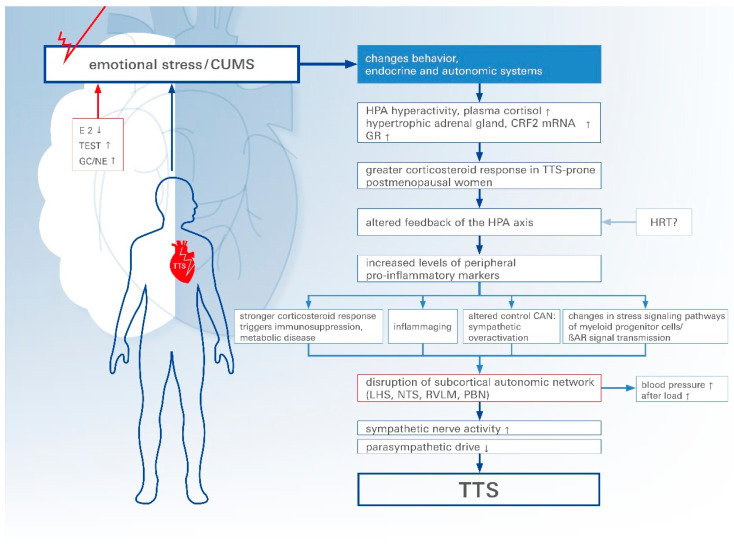
Takotsubo syndrome (TTS) is a cardiomyopathy that clinically presents as a transient and reversible left ventricular wall motion abnormality (LVWMA). Recovery can occur spontaneously within hours or weeks. Studies have shown that it mainly affects older people. In particular, there is a higher prevalence in postmenopausal women. Physical and emotional stress factors are widely discussed and generally recognized triggers. In addition, the hypothalamic-pituitary-adrenal (HPA) axis and the associated glucocorticoid-dependent negative feedback play an important role in the resulting immune response. This review aims to highlight the unstudied aspects of the trigger factors of TTS. The focus is on emotional stress/chronic unpredictable mild stress (CUMS), which is influenced by estrogen concentration and noradrenaline, for example, and can lead to changes in the behavioral, hormonal, and autonomic systems. Age- and gender-specific aspects, as well as psychological effects, must also be considered. We hypothesize that this leads to a stronger corticosteroid response and altered feedback of the HPA axis. This may trigger proinflammatory markers and thus immunosuppression, inflammaging, and sympathetic overactivation, which contributes significantly to the development of TTS. The aim is to highlight the importance of CUMS and psychological triggers as risk factors and to make an exploratory proposal based on the new knowledge. Based on the imbalance between the sympathetic and parasympathetic nervous systems, transcutaneous vagus nerve stimulation (tVNS) is presented as a possible new therapeutic approach.
心肌心尖球形综合征(TTS)是一种心肌病,临床上表现为短暂的、可逆的左心室壁运动异常(LVWMA)。恢复可以在数小时或数周内自发发生。研究表明,它主要影响老年人。特别是,绝经后妇女的患病率较高。身体和情绪应激因素被广泛讨论,并被普遍认为是触发因素。此外,下丘脑-垂体-肾上腺(HPA)轴及其相关的糖皮质激素依赖性负反馈在导致的免疫反应中起着重要作用。本综述旨在强调 TTS 触发因素中未被研究的方面。重点是情绪应激/慢性不可预测轻度应激(CUMS),例如,它受雌激素浓度和去甲肾上腺素的影响,可导致行为、激素和自主神经系统的变化。还必须考虑年龄和性别特异性方面以及心理影响。我们假设这会导致更强的皮质类固醇反应和 HPA 轴的反馈改变。这可能会引发促炎标志物,从而导致免疫抑制、炎症老化和交感神经过度激活,这对 TTS 的发展有重要贡献。目的是强调 CUMS 和心理触发因素作为风险因素的重要性,并根据新知识提出探索性建议。基于交感神经和副交感神经系统之间的不平衡,经皮迷走神经刺激(tVNS)被提出作为一种新的治疗方法。