Moe Fredrik D, Erga Aleksander, Bjornestad Jone, Dettweiler Ulrich
Department of Mental Health, Haukeland University Hospital, Bergen, Norway.
Centre for the Study of the Sciences and the Humanities, University of Bergen, Bergen, Norway.
Front Psychiatry. 2024 Feb 9;15:1288551. doi: 10.3389/fpsyt.2024.1288551. eCollection 2024.
Longitudinal studies with annual follow-up including psychological and social variables in substance use disorder recovery are scarce. We investigated whether levels of substance use, satisfaction with life, and psychological distress fluctuate across five years in relation to having drug-free friends.
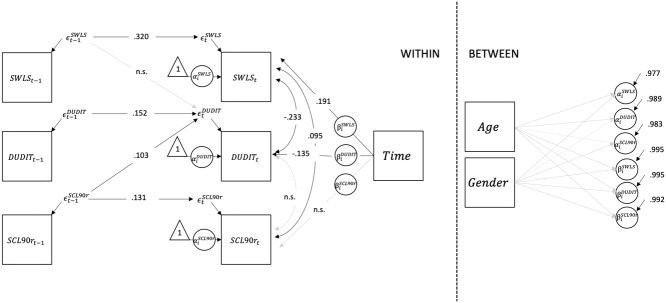
A prospective naturalistic cohort study of change trajectories in a cohort of people diagnosed with substance use disorder and using multiple substances with quarterly and annual follow-up over five years. Two-hundred-and-eight patients were recruited from substance use disorder treatment in Rogaland, Norway. Out of these, 164 participants fulfilled the inclusion criteria. We used Bayesian two-level dynamic structural equation modelling. The variable 'drug-free friends' was assessed by a self-reporting questionnaire, while psychological distress was assessed using the Symptoms Checklist 90 Revised. Satisfaction with life was assessed using the Satisfaction With Life Scale while drug use was assessed using the Drug Use Disorders Identification Test.
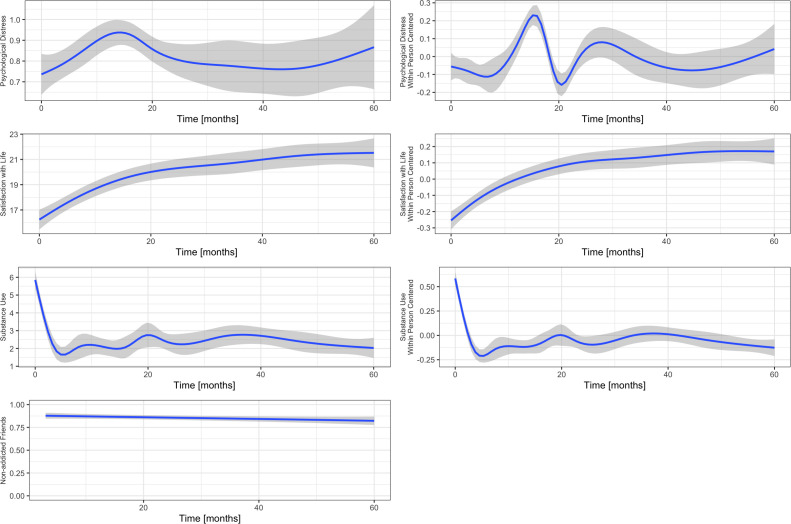
The main findings are that higher-than-average psychological distress at a three-month lag credibly predicts higher-than-normal substance use at the concurrent time point t. Substance use and satisfaction with life seem to have synchronous trajectories over time, i.e. as the first decreases the latter increases and vice versa. During the five years after treatment, the participants mainly experienced a decrease in substance use and increase in satisfaction with life.
Since the participants experienced positive and negative fluctuations for several years after treatment, it seems crucial to establish a dialogue with treatment professionals in order to create functional solutions for maintaining motivation and aiding recovery.
对物质使用障碍康复情况进行年度随访并纳入心理和社会变量的纵向研究较为匮乏。我们调查了在五年时间里,物质使用水平、生活满意度和心理困扰程度与有无无毒品朋友之间的波动关系。
一项针对被诊断患有物质使用障碍且使用多种物质的人群队列变化轨迹的前瞻性自然队列研究,为期五年,每季度和每年进行随访。从挪威罗加兰的物质使用障碍治疗机构招募了280名患者。其中,164名参与者符合纳入标准。我们使用了贝叶斯二级动态结构方程模型。“无毒品朋友”变量通过自我报告问卷进行评估,心理困扰程度使用症状自评量表90修订版进行评估。生活满意度使用生活满意度量表进行评估,药物使用情况使用药物使用障碍识别测试进行评估。
主要研究结果表明,在三个月滞后时高于平均水平的心理困扰可靠地预测了在同时刻t时高于正常水平的物质使用。物质使用和生活满意度似乎随时间具有同步轨迹,即前者下降时后者上升,反之亦然。在治疗后的五年中,参与者主要经历了物质使用的减少和生活满意度的提高。
由于参与者在治疗后的几年中经历了正负波动,因此与治疗专业人员建立对话以创建功能性解决方案以维持动机和辅助康复似乎至关重要。