Kopka Michaela, Heard S Mark, Buchko Gregory M, Hiemstra Laurie A, Lafave Mark R, Kerslake Sarah
Banff Sport Medicine, Banff, Canada.
Department of Surgery, University of Calgary, Calgary, Canada.
Arthrosc Sports Med Rehabil. 2024 Jan 24;6(2):100898. doi: 10.1016/j.asmr.2024.100898. eCollection 2024 Apr.
To compare a large cohort of patients who underwent remnant-sparing anterior cruciate ligament reconstruction (rACLR) with a matched group of patients who underwent anatomic single-bundle anterior cruciate ligament reconstruction (ACLR) with respect to clinical laxity, patient-reported outcomes, and functional testing.
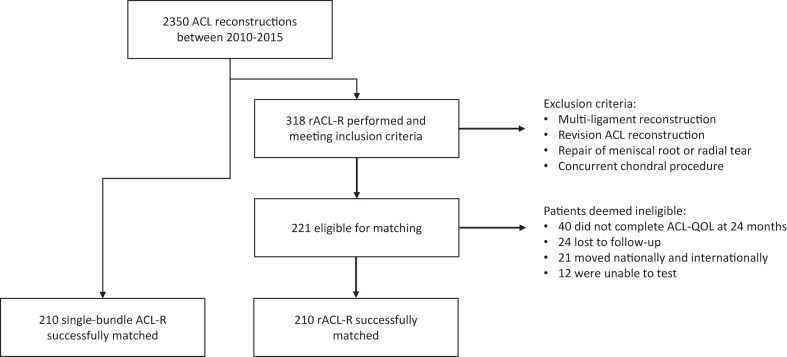
Patients who underwent rACLR between January 2010 and December 2015 were matched according to age, sex, body mass index, and graft type to patients who underwent ACLR. The primary outcome measure was the ACL Quality of Life (ACL-QOL) score at final follow-up of 24 months. Secondary outcomes included functional tests and clinical laxity measurements at 6, 12, and 24 months postoperatively. Concurrent intra-articular pathology at the time of surgery and postoperative complications were also recorded. Statistical analyses included the dependent test and the Wilcoxon signed rank test.
A total of 210 rACLR patients were successfully matched to a corresponding cohort of 210 ACLR patients. There were no statistically significant differences in ACL Quality of Life (ACL-QOL) or functional testing results between the groups; however, scores in both groups showed a steady and statistically significant improvement over time. A statistically significant difference was noted with respect to the Lachman test findings, favoring the rACLR cohort ( = -2.79, = .005); no between-group difference was seen for the pivot-shift test ( = -0.36, = .72). The rACLR group had a significantly lower rate of concurrent meniscal and chondral injury. There was no difference in complications between the groups ( = -0.49, = .63).
There was no difference in patient-reported or functional testing outcomes in patients undergoing remnant-sparing compared with anatomic single-bundle ACLR. There was, however, a significantly lower rate of positive Lachman test findings after rACLR. Furthermore, the rate of concurrent meniscal and chondral pathology was lower in the rACLR group.
Level III, retrospective cohort study.
比较一大群接受保留残端前交叉韧带重建术(rACLR)的患者与一组匹配的接受解剖单束前交叉韧带重建术(ACLR)的患者在临床松弛度、患者报告的结局和功能测试方面的情况。
2010年1月至2015年12月期间接受rACLR的患者根据年龄、性别、体重指数和移植物类型与接受ACLR的患者进行匹配。主要结局指标是在24个月最终随访时的前交叉韧带生活质量(ACL-QOL)评分。次要结局包括术后6、12和24个月时的功能测试和临床松弛度测量。还记录了手术时的并发关节内病变和术后并发症。统计分析包括配对t检验和Wilcoxon符号秩检验。
总共210例rACLR患者成功与210例ACLR患者的相应队列匹配。两组之间在前交叉韧带生活质量(ACL-QOL)或功能测试结果方面没有统计学上的显著差异;然而,两组的评分均随时间显示出稳定且具有统计学意义的改善。在Lachman试验结果方面观察到统计学上的显著差异,有利于rACLR队列(t = -2.79,P = .005);在轴移试验中未观察到组间差异(t = -0.36,P = .72)。rACLR组并发半月板和软骨损伤的发生率显著较低。两组之间的并发症没有差异(t = -0.49,P = .63)。
与解剖单束ACLR相比,接受保留残端手术的患者在患者报告的结局或功能测试结果方面没有差异。然而,rACLR后Lachman试验阳性结果的发生率显著较低。此外,rACLR组并发半月板和软骨病变的发生率较低。
III级,回顾性队列研究。