Investigation performed at The Ohio State University Wexner Medical Center, Columbus, Ohio, USA, and Vanderbilt University Medical Center, Nashville, Tennessee, USA.
Am J Sports Med. 2018 Oct;46(12):2865-2872. doi: 10.1177/0363546518793881. Epub 2018 Sep 7.
Knee laxity in the setting of anterior cruciate ligament (ACL) injury is often assessed through physical examination using the Lachman, pivot shift, and anterior drawer tests. The degree of laxity noted on these examinations may influence treatment decisions and prognosis.
Increased preoperative knee laxity is associated with increased risk of revision ACL reconstruction, increased risk of contralateral ACL reconstruction, and poorer patient-reported outcomes at 6 years postoperatively.
Cohort study; Level of evidence, 2.
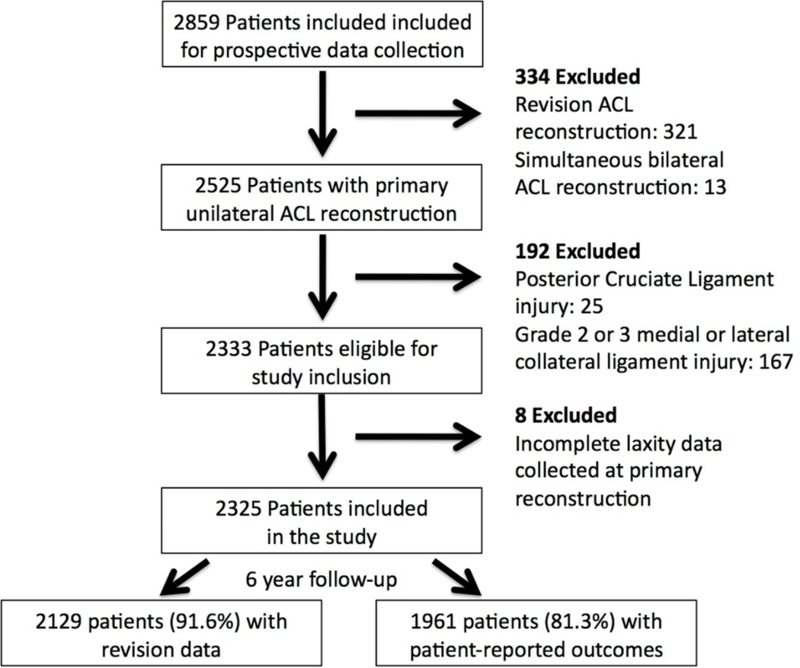
2333 patients who underwent primary isolated ACL reconstruction without additional ligament injury were identified. Patients reported by the operating surgeons to have an International Knee Documentation Committee (IKDC) grade D Lachman, anterior drawer, or pivot shift examination were classified as having a high-grade laxity. Multiple logistic regression models were used to evaluate whether having high-grade preoperative laxity was predictive of increased odds of undergoing subsequent revision or contralateral ACL reconstruction within 6 years of the index procedure, controlling for patient age, sex, body mass index, Marx activity level, sport, graft type, medial meniscal treatment, and lateral meniscal treatment. Multiple linear regression modeling was used to evaluate whether having high-grade preoperative laxity was predictive of poorer IKDC or Knee injury and Osteoarthritis Outcome Score Knee-Related Quality of Life (KOOS-QOL) scores at 6 years postoperatively, after controlling for baseline score, patient age, ethnicity, sex, body mass index, marital status, smoking status, sport participation, competition level, Marx activity rating score, graft type, and articular cartilage and meniscal status.
In total, 743 of 2325 patients (32.0%) were noted to have high-grade laxity on at least 1 physical examination test. High-grade Lachman was noted in 334 patients (14.4%), high-grade pivot shift was noted in 617 patients (26.5%), and high-grade anterior drawer was noted in 233 patients (10.0%). Six-year revision and contralateral ACL reconstruction data were available for 2129 patients (91.6%). High-grade prereconstruction Lachman was associated with significantly increased odds of ACL graft revision (odds ratio [OR], 1.76; 95% CI, 1.10-2.80, P = .02) and contralateral ACL reconstruction (OR, 1.68; 95% CI, 1.09-2.69; P = .019). High-grade prereconstruction pivot shift was associated with significantly increased odds of ACL graft revision (OR, 1.75; 95% CI, 1.19-2.54, P = .002) but not with significantly increased odds of contralateral ACL reconstruction (OR, 1.30; 95% CI, 0.89-1.87; P = .16). High-grade prereconstruction laxity was associated with statistically significantly lower 6-year IKDC (β = -2.26, P = .003), KOOS-QOL (β = -2.67, P = .015), and Marx activity scores (β = -0.54, P = .020), but these differences did not approach clinically relevant differences in patient-reported outcomes.
High-grade preoperative knee laxity is predictive of increased odds of revision ACL reconstruction and contralateral ACL reconstruction 6 years after ACL reconstruction. Poorer patient-reported outcome scores in the high-grade laxity group were also noted, but the difference did not reach a level of clinical relevance.
前交叉韧带(ACL)损伤患者的膝关节松弛度通常通过体格检查,使用 Lachman、枢轴转移和前抽屉试验进行评估。这些检查中注意到的松弛程度可能会影响治疗决策和预后。
术前膝关节松弛度增加与 ACL 重建后翻修的风险增加、对侧 ACL 重建的风险增加以及术后 6 年患者报告的结局较差有关。
队列研究;证据水平,2。
确定了 2333 例接受初次单独 ACL 重建且无其他韧带损伤的患者。手术医生报告的国际膝关节文献委员会(IKDC)Lachman、前抽屉或枢轴转移检查分级 D 的患者被归类为存在高级别松弛度。使用多变量逻辑回归模型评估术前存在高级别松弛度是否与增加后续接受 6 年内翻修或对侧 ACL 重建的几率相关,控制患者年龄、性别、体重指数、Marx 活动水平、运动、移植物类型、内侧半月板治疗和外侧半月板治疗。使用多元线性回归模型评估术前存在高级别松弛度是否与术后 6 年较差的 IKDC 或膝关节损伤和骨关节炎结局评分膝关节相关生活质量(KOOS-QOL)评分相关,在控制基线评分、患者年龄、种族、性别、体重指数、婚姻状况、吸烟状况、运动参与度、比赛水平、Marx 活动评分、移植物类型以及关节软骨和半月板状况后。
共有 2325 例患者中的 743 例(32.0%)在至少 1 项体格检查测试中发现存在高级别松弛度。334 例患者(14.4%)存在高级别 Lachman,617 例患者(26.5%)存在高级别枢轴转移,233 例患者(10.0%)存在高级别前抽屉。2129 例患者(91.6%)有 6 年翻修和对侧 ACL 重建数据。术前存在高级别 Lachman 与 ACL 移植物翻修的几率显著增加相关(比值比 [OR],1.76;95%CI,1.10-2.80,P =.02)和对侧 ACL 重建(OR,1.68;95%CI,1.09-2.69;P =.019)。术前存在高级别枢轴转移与 ACL 移植物翻修的几率显著增加相关(OR,1.75;95%CI,1.19-2.54,P =.002),但与对侧 ACL 重建的几率增加无关(OR,1.30;95%CI,0.89-1.87;P =.16)。术前松弛度较高与 6 年 IKDC(β=-2.26,P =.003)、KOOS-QOL(β=-2.67,P =.015)和 Marx 活动评分(β=-0.54,P =.020)的统计学显著较低相关,但这些差异在患者报告的结果中未达到临床相关的差异。
术前膝关节松弛度较高与 ACL 重建后 6 年内翻修和对侧 ACL 重建的几率增加相关。高级别松弛组患者报告的结局较差,但差异未达到临床相关水平。