Patkaew Songwut, Direkbusarakom Sataporn, Hirono Ikuo, Wuthisuthimethavee Suwit, Powtongsook Sorawit, Pooljun Chettupon
Center of Excellence for Aquaculture Technology and Innovation, School of Agricultural Technology and Food Industry, Walailak University, Nakhon Si Thammarat, Thailand.
Graduate School of Marine Science and Technology, Tokyo University of Marine Science and Technology, Konan 4-5-7, Minato-ku, Tokyo 108-8477, Japan.
Vet World. 2024 Jan;17(1):50-58. doi: 10.14202/vetworld.2024.50-58. Epub 2024 Jan 8.
Oxygen concentration is an essential water quality parameter for aquaculture systems. Recently, supersaturated dissolved oxygen (DO) has been widely used in aquaculture systems to prevent oxygen depletion; however, the long-term effects of supersaturated DO exposure on aquatic animals have not been studied. In this study, we examined the effects of supersaturated DO on the growth, survival, and gene expression of Pacific white shrimp ().
Specific pathogen-free shrimp with a body weight of 8.22 ± 0.03 g were randomly assigned to two groups with four replicates at a density of 15 shrimps per tank. Shrimp were cultivated in recirculating tanks containing 50 L of 15 ppt seawater in each replicate. Oxygen was supplied at 5 mg/L to the control tanks using an air microbubble generator and at 15 mg/L to the treatment tanks using a pure oxygen microbubble generator. Shrimp were fed commercial feed pellets containing 39% protein at 4% of their body weight per day for 30 days. Average daily growth (ADG) and feed conversion ratio (FCR) were determined on days 15 and 30. Shrimp molting was measured every day. Individual hemolymph samples were obtained and analyzed for total hemocyte count, differential hemocyte count, and expression of growth- and immune-related genes at the end of the experiment.
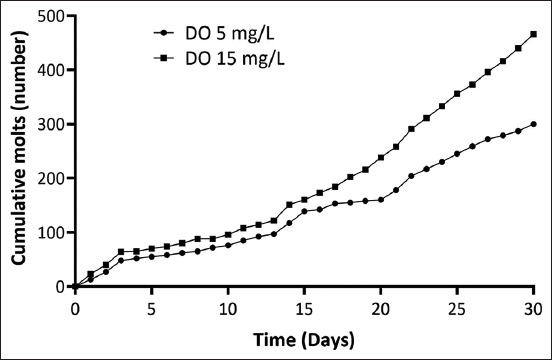
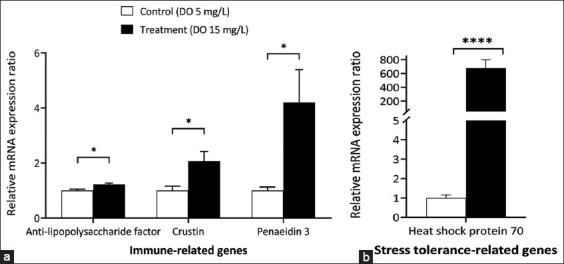
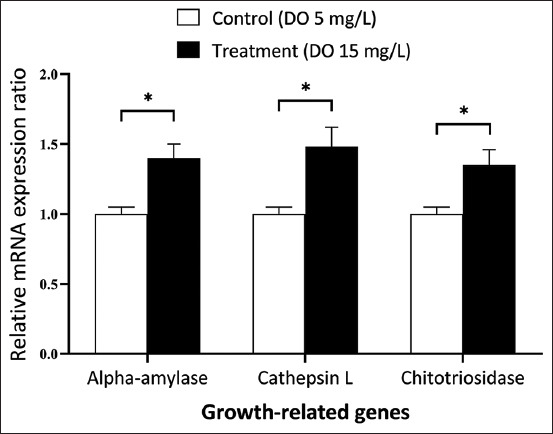
Long-term exposure to supersaturated DO significantly affected shrimp growth. After 30 days of supersaturated DO treatment, the final weight and ADG were 14.73 ± 0.16 g and 0.22 ± 0.04, respectively. Shrimp treated with normal aeration showed significantly lower weight (12.13 ± 0.13 g) and ADG (0.13 ± 0.00) compared with the control group. FCR was 1.55 ± 0.04 in the treatment group and 2.51 ± 0.09 in the control group. Notably, the shrimp molting count was 1.55-fold higher in the supersaturated DO treatment than in the supersaturated DO treatment. The expression of growth-related genes, such as alpha-amylase, cathepsin L, and chitotriosidase, was 1.40-, 1.48-, and 1.35-fold higher, respectively, after supersaturated DO treatment. Moreover, the treatment increased the expression of anti-lipopolysaccharide factor, crustin, penaeidin3, and heat shock protein 70 genes by 1.23-, 2.07-, 4.20-, and 679.04-fold, respectively, compared to the controls.
Supersaturated DO increased growth and ADG production and decreased FCR. Furthermore, enhanced immune-related gene expression by supersaturated DO may improve shrimp health and reduce disease risk during cultivation.
氧浓度是水产养殖系统中一项重要的水质参数。近来,过饱和溶解氧(DO)已在水产养殖系统中广泛用于防止氧耗竭;然而,过饱和DO暴露对水生动物的长期影响尚未得到研究。在本研究中,我们检测了过饱和DO对凡纳滨对虾生长、存活及基因表达的影响。
将体重为8.22±0.03克的无特定病原体对虾随机分为两组,每组四个重复,每缸密度为15只对虾。每个重复在装有50升15ppt海水的循环水族箱中养殖对虾。使用空气微泡发生器向对照水族箱供应5毫克/升的氧气,使用纯氧微泡发生器向处理水族箱供应15毫克/升的氧气。对虾每天按其体重的4%投喂含39%蛋白质的商业饲料颗粒,持续30天。在第15天和第30天测定平均日生长率(ADG)和饲料转化率(FCR)。每天测量对虾蜕皮情况。在实验结束时采集个体血淋巴样本,分析全血细胞计数、不同血细胞计数以及生长和免疫相关基因的表达。
长期暴露于过饱和DO显著影响对虾生长。过饱和DO处理30天后,最终体重和ADG分别为14.73±0.16克和0.22±0.04。与对照组相比,正常曝气处理的对虾体重(12.13±0.13克)和ADG(0.13±0.00)显著更低。处理组的FCR为1.55±0.04,对照组为2.51±0.09。值得注意的是,过饱和DO处理组的对虾蜕皮次数比正常曝气处理组高1.55倍。过饱和DO处理后,与生长相关的基因,如α-淀粉酶、组织蛋白酶L和壳三糖苷酶的表达分别提高了1.40倍、1.48倍和1.35倍。此外,与对照组相比,该处理使抗脂多糖因子、甲壳素、对虾抗菌肽3和热休克蛋白70基因的表达分别提高了1.23倍、2.07倍、4.20倍和679.04倍。
过饱和DO提高了生长和ADG产量并降低了FCR。此外,过饱和DO增强的免疫相关基因表达可能改善对虾健康并降低养殖期间的疾病风险。