Lalonde-Bester Sophie, Malik Mishal, Masoumi Reihaneh, Ng Katie, Sidhu Simran, Ghosh Mahua, Vine Donna
Metabolic and Cardiovascular Disease Laboratory, University of Alberta, Edmonton, Alberta, Canada.
Division of Endocrinology and Metabolism, Faculty of Medicine and Dentistry, University of Alberta, Edmonton, Alberta, Canada.
Adv Nutr. 2024 Apr;15(4):100193. doi: 10.1016/j.advnut.2024.100193. Epub 2024 Feb 24.
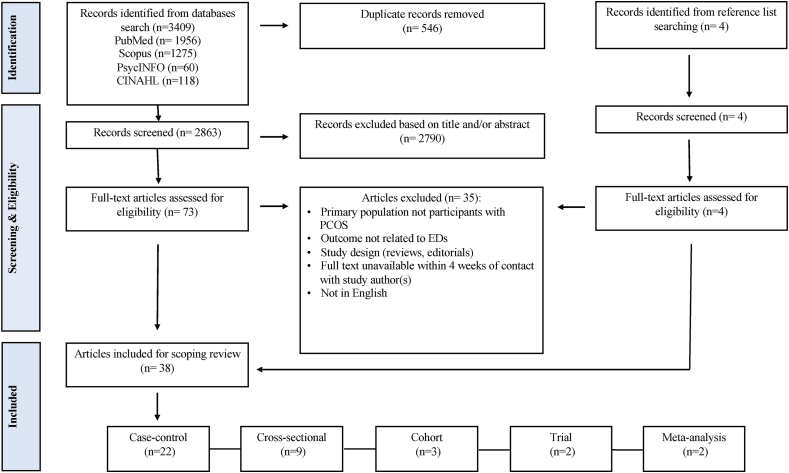
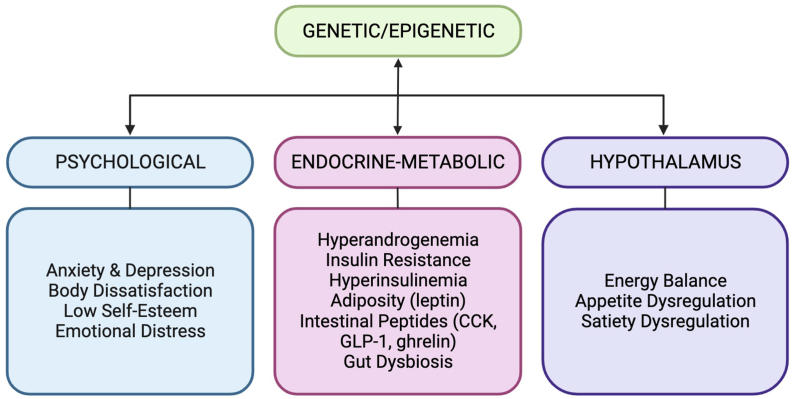
Polycystic ovary syndrome (PCOS) is the most common endocrine-metabolic disorder affecting females across the lifespan. Eating disorders (EDs) are psychiatric conditions that may impact the development of PCOS and comorbidities including obesity, metabolic syndrome, and type 2 diabetes. The aim of this scoping review was to determine the prevalence of EDs and disordered eating, and to review the etiology of EDs in PCOS. The review was conducted using search terms addressing PCOS, EDs, and disordered eating in databases, including PubMed, Scopus, PsycINFO, and CINAHL. Structured interviews, self-administered questionnaires, chart review, or self-reported diagnosis were used to identify EDs in 38 studies included in the review. The prevalence of any ED in those with PCOS ranged from 0% to 62%. Those with PCOS were 3-6-fold more likely to have an ED and higher odds ratios (ORs) of an elevated ED score compared with controls. In those with PCOS, 30% had a higher OR of bulimia nervosa and binge ED was 3-fold higher compared with controls. Studies were limited on anorexia nervosa and other specified feeding or ED (such as night eating syndrome) and these were not reported to be higher in PCOS. To our knowledge, no studies reported on avoidant/restrictive food intake disorder, rumination disorder, or pica in PCOS. Studies showed strong associations between overweight, body dissatisfaction, and disordered eating in PCOS. The etiologic development of EDs in PCOS remains unclear; however, psychological, metabolic, hypothalamic, and genetic factors are implicated. The prevalence of any ED in PCOS varied because of the use of different diagnostic and screening tools. Screening of all individuals with PCOS for EDs is recommended and high-quality studies on the prevalence, pathogenesis of specific EDs, relationship to comorbidities, and effective interventions to treat ED in those with PCOS are needed.
多囊卵巢综合征(PCOS)是影响女性一生的最常见的内分泌代谢紊乱疾病。饮食失调(EDs)是一种精神疾病,可能会影响PCOS的发展以及包括肥胖、代谢综合征和2型糖尿病在内的合并症。本范围综述的目的是确定饮食失调和饮食紊乱的患病率,并综述PCOS中饮食失调的病因。该综述使用了在包括PubMed、Scopus、PsycINFO和CINAHL在内的数据库中涉及PCOS、饮食失调和饮食紊乱的检索词进行。在纳入综述的38项研究中,采用结构化访谈、自填问卷、病历审查或自我报告诊断来识别饮食失调。PCOS患者中任何一种饮食失调的患病率在0%至62%之间。与对照组相比,PCOS患者患饮食失调的可能性高3至6倍,饮食失调评分升高的比值比(ORs)也更高。在PCOS患者中,30%的人神经性贪食症的OR值更高,与对照组相比,暴饮暴食型饮食失调的发生率高3倍。关于神经性厌食症和其他特定的进食或饮食失调(如夜间饮食综合征)的研究有限,且未报告PCOS患者中这些疾病的发生率更高。据我们所知,没有关于PCOS中回避/限制性食物摄入障碍、反刍障碍或异食癖的研究报告。研究表明,PCOS患者的超重、身体不满意与饮食紊乱之间存在密切关联。PCOS中饮食失调的病因发展仍不清楚;然而,心理、代谢、下丘脑和遗传因素都与之有关。由于使用了不同的诊断和筛查工具,PCOS中任何一种饮食失调的患病率各不相同。建议对所有PCOS患者进行饮食失调筛查,并且需要开展关于特定饮食失调的患病率、发病机制、与合并症的关系以及治疗PCOS患者饮食失调的有效干预措施的高质量研究。