Vanden Brink Heidi, McCormick Kathleen C, Lujan Marla E, Chang Jane, Ipp Lisa, Mudrak Erika L, Alladeen Anisah, Lamar Hannah, Kim Joy Y, Mendle Jane
Department of Nutrition, Texas A&M University, College Station, TX, United States.
Institute for Advancing Health through Agriculture, Texas A&M AgriLife, College Station, TX, United States.
Front Endocrinol (Lausanne). 2025 Jun 12;16:1551958. doi: 10.3389/fendo.2025.1551958. eCollection 2025.
PCOS is linked with disproportionately high rates of depression and anxiety that significantly compromise quality of life and pose problems for treatment eligibility and adherence. The overarching objective of the proposed manuscript is to define the presence and severity of psychological symptoms in peri-menarcheal adolescents, and their association with well-described risk-factors for future PCOS.
Fifty-two pre- and early post-menarcheal participants underwent a non-fasting blood draw to measure reproductive hormones (Anti-Mullerian Hormone (AMH), Luteinizing Hormone (LH), Follicle Stimulating Hormone (FSH), Total Testosterone, Sex Hormone Binding Globulin (SHBG) and HbA1c, anthropometry, menstrual history (if post-menarcheal), and a series of surveys to evaluate depression (CES-DC), anxiety (MASC) and, as a novel approach, rumination, which is a transdiagnostic psychological process and early prodromal risk for psychological disorders. Parents/legal guardians completed a demographics survey. Random Forest analysis was used to predict depression, anxiety, and rumination from a predetermined set of variables in this participant sample.
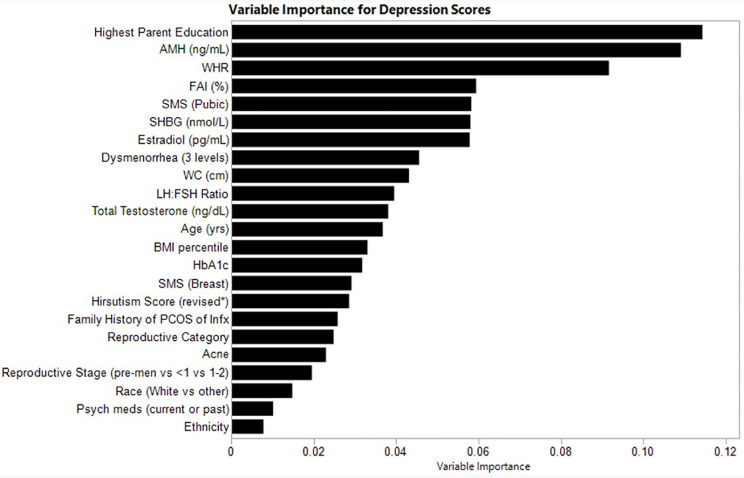
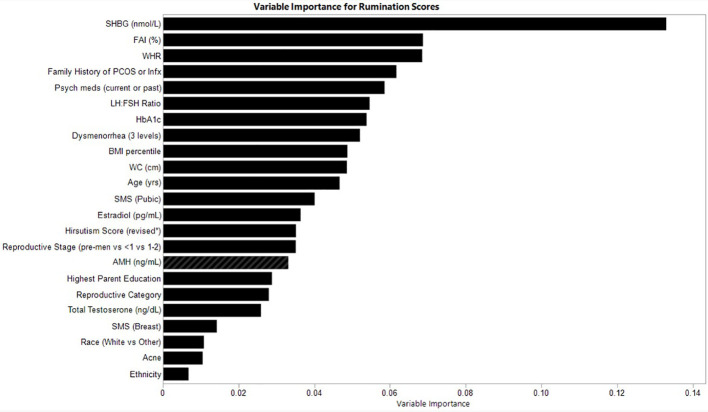
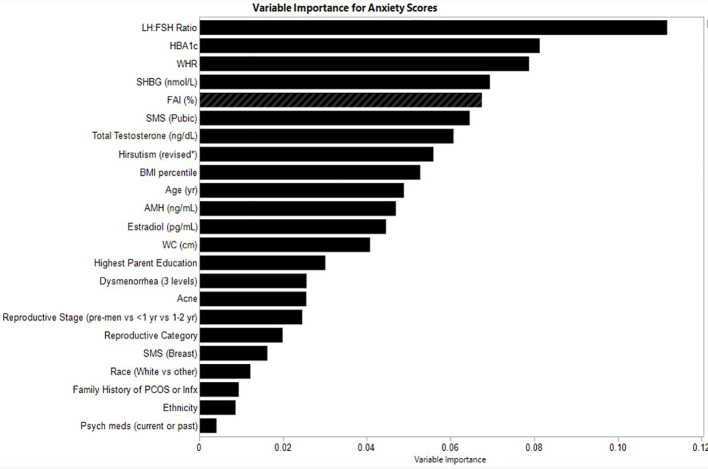
The overall R for depression, anxiety, and rumination from the random forest model were 0.557, 0.555, and 0.597, respectively, suggesting overall good explanatory power for psychological outcomes. Parent education (Portion Sum of Squares (SS) = 11.4%) followed by AMH (Portion SS = 10.9%) and waist-hip-ratio (WHR) (Portion SS = 9.2%) were the most important variables in predicting depression. LH: FSH ratio was the most important variable in the dataset used to differentiate participants along the observed anxiety score continuum (Portion SS = 0.112 (11%) followed by HbA1c (Portion SS = 8.1%) and WHR (Portion SS = 7.9%). SHBG was the most frequently identified variable to differentiate participants reporting rumination (Portion SS = 13.3%) followed by Free Androgen Index (Portion SS = 6.9%) and WHR (Portion SS = 6.9%). Adolescents at high risk for progression to PCOS may already experience psychological vulnerabilities prior to a clinical diagnosis or full manifestation of PCOS. Our study findings highlight PCOS as a lifelong, multifaceted health condition with ramifications earlier than commonly documented.
多囊卵巢综合征(PCOS)与抑郁症和焦虑症的高发病率不成比例相关,这显著损害了生活质量,并给治疗资格和依从性带来问题。本拟议稿件的总体目标是确定初潮前后青少年心理症状的存在和严重程度,以及它们与未来PCOS的公认风险因素之间的关联。
52名初潮前和初潮后早期的参与者进行了非空腹采血,以测量生殖激素(抗苗勒管激素(AMH)、促黄体生成素(LH)、促卵泡生成素(FSH)、总睾酮、性激素结合球蛋白(SHBG)和糖化血红蛋白(HbA1c))、人体测量学指标、月经史(如果是初潮后),并进行了一系列调查,以评估抑郁(儿童抑郁量表(CES-DC))、焦虑(儿童焦虑量表(MASC)),以及作为一种新方法的反刍思维,这是一种跨诊断心理过程,也是心理障碍的早期前驱风险。父母/法定监护人完成了一份人口统计学调查。随机森林分析用于根据该参与者样本中的一组预定变量预测抑郁、焦虑和反刍思维。
随机森林模型对抑郁、焦虑和反刍思维的总体R值分别为0.557、0.555和0.597,表明对心理结果具有总体良好的解释力。预测抑郁的最重要变量是父母教育程度(平方和比例(SS)=11.4%),其次是AMH(SS比例=10.9%)和腰臀比(WHR)(SS比例=9.2%)。在用于沿观察到的焦虑评分连续体区分参与者的数据集中,LH:FSH比值是最重要的变量(SS比例=0.112(11%),其次是HbA1c(SS比例=8.1%)和WHR(SS比例=7.9%)。SHBG是区分报告反刍思维的参与者最常确定的变量(SS比例=13.3%),其次是游离雄激素指数(SS比例=6.9%)和WHR(SS比例=6.9%)。进展为PCOS高风险的青少年在PCOS临床诊断或完全表现之前可能已经经历了心理脆弱性。我们的研究结果强调PCOS是一种终身的、多方面的健康状况,其影响比通常记录的更早。