van Dam Maureen, Krijnen Eva A, Nauta Ilse M, Fuchs Tom A, de Jong Brigit A, Klein Martin, van der Hiele Karin, Schoonheim Menno M, Hulst Hanneke E
MS Center Amsterdam, Anatomy and Neurosciences, Vrije Universiteit Amsterdam, Amsterdam Neuroscience, Amsterdam UMC Location VUmc, Amsterdam, The Netherlands.
Institute of Psychology, Health, Medical and Neuropsychology Unit, Leiden University, Wassenaarseweg 52, Leiden, The Netherlands.
J Neurol. 2024 May;271(5):2195-2206. doi: 10.1007/s00415-024-12227-1. Epub 2024 Feb 26.
The heterogeneous nature of cognitive impairment in people with multiple sclerosis (PwMS) hampers understanding of the underlying mechanisms and developing patient-tailored interventions. We aim to identify and classify cognitive profiles in PwMS, comparing these to cognitive status (preserved versus impaired).
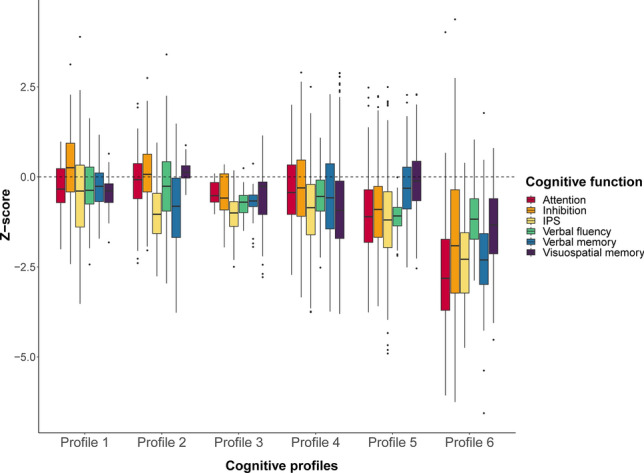
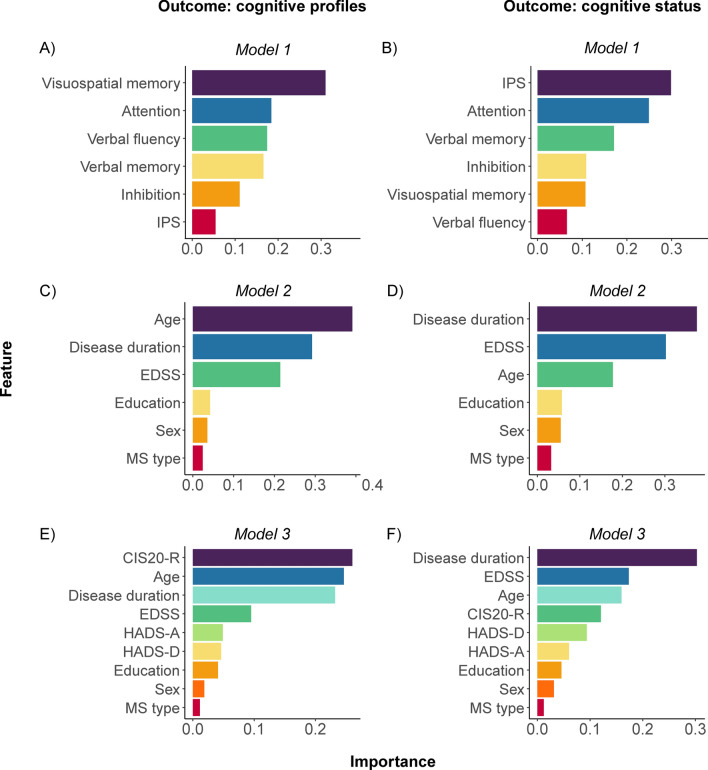
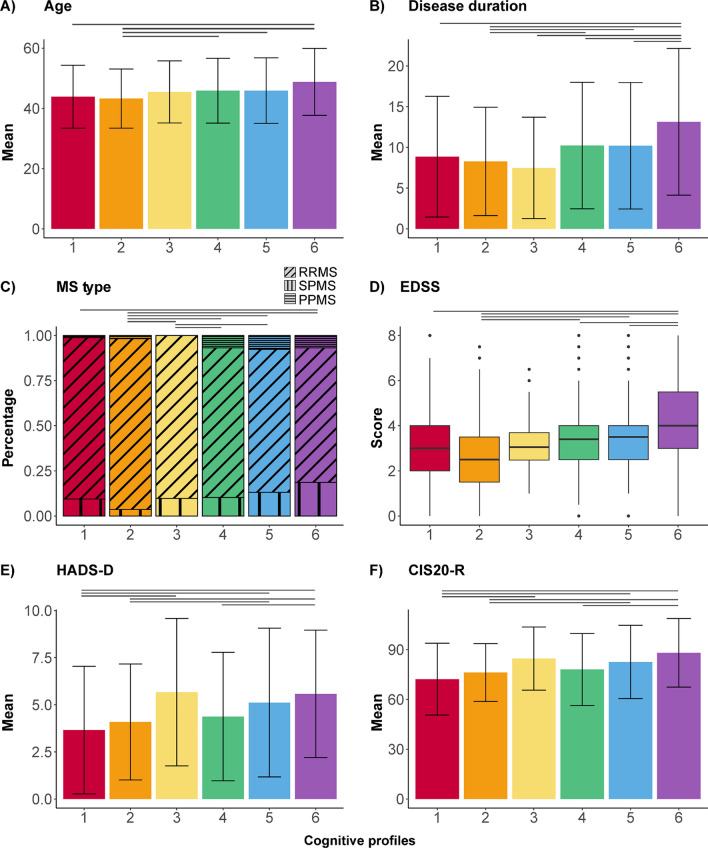
We included 1213 PwMS (72% female, age 45.4 ± 10.7 years, 83% relapsing-remitting MS). Cognitive test scores were converted to Z-scores compared to healthy controls for the functions: attention, inhibition, information processing speed (IPS), verbal fluency and verbal/visuospatial memory. Concerning cognitive status, impaired cognition (CI) was defined as performing at Z ≤ - 1.5 SD on ≥ 2 functions. Cognitive profiles were constructed using latent profile analysis on all cognitive functions. Cognitive profiles or status was classified using gradient boosting decision trees, providing the importance of each feature (demographics, clinical, cognitive and psychological functioning) for the overall classification.
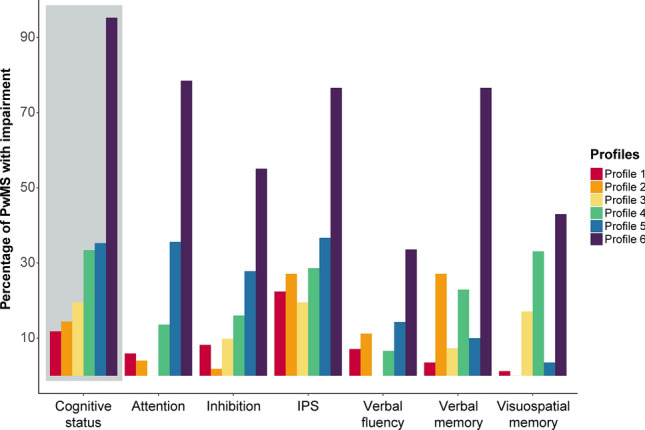
Six profiles were identified, showing variations in overall performance and specific deficits (attention, inhibition, IPS, verbal fluency, verbal memory and visuospatial memory). Across the profiles, IPS was the most impaired function (%CI most preserved profile, Profile 1 = 22.4%; %CI most impaired profile, Profile 6 = 76.6%). Cognitive impairment varied from 11.8% in Profile 1 to 95.3% in Profile 6. Of all cognitive functions, visuospatial memory was most important in classifying profiles and IPS the least (area under the curve (AUC) = 0.910). For cognitive status, IPS was the most important classifier (AUC = 0.997).
This study demonstrated that cognitive heterogeneity in MS reflects a continuum of cognitive severity, distinguishable by distinct cognitive profiles, primarily explained by variations in visuospatial memory functioning.
多发性硬化症患者(PwMS)认知障碍的异质性阻碍了对潜在机制的理解以及制定针对患者的个性化干预措施。我们旨在识别和分类PwMS的认知概况,并将其与认知状态(保留与受损)进行比较。
我们纳入了1213名PwMS(72%为女性,年龄45.4±10.7岁,83%为复发缓解型多发性硬化症)。将认知测试分数与健康对照相比转换为Z分数,涉及的功能包括:注意力、抑制力、信息处理速度(IPS)、语言流畅性和语言/视觉空间记忆。关于认知状态,认知受损(CI)定义为在≥2项功能上Z≤ -1.5标准差。使用所有认知功能的潜在概况分析构建认知概况。使用梯度提升决策树对认知概况或状态进行分类,提供每个特征(人口统计学、临床、认知和心理功能)对总体分类的重要性。
识别出六种概况,显示出总体表现和特定缺陷(注意力、抑制力、IPS、语言流畅性、语言记忆和视觉空间记忆)的差异。在所有概况中,IPS是受损最严重的功能(CI:保留最多的概况,概况1 = 22.4%;CI:受损最严重的概况,概况6 =76.6%)。认知障碍从概况1的11.8%到概况6的95.3%不等。在所有认知功能中,视觉空间记忆在分类概况时最重要,而IPS最不重要(曲线下面积(AUC)= 0.910)。对于认知状态,IPS是最重要的分类器(AUC = 0.997)。
本研究表明,MS中的认知异质性反映了认知严重程度的连续体,可通过不同的认知概况区分,主要由视觉空间记忆功能的差异解释。