Broeders Tommy A A, Douw Linda, Eijlers Anand J C, Dekker Iris, Uitdehaag Bernard M J, Barkhof Frederik, Hulst Hanneke E, Vinkers Christiaan H, Geurts Jeroen J G, Schoonheim Menno M
Department of Anatomy and Neurosciences, MS Center Amsterdam, Amsterdam Neuroscience, Amsterdam UMC, Vrije Universiteit Amsterdam, Amsterdam, The Netherlands.
Department of Neurology, MS Center Amsterdam, Amsterdam Neuroscience, Amsterdam UMC, Vrije Universiteit Amsterdam, Amsterdam, The Netherlands.
Brain Commun. 2022 Apr 12;4(2):fcac095. doi: 10.1093/braincomms/fcac095. eCollection 2022.
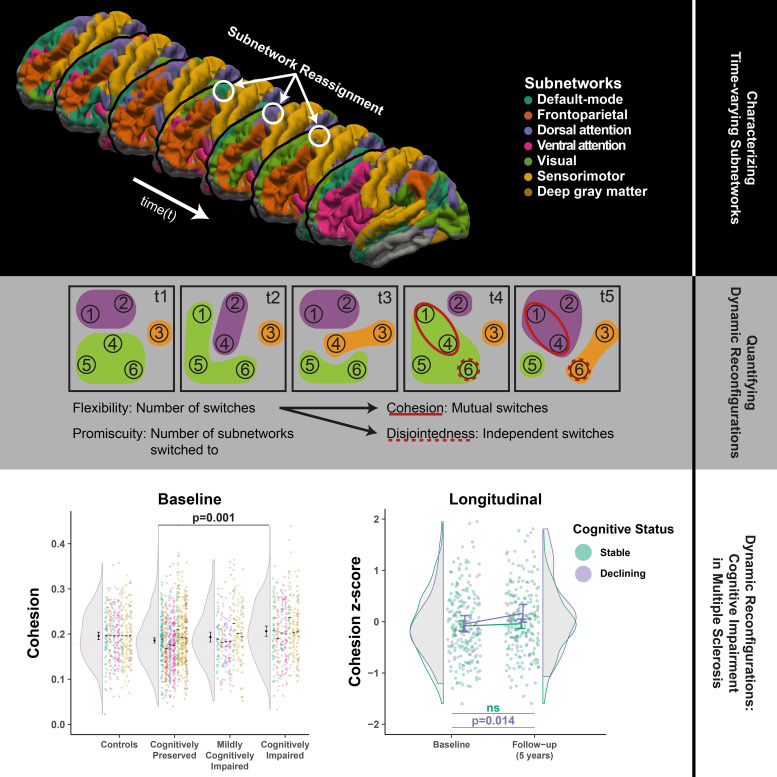
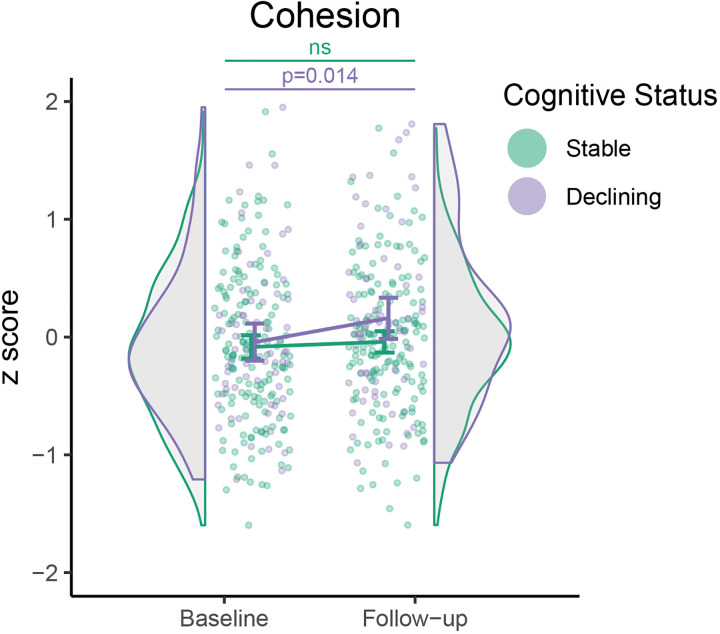
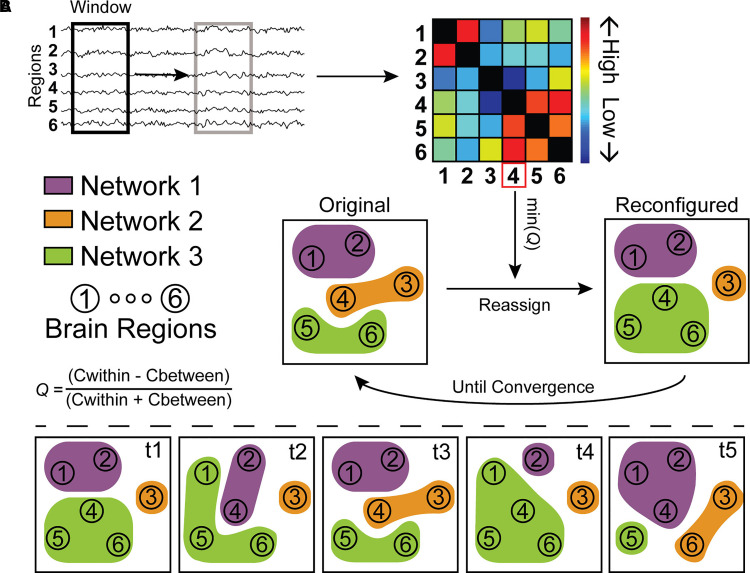
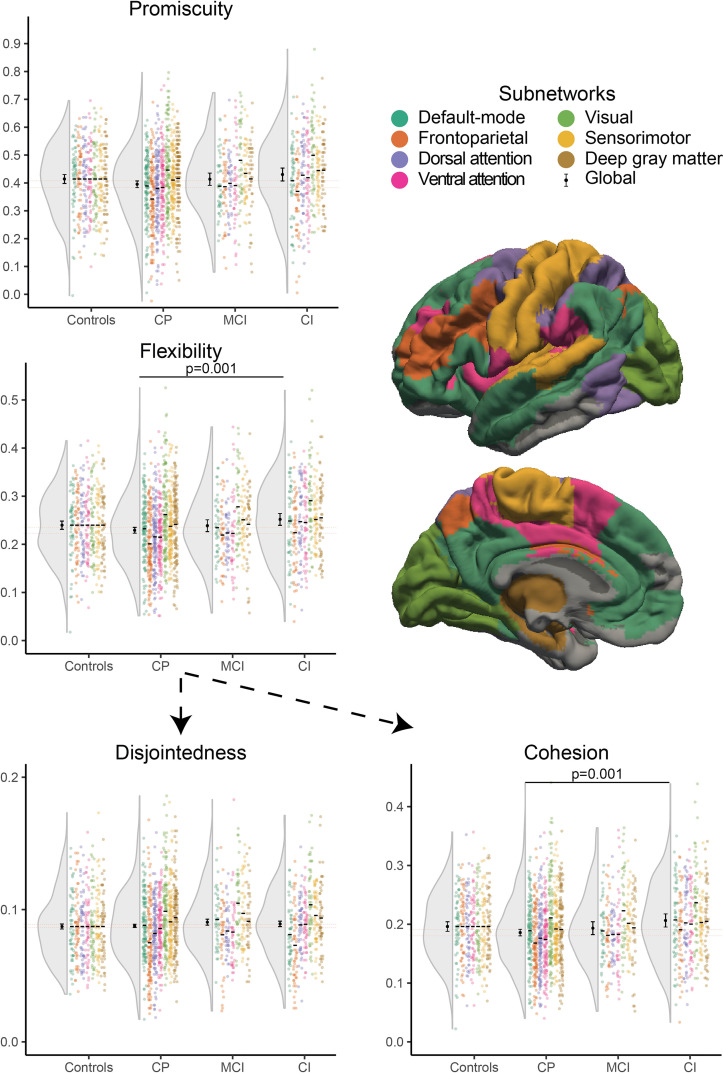
Cognitive impairment is common in people with multiple sclerosis and strongly affects their daily functioning. Reports have linked disturbed cognitive functioning in multiple sclerosis to changes in the organization of the functional network. In a healthy brain, communication between brain regions and which network a region belongs to is continuously and dynamically adapted to enable adequate cognitive function. However, this dynamic network adaptation has not been investigated in multiple sclerosis, and longitudinal network data remain particularly rare. Therefore, the aim of this study was to longitudinally identify patterns of dynamic network reconfigurations that are related to the worsening of cognitive decline in multiple sclerosis. Resting-state functional MRI and cognitive scores (expanded Brief Repeatable Battery of Neuropsychological tests) were acquired in 230 patients with multiple sclerosis and 59 matched healthy controls, at baseline (mean disease duration: 15 years) and at 5-year follow-up. A sliding-window approach was used for functional MRI analyses, where brain regions were dynamically assigned to one of seven literature-based subnetworks. Dynamic reconfigurations of subnetworks were characterized using measures of promiscuity (number of subnetworks switched to), flexibility (number of switches), cohesion (mutual switches) and disjointedness (independent switches). Cross-sectional differences between cognitive groups and longitudinal changes were assessed, as well as relations with structural damage and performance on specific cognitive domains. At baseline, 23% of patients were cognitively impaired (≥2/7 domains < -2) and 18% were mildly impaired (≥2/7 domains < -1.5). Longitudinally, 28% of patients declined over time (0.25 yearly change on ≥2/7 domains based on reliable change index). Cognitively impaired patients displayed more dynamic network reconfigurations across the whole brain compared with cognitively preserved patients and controls, i.e. showing higher promiscuity ( = 0.047), flexibility ( = 0.008) and cohesion ( = 0.008). Over time, cognitively declining patients showed a further increase in cohesion ( = 0.004), which was not seen in stable patients ( = 0.544). More cohesion was related to more severe structural damage (average = 0.166, = 0.015) and worse verbal memory ( = -0.156, = 0.022), information processing speed ( = -0.202, = 0.003) and working memory ( = -0.163, = 0.017). Cognitively impaired multiple sclerosis patients exhibited a more unstable network reconfiguration compared to preserved patients, i.e. brain regions switched between subnetworks more often, which was related to structural damage. This shift to more unstable network reconfigurations was also demonstrated longitudinally in patients that showed cognitive decline only. These results indicate the potential relevance of a progressive destabilization of network topology for understanding cognitive decline in multiple sclerosis.
认知障碍在多发性硬化症患者中很常见,并且严重影响他们的日常功能。报告显示,多发性硬化症患者认知功能紊乱与功能网络结构变化有关。在健康大脑中,脑区之间的通信以及一个区域所属的网络会持续动态调整,以实现适当的认知功能。然而,这种动态网络适应性在多发性硬化症中尚未得到研究,纵向网络数据仍然极为罕见。因此,本研究的目的是纵向识别与多发性硬化症认知衰退恶化相关的动态网络重构模式。对230例多发性硬化症患者和59名匹配的健康对照者在基线期(平均病程:15年)和5年随访期进行静息态功能磁共振成像和认知评分(扩展版简短可重复神经心理测验电池)。采用滑动窗口方法进行功能磁共振成像分析,将脑区动态分配到基于文献的七个子网之一。使用混杂度(切换到的子网数量)、灵活性(切换次数)、凝聚性(相互切换)和不连贯性(独立切换)等指标来表征子网的动态重构。评估了认知组之间的横断面差异和纵向变化,以及与结构损伤和特定认知领域表现的关系。在基线期,23%的患者存在认知障碍(≥2/7个领域<-2),18%的患者存在轻度认知障碍(≥2/7个领域<-1.5)。纵向来看,28%的患者随时间出现衰退(基于可靠变化指数,≥2/7个领域每年变化0.25)。与认知功能正常的患者和对照组相比,认知障碍患者在全脑表现出更多的动态网络重构,即显示出更高的混杂度(=0.047)、灵活性(=0.008)和凝聚性(=0.008)。随着时间推移,认知衰退患者的凝聚性进一步增加(=0.004),而稳定患者则未出现这种情况(=0.544)。更多的凝聚性与更严重的结构损伤(平均=0.166,=0.015)以及更差的言语记忆(= -0.156,=0.022)、信息处理速度(= -0.202,=0.003)和工作记忆(= -0.163,=0.017)相关。与认知功能正常的患者相比,认知障碍的多发性硬化症患者表现出更不稳定的网络重构,即脑区在子网之间的切换更频繁,这与结构损伤有关。仅出现认知衰退的患者在纵向研究中也表现出向更不稳定网络重构的转变。这些结果表明,网络拓扑结构的渐进性不稳定对于理解多发性硬化症的认知衰退可能具有潜在相关性。