Case Western Reserve University School of Medicine, Cleveland, OH, USA.
Department of General Surgery, Cleveland Clinic, 2049 E 100th St, Desk A-100, Cleveland, OH, 44106, USA.
Hernia. 2024 Apr;28(2):637-642. doi: 10.1007/s10029-024-02972-7. Epub 2024 Feb 26.
Heavyweight polypropylene (HWPP) mesh is thought to increase inflammatory response and delay tissue integration compared to mediumweight (MWPP). Reactive fluid volume (i.e., drain output) may be a reasonable surrogate for integration. We hypothesized that daily drain output is higher with HWPP compared to MWPP in open retromuscular ventral hernia repair (VHR).
This is a post-hoc analysis of a multicenter, randomized clinical trial conducted March 2017-April 2019 comparing MWPP and HWPP for VHR. Retromuscular drain output in milliliters was measured at 24-h intervals up to postoperative day seven. Univariate analyses compared differences in daily drain output and time to drain removal. Multivariable analyses compared total drain output and wound morbidity within 30 days and hernia recurrence at 1 year.
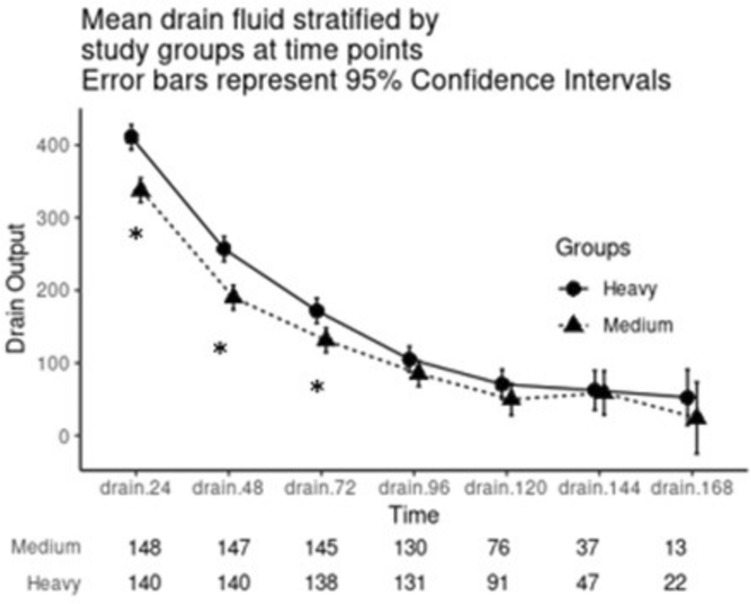
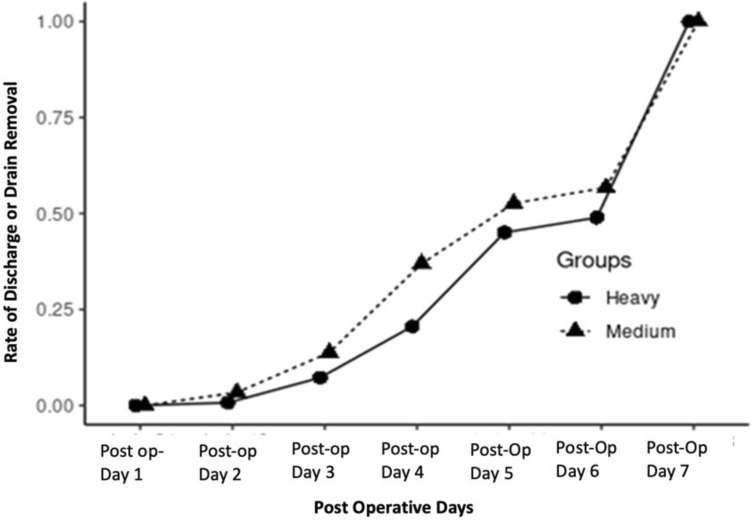
288 patients were included; 140 (48.6%) HWPP and 148 (51.4%) MWPP. Daily drain output for days 1-3 was higher for HWPP vs. MWPP (total volume: 837.8 mL vs. 656.5 mL) (p < 0.001), but similar on days 4-7 (p > 0.05). Median drain removal time was 5 days for both groups. Total drain output was not predictive of 30-day wound morbidity (p > 0.05) or hernia recurrence at 1 year (OR 1, p = 0.29).
While HWPP mesh initially had higher drain outputs, it rapidly returned to levels similar to MWPP by postoperative day three and there was no difference in clinical outcomes. We believe that drains placed around HWPP mesh can be managed similarly to MWPP mesh.
与中重量聚丙烯(MWPP)网片相比,重重量聚丙烯(HWPP)网片被认为会增加炎症反应并延迟组织整合。反应性液体量(即引流液量)可能是整合的合理替代指标。我们假设在开放式腹直肌后腹疝修补术(VHR)中,HWPP 的每日引流量高于 MWPP。
这是 2017 年 3 月至 2019 年 4 月进行的一项多中心、随机临床试验的事后分析,该试验比较了 MWPP 和 HWPP 在 VHR 中的应用。在术后 7 天内,以 24 小时为间隔测量后肌内引流液的毫升数。单变量分析比较了每日引流量和引流管去除时间的差异。多变量分析比较了 30 天内总引流量和伤口发病率以及 1 年内疝复发率。
共纳入 288 例患者,其中 HWPP 组 140 例(48.6%),MWPP 组 148 例(51.4%)。HWPP 与 MWPP 相比,术后第 1-3 天的每日引流量较高(总量:837.8ml 比 656.5ml)(p<0.001),但第 4-7 天相似(p>0.05)。两组引流管拔除时间的中位数均为 5 天。总引流量与 30 天伤口发病率(p>0.05)或 1 年疝复发无相关性(OR1,p=0.29)。
虽然 HWPP 网片最初的引流量较高,但在术后第 3 天迅速恢复到与 MWPP 相似的水平,且临床结果无差异。我们认为 HWPP 网片周围放置的引流管可以与 MWPP 网片的管理方式相似。