Lim Tong Wah, Huang Shi, Jiang Yuesong, Zhang Yufeng, Burrow Michael Francis, McGrath Colman
Division of Restorative Dental Sciences, Faculty of Dentistry, The University of Hong Kong, Hong Kong SAR, China.
Division of Applied Oral Sciences and Community Dental Care, Faculty of Dentistry, The University of Hong Kong, Hong Kong SAR, China.
J Oral Microbiol. 2024 Feb 22;16(1):2317059. doi: 10.1080/20002297.2024.2317059. eCollection 2024.
The microbiomes on the surface of unclean removable prostheses are complex and yet largely underexplored using metagenomic sequencing technology.
To characterize the microbiome of removable prostheses with different levels of cleanliness using Type IIB Restriction-site Associated DNA for Microbiome (2bRAD-M) sequencing and compare the Microbial Index of Pathogenic Bacteria (MIP) between clean and unclean prostheses.
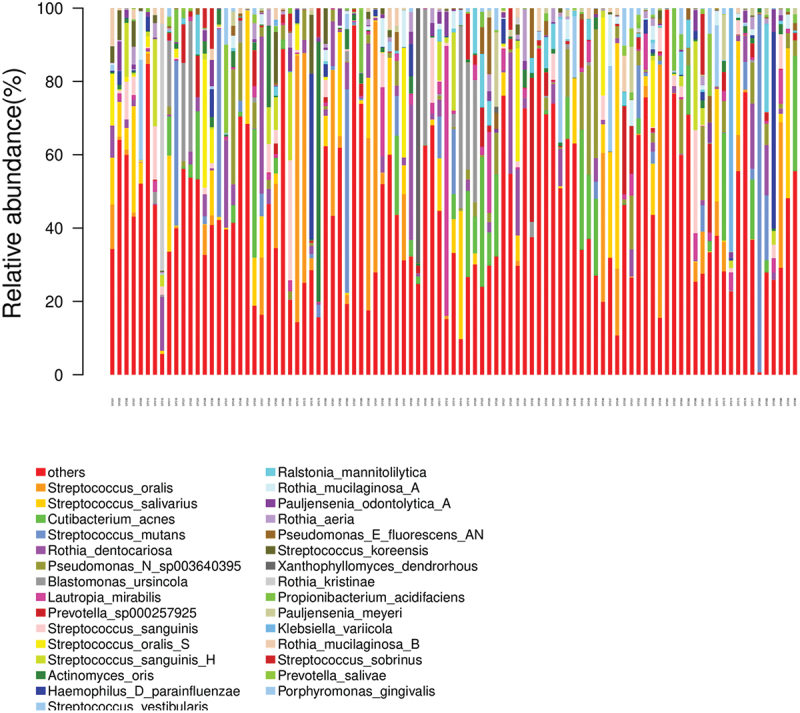
Ninety-seven removable prostheses were classified into 'clean' and 'unclean' groups. All prosthesis plaque samples underwent 2bRAD metagenomic sequencing to characterize the species-resolved microbial composition. MIPs for clean and unclean prostheses were calculated based on the sum of the relative abundance of pathogenic bacteria in a microbiome using a reference database that contains opportunistic pathogenic bacteria and disease-associated information.
Beta diversity analyses based on Jaccard qualitative and Bray-Curtis quantitative distance matrices identified significant differences between the two groups ( < 0.05). There was a significant enrichment of many pathogenic bacteria in the unclean prosthesis group. The MIP for unclean prostheses (0.47 ± 0.25) was significantly higher than for clean prostheses (0.37 ± 0.29), = 0.029.
The microbial community of plaque samples from 'unclean' prostheses demonstrated compositional differences compared with 'clean' prostheses. In addition, the pathogenic microbiome in the 'unclean' versus 'clean' group differed.
不洁可摘义齿表面的微生物群落复杂,但使用宏基因组测序技术对其进行的研究仍很有限。
使用微生物组IIB型限制性位点相关DNA测序(2bRAD-M)来表征不同清洁程度的可摘义齿的微生物群落,并比较清洁和不洁义齿之间的病原菌微生物指数(MIP)。
97个可摘义齿被分为“清洁”组和“不洁”组。所有义齿菌斑样本均进行2bRAD宏基因组测序,以表征物种解析的微生物组成。使用包含机会性病原菌和疾病相关信息的参考数据库,根据微生物组中病原菌相对丰度的总和计算清洁和不洁义齿的MIP。
基于Jaccard定性和Bray-Curtis定量距离矩阵的β多样性分析表明,两组之间存在显著差异(<0.05)。不洁义齿组中许多病原菌显著富集。不洁义齿的MIP(0.47±0.25)显著高于清洁义齿(0.37±0.29),P=0.029。
“不洁”义齿菌斑样本的微生物群落与“清洁”义齿相比存在组成差异。此外,“不洁”组与“清洁”组中的病原菌微生物群也有所不同。