Braisted John, Henderson Theresa, Newman John W, Moore Steven C, Sampson Joshua, McClain Kathleen, Ross Sharon, Baer David J, Mathé Ewy A, Zanetti Krista A
Division of Preclinical Innovation, National Center for Advancing Translational Sciences, Rockville, MD.
Food Components and Health Laboratory, Agriculture Research Service, United States Department of Agriculture, Beltsville, MD.
medRxiv. 2024 Jan 25:2024.01.24.24301735. doi: 10.1101/2024.01.24.24301735.
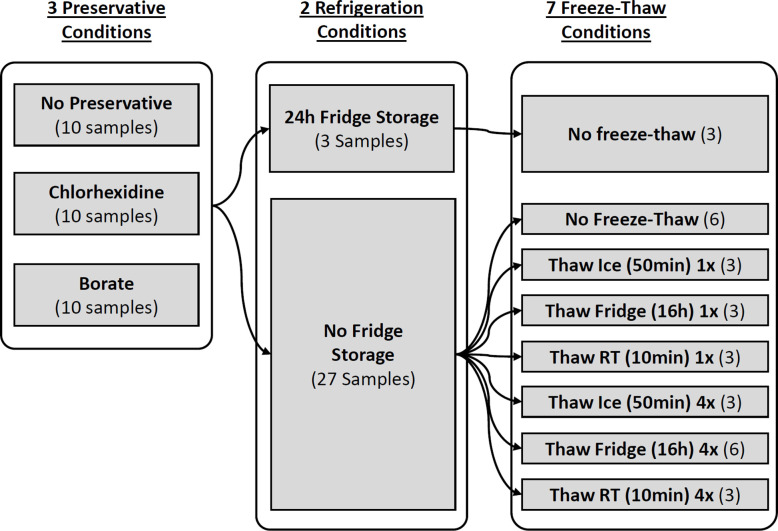
Epidemiology studies evaluate associations between the metabolome and disease risk. Urine is a common biospecimen used for such studies due to its wide availability and non-invasive collection. Evaluating the robustness of urinary metabolomic profiles under varying preanalytical conditions is thus of interest. Here we evaluate the impact of sample handling conditions on urine metabolome profiles relative to the gold standard condition (no preservative, no refrigeration storage, single freeze thaw). Conditions tested included the use of borate or chlorhexidine preservatives, various storage and freeze/thaw cycles. We demonstrate that sample handling conditions impact metabolite levels, with borate showing the largest impact with 125 of 1,048 altered metabolites (adjusted P < 0.05). When simulating a case-control study with expected inconsistencies in sample handling, we predicted the occurrence of false positive altered metabolites to be low (< 11). Predicted false positives increased substantially (³63) when cases were simulated to undergo alternate handling. Finally, we demonstrate that sample handling impacts on the urinary metabolome were markedly smaller than those in serum. While changes in urine metabolites incurred by sample handling are generally small, we recommend implementing consistent handling conditions and evaluating robustness of metabolite measurements for those showing significant associations with disease outcomes.
流行病学研究评估代谢组与疾病风险之间的关联。尿液因其广泛可得性和非侵入性采集,是此类研究常用的生物样本。因此,评估不同分析前条件下尿液代谢组学特征的稳健性很有意义。在此,我们相对于金标准条件(无防腐剂、无冷藏储存、单次冻融)评估样本处理条件对尿液代谢组特征的影响。测试的条件包括使用硼酸盐或洗必泰防腐剂、各种储存和冻融循环。我们证明样本处理条件会影响代谢物水平,硼酸盐的影响最大,1048种代谢物中有125种发生改变(校正P<0.05)。当模拟样本处理存在预期不一致的病例对照研究时,我们预测假阳性改变代谢物的发生率较低(<11)。当模拟病例采用替代处理时,预测的假阳性大幅增加(≥63)。最后,我们证明样本处理对尿液代谢组的影响明显小于血清。虽然样本处理引起的尿液代谢物变化通常较小,但我们建议采用一致的处理条件,并评估那些与疾病结局显示出显著关联的代谢物测量的稳健性。