Faculty of Social Sciences, University of Helsinki, Helsinki, Finland.
Centre for Public Health, Queen's University Belfast, Belfast, Northern Ireland.
BMC Health Serv Res. 2024 Feb 27;24(1):252. doi: 10.1186/s12913-024-10728-3.
The compounded effect of a migratory background and ageing increases the risk of unequal medical treatment opportunities. The aim of this article is to investigate the social determinants of barriers to health services.
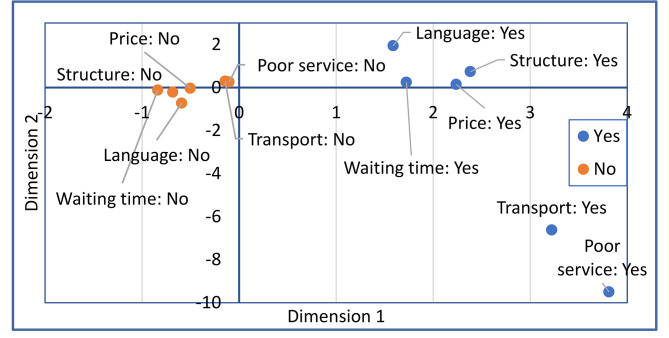
The study uses population-based survey data of Russian-speaking migrants (50 + years) residing in Finland (n = 1082, 57% of men, mean age 63 years). Multiple correspondence analysis was performed as a dimension reduction procedure on six barriers to health services. Multiple ordinary least-squares linear regression was used for the predicted score of the barriers as an outcome variable.
Most of the sociodemographic characteristics were not associated with barriers to health services, except gender, as women tended to face more disadvantages. Migration-related factors, such as the need for interpreters for health services and experienced discrimination, were associated with an increased likelihood of reporting barriers to health services. Using the internet as a primary source of health information was associated with more access barriers to health services.
Migrants 50 years of age or older face multiple barriers to health services. Given that the healthcare needs increase with age, addressing this issue becomes crucial, necessitating improved access to health services for older migrants.
迁移背景和老龄化的综合影响增加了获得不平等医疗机会的风险。本文旨在探讨卫生服务障碍的社会决定因素。
本研究使用了居住在芬兰的俄语移民(50 岁以上)的基于人口的调查数据(n=1082,其中 57%为男性,平均年龄 63 岁)。采用多元对应分析对 6 项卫生服务障碍进行降维处理。采用多元普通最小二乘法线性回归分析作为因变量的障碍预测评分。
除性别外,大多数社会人口学特征与卫生服务障碍无关,女性往往面临更多的劣势。与移民相关的因素,如卫生服务口译的需求和经历的歧视,与报告卫生服务障碍的可能性增加有关。将互联网作为主要的健康信息来源与更多的卫生服务获取障碍有关。
50 岁及以上的移民面临多种卫生服务障碍。鉴于随着年龄的增长医疗需求增加,解决这个问题变得至关重要,需要改善老年移民获得卫生服务的机会。