Clinical Research Center, Shanghai General Hospital, Shanghai Jiao Tong University School of Medicine, Shanghai, 200080, People's Republic of China.
Department of Ophthalmology, Shanghai General Hospital, Shanghai Jiao Tong University School of Medicine; Shanghai Key Laboratory of Ocular Fundus Diseases, Shanghai General Hospital, Shanghai Engineering Center for Visual Science and Photomedicine, Shanghai, 200040, People's Republic of China.
Int J Nanomedicine. 2024 Feb 23;19:1887-1908. doi: 10.2147/IJN.S446425. eCollection 2024.
Since intrinsic ocular barrier limits the intraocular penetration of therapeutic protein through eye drops, repeated intravitreal injections of anti-vascular endothelial growth factor (anti-VEGF) agents are the standard therapy for neovascular age-related macular degeneration (nAMD), which are highly invasive and may cause particular ocular complications, leading to poor patient compliance.
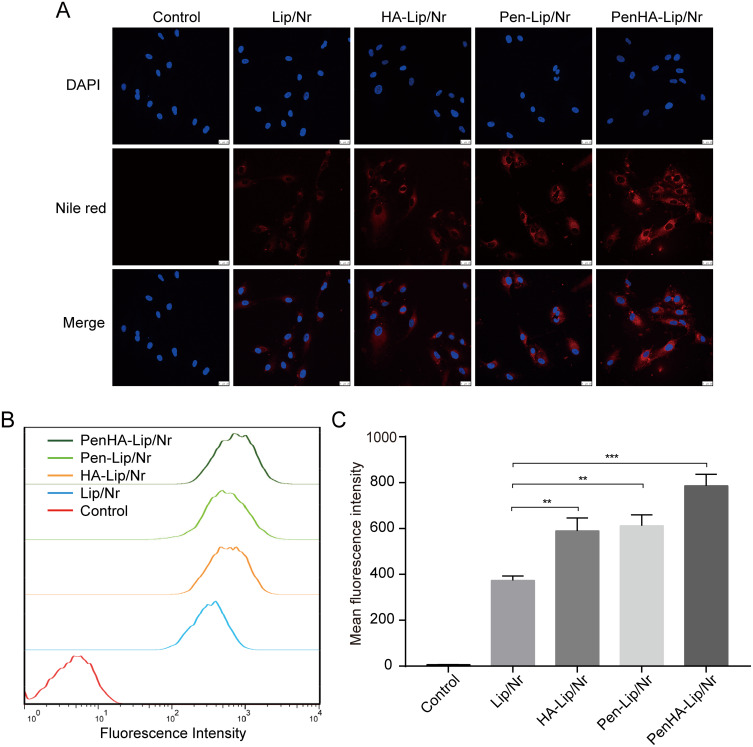
Using Penetratin (Pen) as the ocular penetration enhancer and hyaluronic acid (HA) as the retina-targeting ligand, a dual-modified ophthalmic liposome (Penetratin hyaluronic acid-liposome/Conbercept, PenHA-Lip/Conb) eye drop was designed to non-invasively penetrate the ocular barrier and deliver anti-VEGF therapeutic agents to the targeted intraocular tissue.
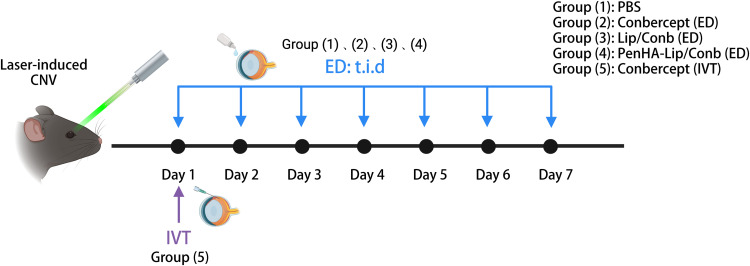
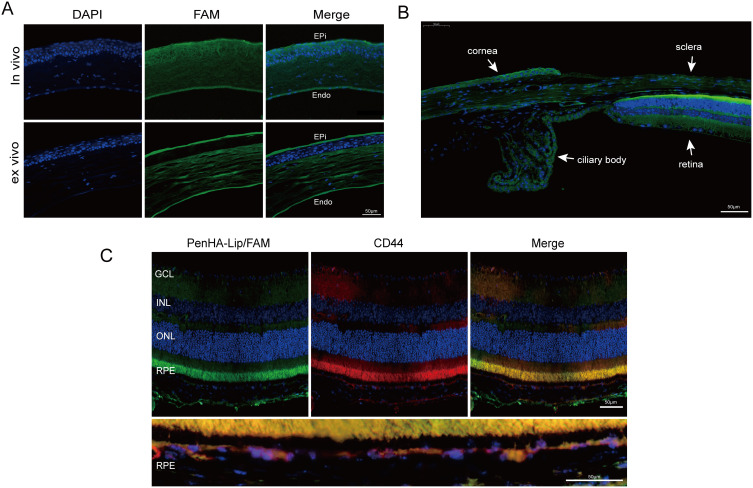
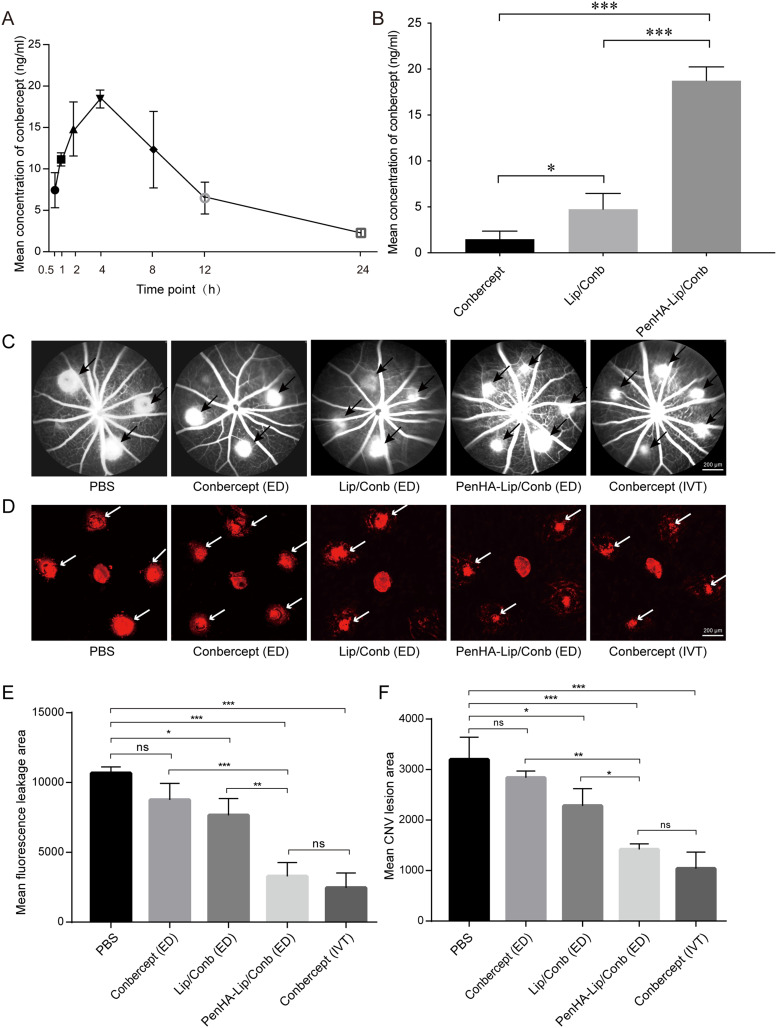
PenHA-Lip effectively penetrates the ocular barrier and targets the retinal pigment epithelium via corneal and non-corneal pathways. After a single topical administration of conbercept-loaded PenHA-Lip (PenHA-Lip/Conb), the intraocular concentration of conbercept peaked at 18.74 ± 1.09 ng/mL at 4 h, which is 11.55-fold higher than unmodified conbercept. In a laser-induced choroidal neovascularization (CNV) mouse model, PenHA-Lip/Conb eye drops three times daily for seven days inhibited CNV formation and progression without any significant tissue toxicity and achieved an equivalent effect to a single intravitreal conbercept injection.
PenHA-Lip efficiently and safely delivered conbercept to the posterior eye segment and may be a promising noninvasive therapeutic option for nAMD.
由于眼内固有屏障限制了治疗性蛋白通过滴眼液进入眼内,因此,抗血管内皮生长因子(anti-VEGF)药物的重复玻璃体内注射是治疗新生血管性年龄相关性黄斑变性(nAMD)的标准疗法,但其具有高度侵袭性,可能引起特殊的眼部并发症,导致患者顺应性差。
使用穿透肽(Pen)作为眼部穿透增强剂,透明质酸(HA)作为视网膜靶向配体,设计了一种双重修饰的眼科脂质体(穿透肽透明质酸脂质体/康柏西普,PenHA-Lip/Conb)滴眼剂,以非侵入性方式穿透眼屏障,并将抗 VEGF 治疗药物递送至靶向眼内组织。
PenHA-Lip 可有效穿透眼屏障,并通过角膜和非角膜途径靶向视网膜色素上皮细胞。单次局部给予载康柏西普的 PenHA-Lip(PenHA-Lip/Conb)后,康柏西普的眼内浓度在 4 小时时达到 18.74±1.09ng/mL,是未修饰康柏西普的 11.55 倍。在激光诱导脉络膜新生血管(CNV)小鼠模型中,PenHA-Lip/Conb 滴眼剂每日三次,连续 7 天,可抑制 CNV 形成和进展,且无明显组织毒性,与单次玻璃体内注射康柏西普的效果相当。
PenHA-Lip 可有效且安全地将康柏西普递送至眼后段,可能是治疗 nAMD 的一种有前途的非侵入性治疗选择。