Instituto de Efectividad Clínica y Sanitaria (IECS), Institute for Clinical Efectiveness and Health Policy (IECS), Buenos Aires, Argentina.
Consejo Nacional de Investigaciones Científicas y Técnicas (CONICET), Buenos Aires, Argentina.
Front Public Health. 2024 Feb 12;11:1321319. doi: 10.3389/fpubh.2023.1321319. eCollection 2023.
Tobacco use has significant health consequences in Latin America, and while studies have examined the overall impact, the gender-specific effects have not been thoroughly researched. Understanding these differences is crucial for effective tobacco control policies. The objective of this study was to explore the differences in tobacco-attributable disease and economic burden between men and women in Argentina, Brazil, Chile, Colombia, Costa Rica, Ecuador, Mexico, and Peru.
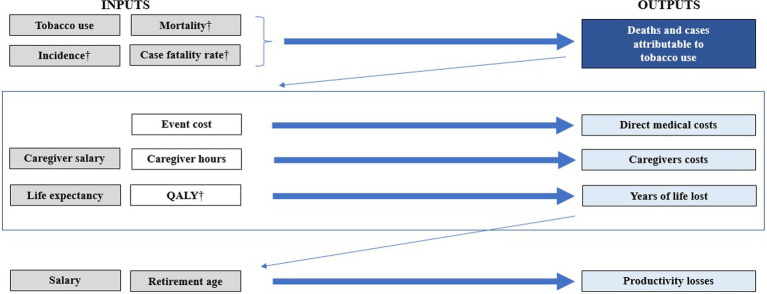
We used a previously validated economic model to quantify the impact of tobacco-related illnesses, including morbidity, mortality, healthcare costs, productivity losses, informal care expenses, and DALYs, by gender and age. We utilized data from national surveys, records, studies, and expert opinions to populate the model.
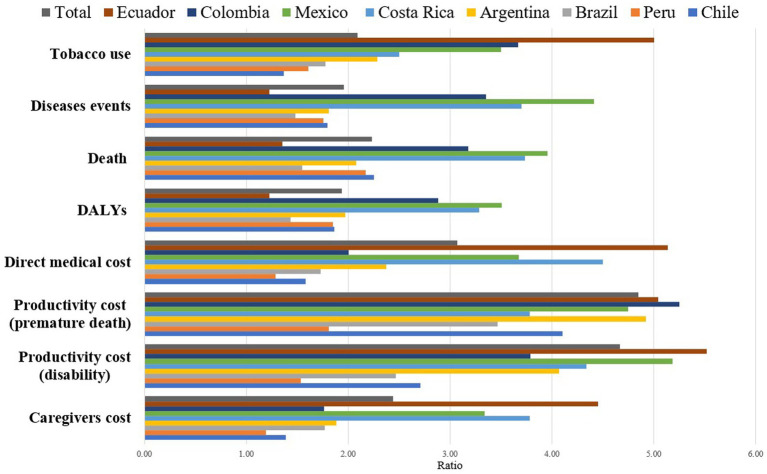
In 2020, there were 351,000 smoking-attributable deaths. Men accounted for 69% and women 31%. Ecuador and Mexico had the highest male-to-female death ratio, while Peru and Chile had the smallest disparities. 2.3 million tobacco-related disease events occurred, with 65% in men and 35% in women. Ecuador and Mexico had higher disease rates among men, while Peru had a more balanced ratio. Regarding DALYs, men lost 6.3 million due to tobacco, while women lost 3.3 million, primarily from COPD, cardiovascular disease, and cancer. Brazil and Mexico had the highest DALY losses for both genders. Costa Rica had a lower male-to-female tobacco use prevalence ratio but ranked second in deaths, disease events, and DALYs attributed to tobacco. Colombia had a unique pattern with a male-to-female death ratio of 2.08 but a higher ratio for disease events. The health systems spent $22.8 billion to treat tobacco-attributable diseases, with a male-to-female cost ratio 2.15. Ecuador showed the greatest gender cost difference, while Peru had the lowest. Productivity loss due to tobacco was $16.2 billion, with Ecuador and Mexico exhibiting the highest gender disparities and Peru the lowest. Informal care costs amounted to $10.8 billion, with men incurring higher costs in Ecuador, Costa Rica, and Mexico.
Tobacco causes significant health and economic burdens in Latin America, with gender-based differences. There is a need for gender-disaggregated data to improve tobacco control policies.
在拉丁美洲,烟草使用对健康有重大影响,虽然已有研究考察了整体影响,但对性别特异性影响尚未进行彻底研究。了解这些差异对于有效的烟草控制政策至关重要。本研究旨在探讨阿根廷、巴西、智利、哥伦比亚、哥斯达黎加、厄瓜多尔、墨西哥和秘鲁男女之间在烟草相关疾病和经济负担方面的差异。
我们使用先前经过验证的经济模型,按性别和年龄量化了与烟草相关的疾病(包括发病率、死亡率、医疗保健费用、生产力损失、非正式护理费用和 DALY)的影响。我们利用国家调查、记录、研究和专家意见的数据来填充模型。
2020 年,有 35.1 万人死于吸烟。男性占 69%,女性占 31%。厄瓜多尔和墨西哥的男性与女性死亡率比值最高,而秘鲁和智利的性别差异最小。发生了 230 万例与烟草相关的疾病事件,其中 65%发生在男性,35%发生在女性。厄瓜多尔和墨西哥的男性发病率较高,而秘鲁的性别比例更为均衡。就 DALY 而言,男性因烟草丧失了 630 万生命年,而女性丧失了 330 万生命年,主要是由于 COPD、心血管疾病和癌症。巴西和墨西哥的两性 DALY 损失最高。哥斯达黎加的男性与女性烟草使用率比值较低,但在死亡、疾病事件和与烟草相关的 DALY 方面排名第二。哥伦比亚的模式较为独特,男性与女性的死亡率比值为 2.08,但疾病事件的比值更高。卫生系统花费 228 亿美元用于治疗与烟草相关的疾病,男性与女性的成本比值为 2.15。厄瓜多尔的性别成本差异最大,而秘鲁的性别成本差异最小。烟草导致的生产力损失为 162 亿美元,厄瓜多尔和墨西哥的性别差异最大,秘鲁的性别差异最小。非正式护理费用为 108 亿美元,厄瓜多尔、哥斯达黎加和墨西哥的男性护理费用较高。
烟草在拉丁美洲造成了重大的健康和经济负担,存在性别差异。需要有按性别分类的数据来改进烟草控制政策。