Epidemiology Branch, National Institute of Environmental Health Sciences, National Institutes of Health, Department of Health and Human Services, Research Triangle Park, North Carolina, USA.
Social & Scientific Systems, Inc., a DLH Holdings Company, Durham, North Carolina, USA.
Environ Health Perspect. 2024 Feb;132(2):27013. doi: 10.1289/EHP13183. Epub 2024 Feb 28.
Studies are increasingly examining the relationship between the neighborhood environment and cognitive decline; yet, few have investigated associations between multiple neighborhood features and Alzheimer's disease and related dementias (ADRD).
We investigated the relationship between neighborhood features and ADRD cumulative incidence from 2010 to 2014 in the South Carolina Alzheimer's Disease Registry (SCADR).
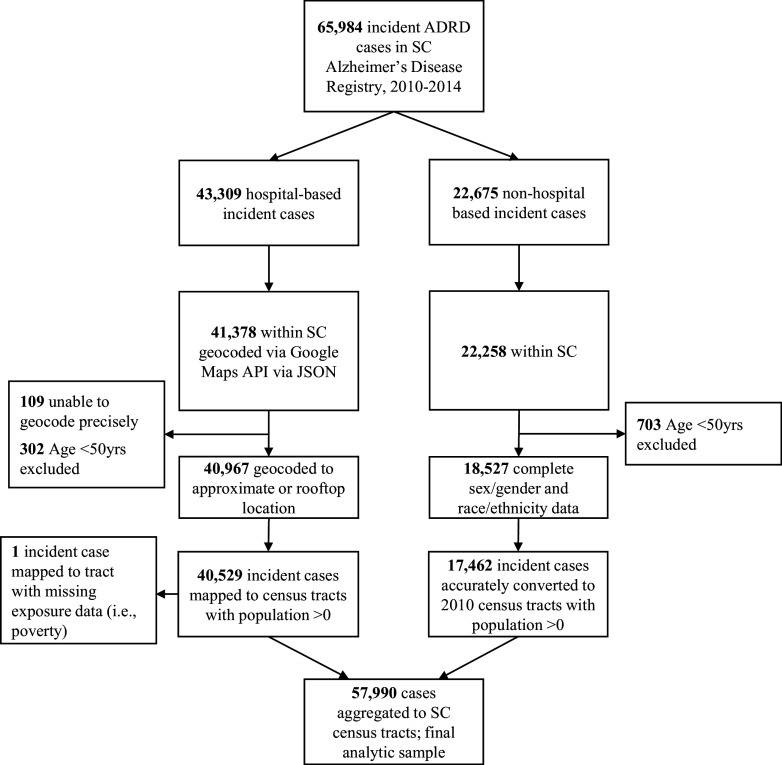
Diagnosed ADRD cases of age were ascertained from the SCADR by ZIP code and census tract. Neighborhood features from multiple secondary sources included poverty, air pollution [particulate matter with a diameter of 2.5 micrometers or less ()], and rurality at the census-tract level and access to healthy food, recreation facilities, and diabetes screening at the county level. In addition to using Poisson generalized linear regression to estimate ADRD incident rate ratios (IRR) with 95% confidence intervals (CIs), we applied integrated nested Laplace approximations and stochastic partial differential equations (INLA-SPDE) to address disparate spatial scales. We estimated associations between neighborhood features and ADRD cumulative incidence.
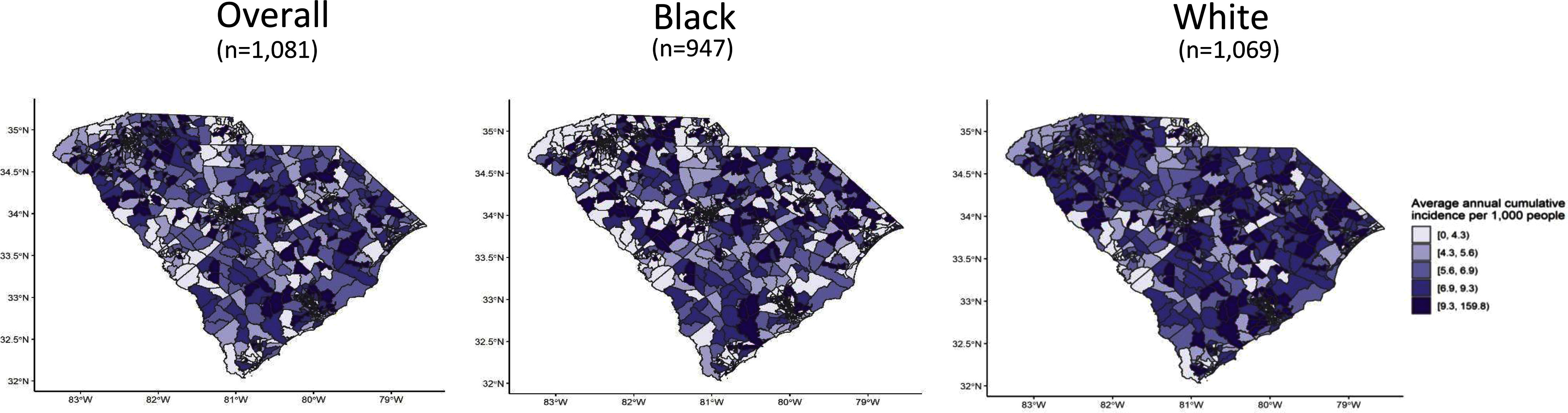
The average annual ADRD cumulative incidence was 690 per 100,000 people per census tract (95% CI: 660, 710). The analysis was limited to 98% of census tracts with a population old (i.e., 1,081 of 1,103). The average percent of families living below the federal poverty line per census tract was 18.8%, and of census tracts were considered rural. The average percent of households with limited access to healthy food was 6.4%. In adjusted models, every ) increase of was associated with 65% higher ADRD cumulative incidence (; 95% CI: 1.30, 2.09), where at or below is considered healthy. Compared to large urban census tracts, rural and small urban tracts had 10% (; 95% CI: 1.00, 1.23) and 5% (; 95% CI: 0.96, 1.16) higher ADRD, respectively. For every percent increase of the county population with limited access to healthy food, ADRD was 2% higher (; 95% CI: 1.01, 1.04).
Neighborhood environment features, such as higher air pollution levels, were associated with higher neighborhood ADRD incidence. The INLA-SPDE method could have broad applicability to data collected across disparate spatial scales. https://doi.org/10.1289/EHP13183.
越来越多的研究正在检验邻里环境与认知能力下降之间的关系;然而,很少有研究调查多个邻里特征与阿尔茨海默病和相关痴呆症(ADRD)之间的关联。
我们调查了 2010 年至 2014 年南卡罗来纳州阿尔茨海默病登记处(SCADR)中邻里特征与 ADRD 累积发病率之间的关系。
通过邮政编码和普查地段确定年龄在诊断出 ADRD 的病例。来自多个次要来源的邻里特征包括贫困、空气污染[直径 2.5 微米或以下的颗粒物()]和农村地区在普查地段层面以及获得健康食品、娱乐设施和糖尿病筛查在县级层面。除了使用泊松广义线性回归来估计具有 95%置信区间(CI)的 ADRD 发病率比(IRR)外,我们还应用集成嵌套拉普拉斯近似法和随机偏微分方程(INLA-SPDE)来解决不同的空间尺度。我们估计了邻里特征与 ADRD 累积发病率之间的关联。
每个普查地段每年平均有 690 例 ADRD 累积发病率为每 100,000 人(95%CI:660,710)。分析仅限于人口超过 1081 岁的 98%的普查地段(即 1,103 个中的 1,081 个)。每个普查地段的平均贫困家庭百分比为 18.8%, 为农村地区。平均每 6.4%的家庭难以获得健康食品。在调整后的模型中,每增加 10 微克/立方米的 与 ADRD 累积发病率增加 65%相关( ;95%CI:1.30,2.09),其中 或以下被认为是健康的。与大型城市普查地段相比,农村和小型城市普查地段的 ADRD 分别高出 10%( ;95%CI:1.00,1.23)和 5%( ;95%CI:0.96,1.16)。每个县级人口中难以获得健康食品的百分比增加 1%,ADRD 增加 2%( ;95%CI:1.01,1.04)。
邻里环境特征,如更高的空气污染水平,与更高的邻里 ADRD 发病率有关。INLA-SPDE 方法可能具有广泛的适用性,可以应用于在不同空间尺度上收集的数据。https://doi.org/10.1289/EHP13183.