Healthcare, Ipsos MORI UK, London, UK
Epidemiology and Population Health, London School of Hygiene & Tropical Medicine, London, UK.
BMJ Open. 2024 Feb 28;14(2):e063138. doi: 10.1136/bmjopen-2022-063138.
The aim of the research was to understand what drives and motivates young women living with HIV in their treatment journeys, as well as their key influencers. The findings will assist in appreciating their obstacles to treatment and constructing the most effective ways to convey fresh messages to them. These insights will contribute to the messaging developed for a campaign across sub-Saharan Africa, primarily Malawi and Zimbabwe.
This was a qualitative study conducted in order to build an understanding of unknown parts of the HIV treatment journey through in-depth interviews. A hybrid approach was used to conduct thematic analysis.
Study participants were HIV-positive women, their influencers (eg, parents/partners/siblings/aunts and uncles/religious leaders, etc) and healthcare providers from a range of regions in Zimbabwe and Malawi.
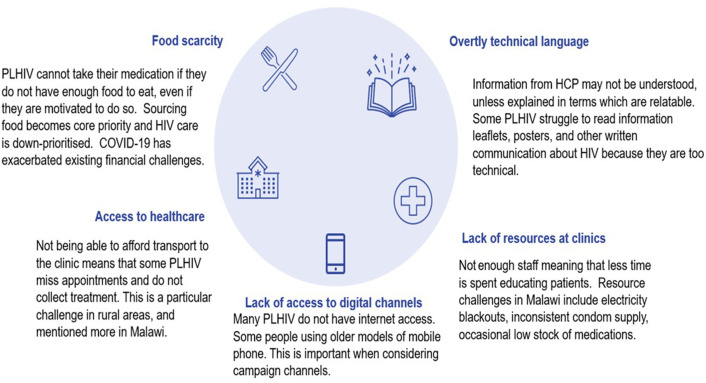
A total of 26 young people living with HIV (PLHIV), 29 healthcare providers and 24 influencers such as maternal figures in the community were interviewed. Two main broad insights were drawn, that is, key needs and wider contextual factors. The key needs of young PLHIV to stay on treatment were empathy, support and emotional connection with antiretroviral therapy (ART), while the wider contextual factors impacting their treatment journeys were structural challenges and cultural reference points. Fear of shame and humiliation can also be significant barriers to disclosure and treatment. The fear predisposes the PLHIV to the need for empathy, support and connection with ART. Mental health and anxiety appear to be comorbid with HIV. Some PLHIV have a small and limited support network leading to very few people living openly with HIV. There is no 'one-size-fits-all' approach, and maximising campaign reach will likely need a multifaceted approach.
Currently, the relationship between nurses and PLHIV can appear to be transactional. Through learning about the community (including PLHIV), there are more chances of communicating in a way that resonates.
本研究旨在了解感染 HIV 的年轻女性在治疗过程中的动力和动机,以及她们的关键影响因素。研究结果将有助于了解她们在治疗过程中面临的障碍,并构建向她们传达新信息的最有效方式。这些见解将有助于为撒哈拉以南非洲(主要是马拉维和津巴布韦)的一项运动制定信息传递策略。
这是一项定性研究,旨在通过深入访谈来了解 HIV 治疗过程中未知的部分。采用混合方法进行主题分析。
研究参与者包括来自津巴布韦和马拉维多个地区的 HIV 阳性女性、她们的影响者(如父母/伴侣/兄弟姐妹/阿姨和叔叔/宗教领袖等)以及医疗保健提供者。
共采访了 26 名感染 HIV 的年轻人(PLHIV)、29 名医疗保健提供者和 24 名影响者,如社区中的母亲形象。得出了两个主要的广泛见解,即关键需求和更广泛的背景因素。年轻 PLHIV 继续接受治疗的关键需求是与抗逆转录病毒治疗(ART)保持同理心、支持和情感联系,而影响他们治疗过程的更广泛背景因素是结构挑战和文化参照点。对羞耻和羞辱的恐惧也可能是披露和治疗的重大障碍。这种恐惧使 PLHIV 需要同理心、支持和与 ART 的联系。心理健康和焦虑似乎与 HIV 同时存在。一些 PLHIV 的支持网络很小且有限,导致很少有人公开感染 HIV。没有“一刀切”的方法,最大限度地扩大运动覆盖面可能需要采取多方面的方法。
目前,护士与 PLHIV 之间的关系似乎是交易性的。通过了解社区(包括 PLHIV),有更多机会以共鸣的方式进行沟通。