Kristiansen Steinar, Jarmund Anders Hagen, Hilmo Jonas, Mollnes Tom Eirik, Leth-Olsen Martin, Nyrnes Siri Ann, Nilsen Bent Aksel, Grønli Renathe Henriksen, Faldaas Bjørn Ove, Storm Benjamin, Espenes Arild, Nielsen Erik Waage
Department of Surgery, Nordland Hospital, Bodø, Norway.
Institute of Clinical Medicine, University of Tromsø, Tromsø, Norway.
JB JS Open Access. 2024 Feb 28;9(1). doi: 10.2106/JBJS.OA.23.00128. eCollection 2024 Jan-Mar.
Shaft fractures of the femur are commonly treated with intramedullary nailing, which can release bone marrow emboli into the bloodstream. Emboli can travel to the lungs, impairing gas exchange and causing inflammation. Occasionally, emboli traverse from the pulmonary to the systemic circulation, hindering perfusion and resulting in injuries such as heart and brain infarctions, known as . We studied the extent of systemic bone marrow embolization in a pig model.
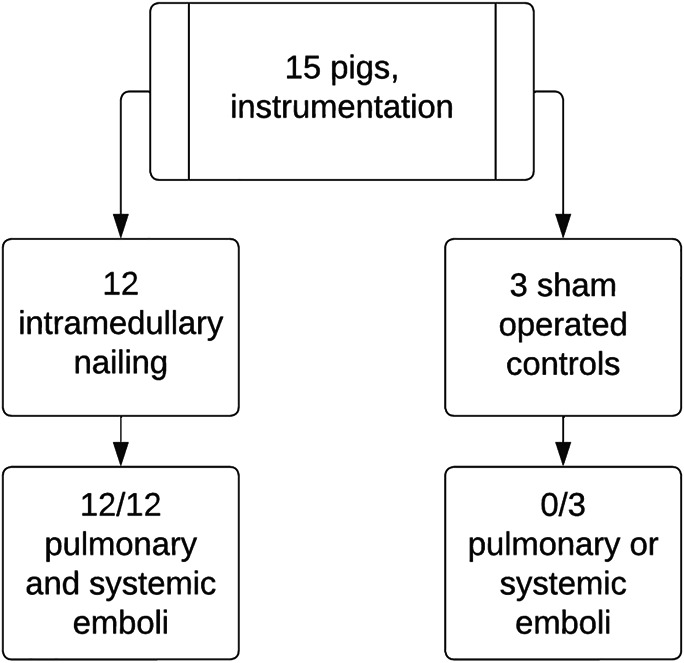
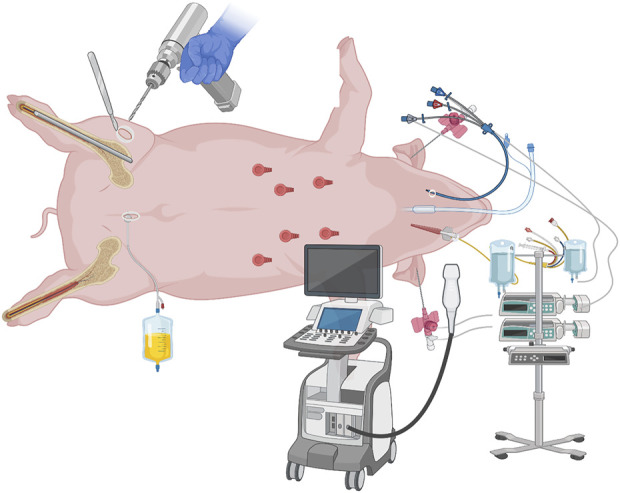
Twelve anesthetized pigs underwent bilateral intramedullary nailing of the femur, while 3 animals served as sham controls. Monitoring included transesophageal echocardiography (TEE), pulse oximetry, electrocardiography, arterial blood pressure measurement, and blood gas and troponin-I analysis. After surgery, animals were monitored for 240 minutes before euthanasia. Post mortem, the heart, lungs, and brain were biopsied.
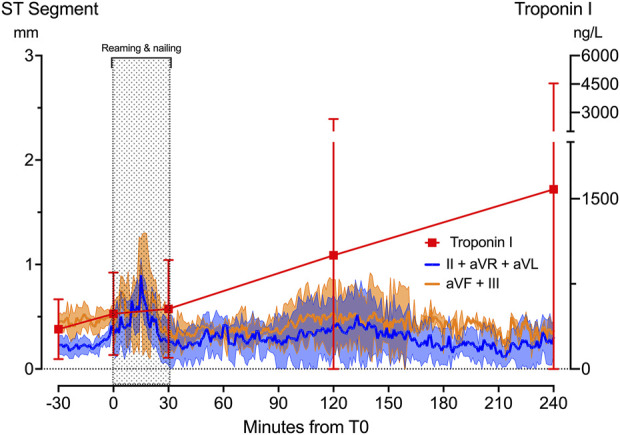
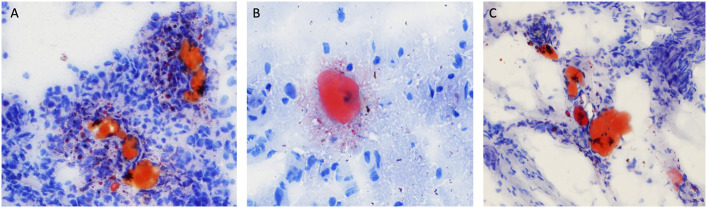
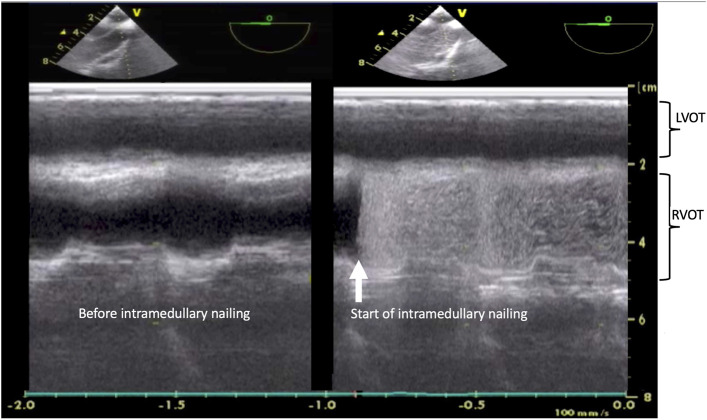
Bone marrow emboli were found in the heart and lungs of all 12 of the pigs that underwent intramedullary nailing and in the brains of 11 of them. No emboli were found in the sham group. The pigs subjected to intramedullary nailing exhibited significant hypoxia (PaO/FiO ratio, 410 mm Hg [95% confidence interval (CI), 310 to 510) compared with the sham group (594 mm Hg [95% CI, 528 to 660]). The nailing group exhibited ST-segment alterations consistent with myocardial ischemia and a significant increase in the troponin-I level compared with the sham group (1,580 ng/L [95% CI, 0 to 3,456] versus 241 ng/L [95% CI, 0 to 625] at the 240-minute time point; p = 0.005). TEE detected emboli in the right ventricular outflow tract, but not systemically, in the nailing group.
Bilateral intramedullary nailing caused bone marrow emboli in the lungs and systemic emboli in the heart and brain in this pig model. The observed clinical manifestations were consistent with coronary and pulmonary emboli. TEE detected pulmonary but not systemic embolization.
Femoral intramedullary nailing in humans is likely to result in embolization as described in our pig model. Focused monitoring is necessary for detection of fat embolism syndrome. Absence of visual emboli in the left ventricle on TEE does not exclude the occurrence of systemic bone marrow emboli.
股骨干骨折通常采用髓内钉固定治疗,这可能会使骨髓栓子进入血液循环。栓子可进入肺部,损害气体交换并引发炎症。偶尔,栓子会从肺循环进入体循环,阻碍灌注并导致诸如心脏和脑梗死等损伤,即所谓的 。我们在猪模型中研究了全身骨髓栓塞的程度。
12只麻醉猪接受双侧股骨髓内钉固定,3只动物作为假手术对照。监测包括经食管超声心动图(TEE)、脉搏血氧饱和度测定、心电图、动脉血压测量以及血气和肌钙蛋白-I分析。术后,在安乐死之前对动物监测240分钟。死后,对心脏、肺和脑进行活检。
在接受髓内钉固定的所有12只猪的心脏和肺中均发现骨髓栓子,其中11只猪的脑中也发现了栓子。假手术组未发现栓子。与假手术组(594 mmHg [95%置信区间(CI),528至660])相比,接受髓内钉固定的猪出现明显缺氧(动脉血氧分压/吸入氧分数比值为410 mmHg [95% CI,310至510])。与假手术组相比,髓内钉固定组出现与心肌缺血一致的ST段改变,且肌钙蛋白-I水平显著升高(在240分钟时间点,分别为1580 ng/L [95% CI,0至3456]和241 ng/L [95% CI,0至625];p = 0.005)。TEE在髓内钉固定组的右心室流出道检测到栓子,但未在全身检测到。
在该猪模型中,双侧髓内钉固定导致肺部骨髓栓子以及心脏和脑的全身栓子形成。观察到的临床表现与冠状动脉和肺栓塞一致。TEE检测到肺部栓塞,但未检测到全身栓塞。
人类股骨髓内钉固定可能会导致如我们猪模型中所描述的栓塞。对于脂肪栓塞综合征的检测,有必要进行重点监测。TEE未在左心室发现可见栓子并不排除全身骨髓栓子的发生。