Shishkina Elena A, Sharagin Pavel A, Tolstykh Evgenia I, Smith Michael A, Napier Bruce A, Degteva Marina O
Urals Research Center for Radiation Medicine, Chelyabinsk, Russia.
Chelyabinsk State University, Chelyabinsk, Russia.
Heliyon. 2024 Feb 10;10(4):e26275. doi: 10.1016/j.heliyon.2024.e26275. eCollection 2024 Feb 29.
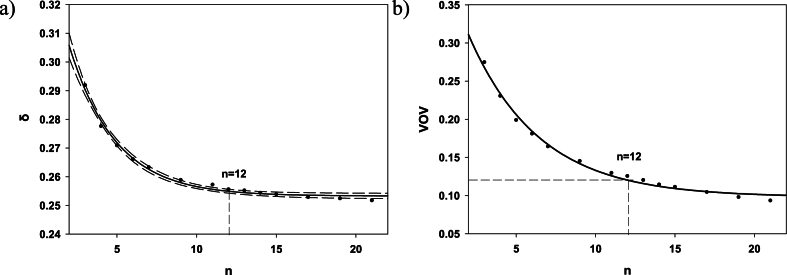
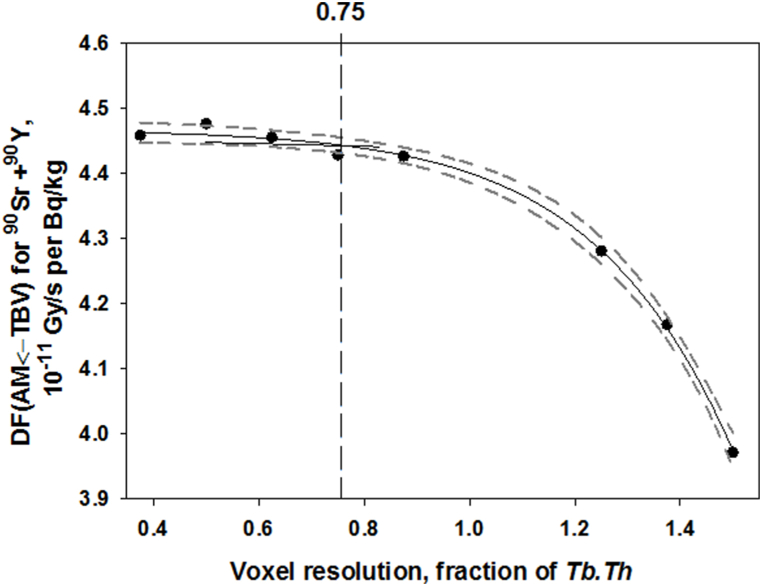
The objective of this study is to evaluate the uncertainties of the dosimetric modeling of active marrow (AM) exposure from bone-seeking Sr. The stochastic parametric skeletal dosimetry (SPSD) model was specifically developed to study the long-term effects resulting from chronic Sr exposure in populations of the radioactively contaminated territories of the Southern Urals region of the Russian Federation. The method permits the evaluation of the dose factors ( and , which convert the radionuclide activity concentration in trabecular () and cortical () bone volumes into dose rate in the , and their uncertainties. The sources of uncertainty can be subdivided into inherent uncertainties related to the individual variability of the simulated objects and introduced uncertainties related to model simplifications. Inherent uncertainty components are the individual variability of bone chemical composition, bone density, bone micro- and macro-architecture as well as distribution within the skeleton. The introduced uncertainties may result from the stylization of bone segment geometry, assumption of uniform cortical thickness, restriction of bone geometry and the selection of the applied voxel resolution. The inherent uncertainty depends on a number of factors of influence. Foremost, it is the result of variability of distribution within the skeleton. Another important factor is the variability of bone micro- and macro-architecture. The inherent uncertainty of skeletal-average dose factors was found to be about 40-50%. The introduced uncertainty associated with the SPSD model approach does not exceed 16% and mainly depends on the error of bone-shape stylization. The overall inherent and introduced uncertainties of and are below 55% and 63%, respectively. The results obtained will be incorporated into the stochastic version of the Techa River Dosimetry System (TRDS-2016MC) that provides multiple realizations of the annual doses for each cohort member to obtain both a central estimate of the individual dose and information on the dose uncertainty.
本研究的目的是评估亲骨性锶所致活性骨髓(AM)照射剂量学建模的不确定性。专门开发了随机参数骨骼剂量学(SPSD)模型,以研究俄罗斯联邦南乌拉尔地区放射性污染区域人群长期暴露于慢性锶所产生的影响。该方法能够评估剂量因子(以及,它们将小梁()和皮质()骨体积中的放射性核素活度浓度转换为中的剂量率,及其不确定性。不确定性来源可细分为与模拟对象个体变异性相关的固有不确定性和与模型简化相关的引入不确定性。固有不确定性成分包括骨化学成分、骨密度、骨微观和宏观结构的个体变异性以及在骨骼内的分布。引入的不确定性可能源于骨段几何形状的程式化、皮质厚度均匀性的假设、骨几何形状的限制以及所应用体素分辨率的选择。固有不确定性取决于许多影响因素。首先,它是骨骼内分布变异性的结果。另一个重要因素是骨微观和宏观结构的变异性。发现骨骼平均剂量因子的固有不确定性约为40 - 50%。与SPSD模型方法相关的引入不确定性不超过16%,主要取决于骨形状程式化的误差。和的总体固有和引入不确定性分别低于55%和63%。所获得的结果将纳入捷恰河剂量学系统(TRDS - 2016MC)的随机版本,该版本为每个队列成员提供年度剂量的多个实现,以获得个体剂量的中心估计以及剂量不确定性信息。