Green Delbert A, Polidori Sean, Stratton Samuel M
Department of Ecology and Evolutionary Biology, University of Michigan-Ann Arbor, 1105 N. University Avenue, Ann Arbor, MI 48109, USA.
iScience. 2024 Feb 1;27(3):109063. doi: 10.1016/j.isci.2024.109063. eCollection 2024 Mar 15.
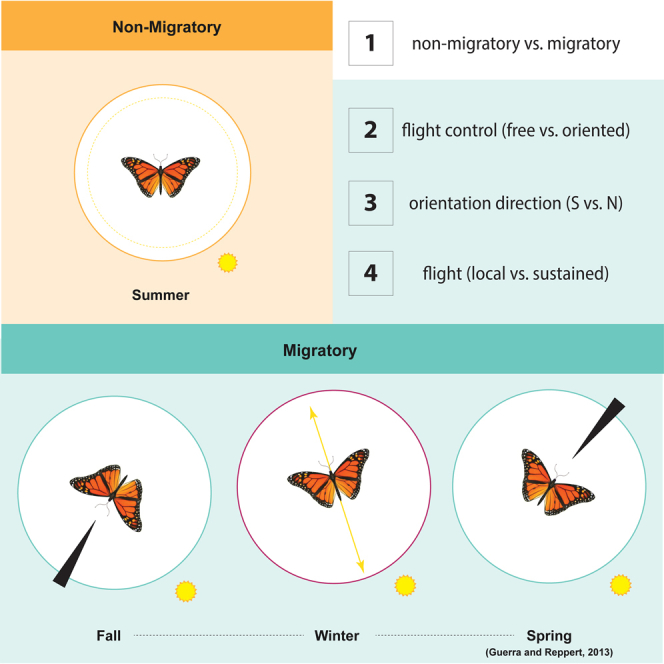
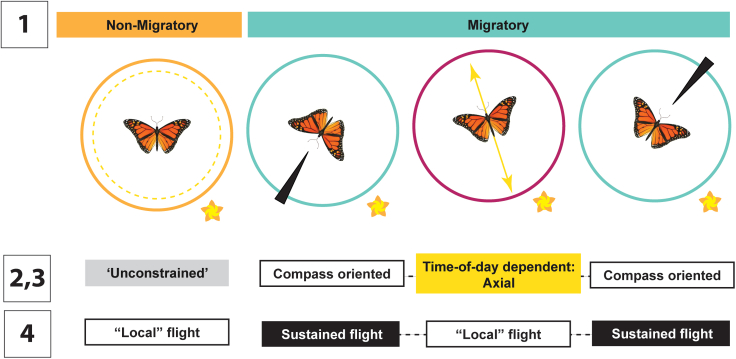
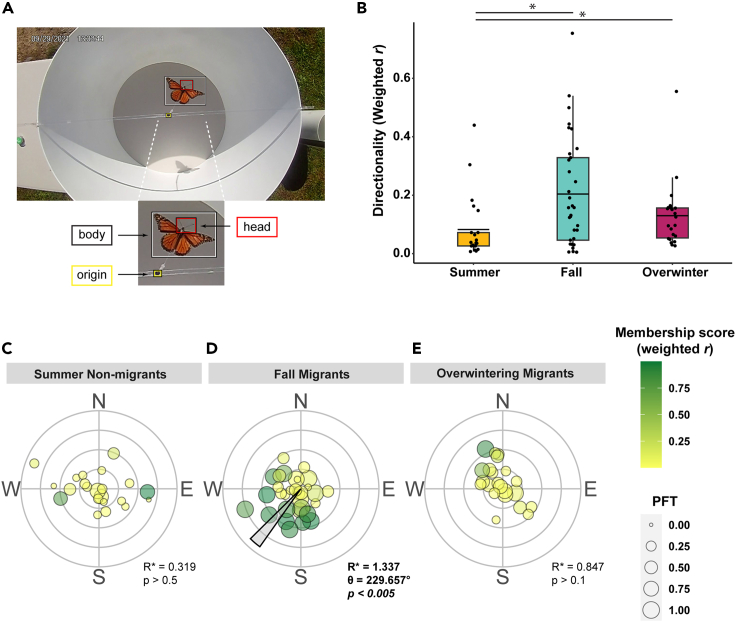
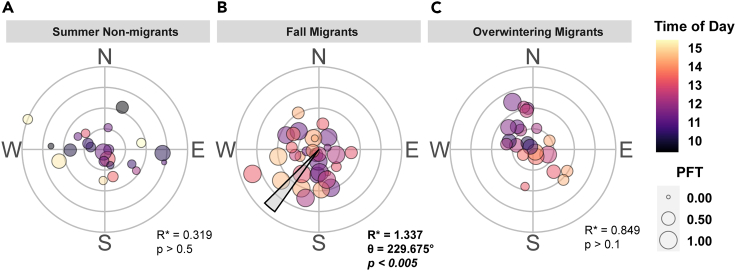
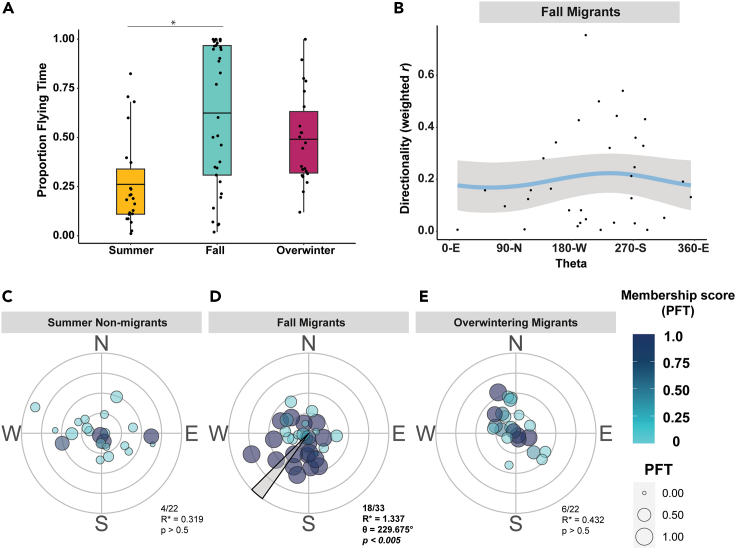
Eastern North American migratory monarch butterflies exhibit migratory behavioral states in fall and spring characterized by sun-dependent oriented flight. However, it is unclear how monarchs transition between these behavioral states at their overwintering site. Using a modified Mouritsen-Frost flight simulator, we confirm individual directionality and compass-based orientation (leading to group orientation) in fall migrants, and also uncover sustained flight propensity and direction-based flight reinforcement as distinctly migratory behavioral traits. By testing monarchs at their Mexican overwintering sites, we show that overwintering monarchs show reduced propensity for sustained flight and lose individual directionality, leading to the loss of group-level orientation. Overwintering fliers orient axially in a time-of-day dependent manner, which may indicate local versus long-distance directional heading. These results support a model of migratory flight behavior in which modular, state-dependent switches for flight propensity and orientation control are highly dynamic and are controlled in season- and location-dependent manners.
北美洲东部的迁徙黑脉金斑蝶在秋季和春季表现出以依赖太阳的定向飞行为特征的迁徙行为状态。然而,尚不清楚黑脉金斑蝶在其越冬地点如何在这些行为状态之间转换。使用改良的莫里森 - 弗罗斯特飞行模拟器,我们证实了秋季迁徙者的个体方向性和基于罗盘的定向(导致群体定向),并且还发现持续飞行倾向和基于方向的飞行强化是明显的迁徙行为特征。通过在墨西哥越冬地点测试黑脉金斑蝶,我们表明越冬黑脉金斑蝶持续飞行的倾向降低,个体方向性丧失,导致群体水平定向的丧失。越冬飞行者以依赖一天中时间的方式轴向定向,这可能表明是本地还是长途定向飞行。这些结果支持了一种迁徙飞行行为模型,其中用于飞行倾向和定向控制的模块化、状态依赖开关是高度动态的,并以季节和位置依赖的方式受到控制。