Department of Thoracic Surgery, Hsinchu MacKay Memorial Hospital, Hsinchu, Taiwan.
Department of Life Science & Institute of Molecular and Cellular Biology, National Tsing Hua University, Hsinchu, Taiwan.
PLoS One. 2024 Feb 29;19(2):e0299256. doi: 10.1371/journal.pone.0299256. eCollection 2024.
Obesity is a global health issue with increasing prevalence. Surgical procedures, such as surgical stabilization of rib fractures (SSRF), may be affected by obesity-related complications. The objective of the study is to investigate the effects of obesity on SSRF outcomes in multiple rib fractures.
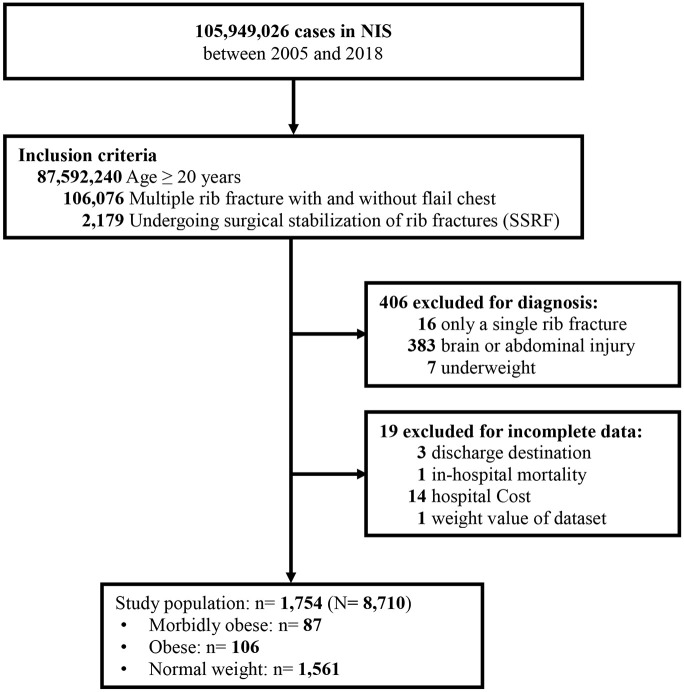
This retrospective study analyzed data from adults aged ≥ 20 years in the Nationwide Inpatient Sample (NIS) database diagnosed with multiple rib fractures who underwent SSRF between 2005 and 2018. It investigated the relationship between obesity and in-patient outcomes, such as discharge status, length of stay (LOS), in-hospital mortality, hospital costs, and adverse events using logistic and linear regression analyses.
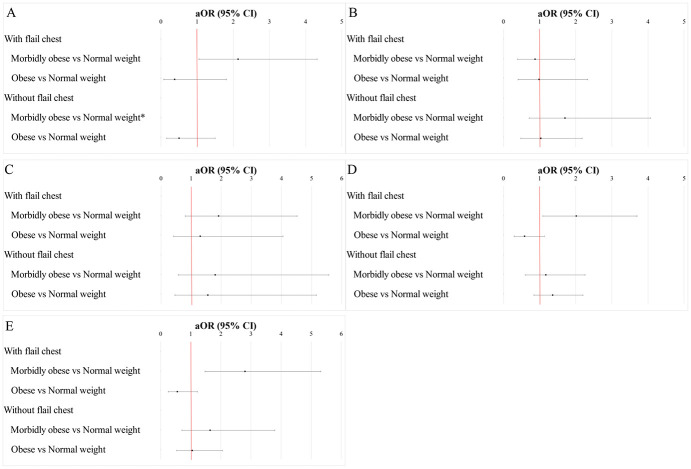
Analysis of data from 1,754 patients (morbidly obese: 87; obese: 106; normal weight: 1,561) revealed that morbid obesity was associated with longer LOS (aBeta = 0.07, 95% CI: 0.06, 0.07), higher hospital costs (aBeta = 47.35, 95% CI: 38.55, 56.14), increased risks of adverse events (aOR = 1.63, 95% CI: 1.02, 2.61), hemorrhage/need for transfusion (aOR = 1.77, 95% CI: 1.12, 2.79) and mechanical ventilation ≥ 96 hours (aOR = 2.14, 95% CI: 1.28, 3.58) compared to normal weight patients. Among patients with flail chest, morbid obesity was significantly associated with tracheostomy (aOR = 2.13, 95% CI: 1.05, 4.32), ARDS/respiratory failure (aOR = 2.01, 95% CI: 1.09, 3.70), and mechanical ventilation ≥ 96 hours (aOR = 2.80, 95% CI: 1.47, 5.32). In contrast, morbid obesity had no significant associations with these adverse respiratory outcomes among patients without a flail chest (p > 0.05).
Morbid obesity is associated with adverse outcomes following SSRF for multiple rib fractures, especially for flail chest patients.
肥胖是一个全球性的健康问题,其患病率不断上升。手术治疗,如外科肋骨骨折稳定术(Surgical Stabilization of Rib Fractures,SSRF),可能会受到肥胖相关并发症的影响。本研究的目的是探讨肥胖对多发性肋骨骨折 SSRF 结局的影响。
这是一项回顾性研究,分析了 2005 年至 2018 年期间在全国住院患者样本(Nationwide Inpatient Sample,NIS)数据库中接受 SSRF 治疗的年龄≥20 岁的成人多发性肋骨骨折患者的数据。使用逻辑回归和线性回归分析探讨了肥胖与住院结局(如出院状态、住院时间(Length of Stay,LOS)、院内死亡率、住院费用和不良事件)之间的关系。
对 1754 名患者(病态肥胖:87 例;肥胖:106 例;正常体重:1561 例)的数据进行分析,结果显示病态肥胖与 LOS 延长(aBeta = 0.07,95%置信区间:0.06,0.07)、住院费用增加(aBeta = 47.35,95%置信区间:38.55,56.14)、不良事件风险增加(aOR = 1.63,95%置信区间:1.02,2.61)、出血/需要输血(aOR = 1.77,95%置信区间:1.12,2.79)和机械通气≥96 小时(aOR = 2.14,95%置信区间:1.28,3.58)有关,与正常体重患者相比。在连枷胸患者中,病态肥胖与气管切开术(aOR = 2.13,95%置信区间:1.05,4.32)、急性呼吸窘迫综合征/呼吸衰竭(aOR = 2.01,95%置信区间:1.09,3.70)和机械通气≥96 小时(aOR = 2.80,95%置信区间:1.47,5.32)显著相关。相反,病态肥胖与无连枷胸患者的这些不良呼吸结局无显著相关性(p > 0.05)。
病态肥胖与多发性肋骨骨折 SSRF 后的不良结局相关,尤其是对连枷胸患者。