Population Health Sciences, Bristol Medical School, University of Bristol, Bristol, UK.
School of Social and Political Sciences, University of Glasgow, Glasgow, UK.
Int J Equity Health. 2024 Feb 29;23(1):45. doi: 10.1186/s12939-024-02133-3.
In 2021, Scotland became the first UK country to launch a Women's Health Plan. This policy signals increasing commitment to broader ambitions surrounding gender equality in health. Research shows a connection between discrimination and health, representing a contributor to health inequalities. There remains sparse evidence on how certain groups experience discrimination that could be useful for policymaking. This research set out to address this evidence gap through exploring how discrimination shapes young women's experiences of mental health and inequalities in Scotland.
We interviewed women aged 16-25 years (n=28), living in Scotland, UK, adopting an intersectional approach to recruitment and data analysis. We used a semi-structured topic guide to facilitate open discussion about discrimination and health. Transcripts were analysed by two researchers using Thematic Analysis and NVivo software.
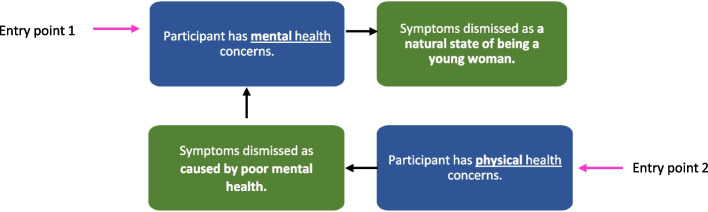
We identified three themes that illuminate intersectional discrimination and the impact on mental health. The first outlines how experiences of discrimination in school, work and public spaces (and the anticipation of such) creates stress leading to mental health problems, particularly for participants from ethnic minority groups. The second highlights the lack of support for mental health, both at structural and interpersonal levels, which was viewed by young women as a form of intersectional discrimination, largely because of their gender and age. Finally, we developed a mid-level theory termed the 'chain of dismissal' that displays that for both physical or mental health symptoms, young women's concerns are immediately "written off" as anxiety-related and in turn a natural attribute of young women. These themes show that discrimination has the potential to amplify mental health problems for young women and is a likely contributor to health inequalities.
Structural disadvantages such as racism intersect with gender and age to compound the experience of discrimination for marginalised young women. To improve mental health and reduce health inequalities for young women, multi-level approaches are needed, with strong consideration of how the structural and cultural landscape as well as assumptions made by healthcare professionals have critical implications for young women's health.
2021 年,苏格兰成为首个推出妇女健康计划的英国地区。该政策表明对更广泛的性别平等健康目标的承诺不断增加。研究表明,歧视与健康之间存在联系,是健康不平等的一个促成因素。关于某些群体经历歧视的情况,仍缺乏有用的证据来制定政策。这项研究旨在通过探索歧视如何影响苏格兰年轻女性的心理健康和不平等问题来填补这一证据空白。
我们采访了年龄在 16-25 岁之间的(n=28)苏格兰女性,采用交叉方法进行招募和数据分析。我们使用半结构化主题指南来促进关于歧视和健康的开放讨论。两位研究人员使用主题分析和 NVivo 软件对转录本进行分析。
我们确定了三个主题,阐明了交叉歧视和对心理健康的影响。第一个主题概述了在学校、工作和公共场所(以及对这种情况的预期)经历歧视如何导致压力,从而导致心理健康问题,特别是对于少数族裔群体的参与者。第二个主题强调了在结构和人际层面上对心理健康缺乏支持,年轻女性认为这是一种交叉歧视,主要是因为她们的性别和年龄。最后,我们提出了一个中级理论,称为“解雇链”,该理论表明,对于身体或心理健康症状,年轻女性的担忧立即被“归为”与焦虑相关的问题,反过来又被认为是年轻女性的自然特征。这些主题表明,歧视有可能放大年轻女性的心理健康问题,是健康不平等的一个可能原因。
种族主义等结构性劣势与性别和年龄交织在一起,使边缘化的年轻女性更加遭受歧视。为了改善年轻女性的心理健康并减少健康不平等,需要采取多层次的方法,强烈考虑结构性和文化景观以及医疗保健专业人员的假设对年轻女性健康的关键影响。