Edmans Jake G, Murdoch Craig, Hatton Paul V, Madsen Lars Siim, Santocildes-Romero Martin E, Spain Sebastian G, Colley Helen E
School of Clinical Dentistry, University of Sheffield, 19 Claremont Crescent, Sheffield, S10 2TA UK.
Department of Chemistry, University of Sheffield, Brook Hill, Sheffield, S3 7HF UK.
Biomed Mater Devices. 2024;2(1):444-453. doi: 10.1007/s44174-023-00098-5. Epub 2023 Jun 21.
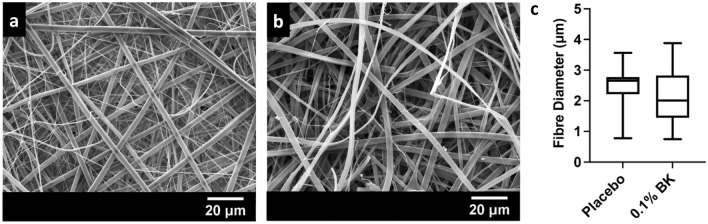
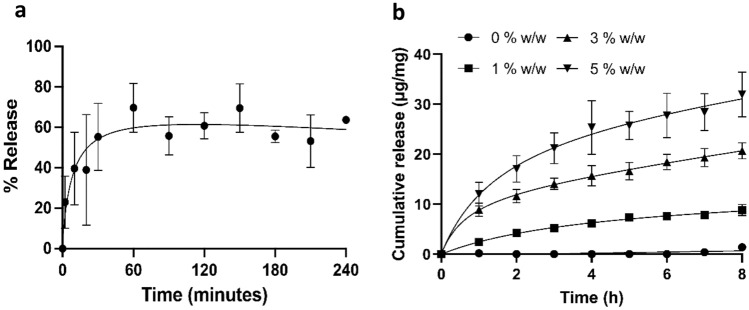
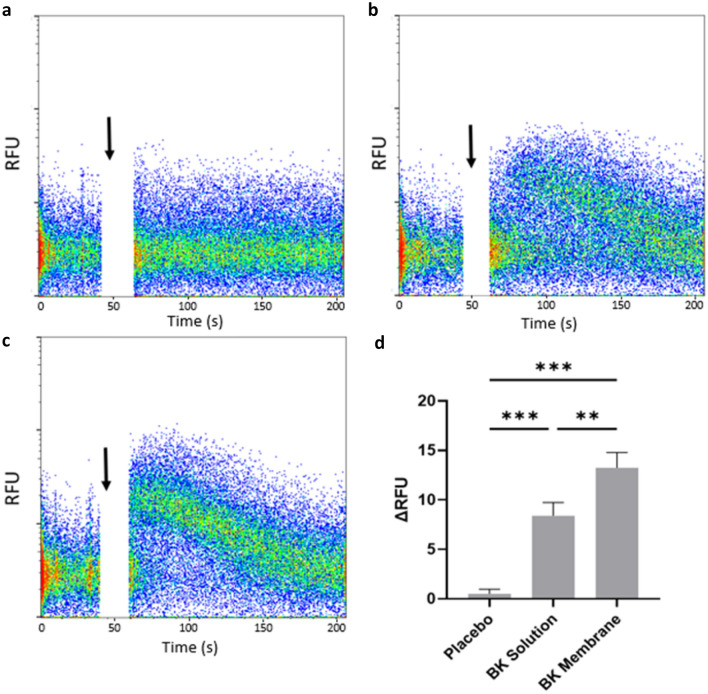
Protein-based biologics constitute a rapidly expanding category of therapeutic agents with high target specificity. Their clinical use has dramatically increased in recent years, but administration is largely via injection. Drug delivery across the oral mucosa is a promising alternative to injections, in order to avoid the gastrointestinal tract and first-pass metabolism. Current drug delivery formulations include liquid sprays, mucoadhesive tablets and films, which lack dose control in the presence of salivary flow. To address this, electrospun membranes that adhere tightly to the oral mucosa and release drugs locally have been developed. Here, we investigated the suitability of these mucoadhesive membranes for peptide or protein release. Bradykinin (0.1%) or insulin (1, 3, and 5%) were incorporated by electrospinning from ethanol/water mixtures. Immersion of membranes in buffer resulted in the rapid release of bradykinin, with a maximal release of 70 ± 12% reached after 1 h. In contrast, insulin was liberated more slowly, with 88 ± 11, 69.0 ± 5.4, and 63.9 ± 9.0% cumulative release of the total encapsulated dose after 8 h for membranes containing 1, 3, and 5% w/w insulin, respectively. Membrane-eluted bradykinin retained pharmacological activity by inducing rapid intracellular calcium release upon binding to its cell surface receptor on oral fibroblasts, when examined by flow cytometry. To quantify further, time-lapse confocal microscopy revealed that membrane-eluted bradykinin caused a 1.58 ± 0.16 fold-change in intracellular calcium fluorescence after 10 s compared to bradykinin solution (2.13 ± 0.21), relative to placebo. In conclusion, these data show that electrospun membranes may be highly effective vehicles for site-specific administration of biotherapeutic proteins or peptides directly to the oral mucosa for either local or systemic drug delivery applications.
基于蛋白质的生物制剂是一类治疗药物,其靶向特异性高且正在迅速扩展。近年来它们的临床应用显著增加,但给药方式主要是注射。经口腔黏膜给药是一种有前景的替代注射的方式,以避免胃肠道和首过代谢。当前的药物递送制剂包括液体喷雾剂、黏膜黏附片和薄膜,在有唾液流动的情况下缺乏剂量控制。为了解决这个问题,已经开发出能紧密黏附于口腔黏膜并在局部释放药物的电纺膜。在此,我们研究了这些黏膜黏附膜用于肽或蛋白质释放的适用性。通过从乙醇/水混合物中进行电纺将缓激肽(0.1%)或胰岛素(1%、3%和5%)掺入其中。将膜浸入缓冲液中导致缓激肽快速释放,1小时后最大释放量达到70±12%。相比之下,胰岛素释放得更慢,对于分别含有1%、3%和5%(w/w)胰岛素的膜,8小时后总包封剂量的累积释放量分别为88±11%、69.0±5.4%和63.9±9.0%。当通过流式细胞术检测时,膜洗脱的缓激肽在与口腔成纤维细胞表面受体结合后诱导细胞内钙快速释放,从而保留了药理活性。为了进一步定量,延时共聚焦显微镜显示,与缓激肽溶液(2.13±0.21)相比,膜洗脱的缓激肽在10秒后导致细胞内钙荧光相对于安慰剂有1.58±0.16倍的变化。总之,这些数据表明,电纺膜可能是将生物治疗性蛋白质或肽直接用于口腔黏膜局部或全身给药的位点特异性给药的高效载体。