North Sichuan Medical College, Nanchong, Sichuan, China.
Department of Pediatrics, The Third People's Hospital of Chengdu, The Affiliated Hospital of Southwest Jiaotong University, Chengdu, China.
Medicine (Baltimore). 2024 Mar 1;103(9):e37284. doi: 10.1097/MD.0000000000037284.
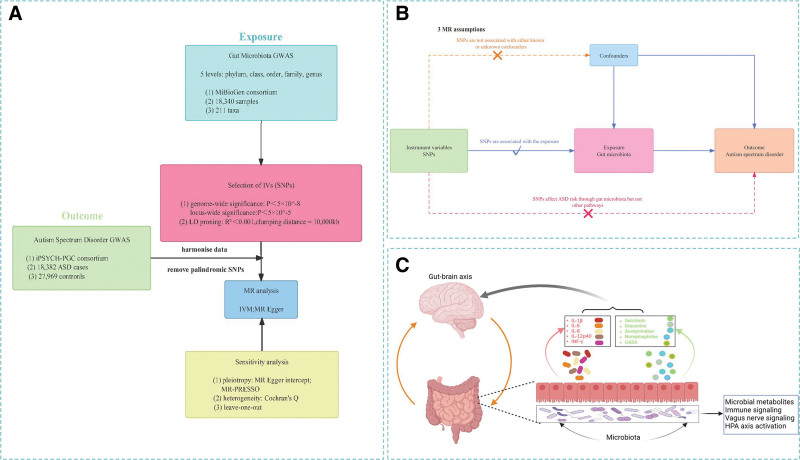
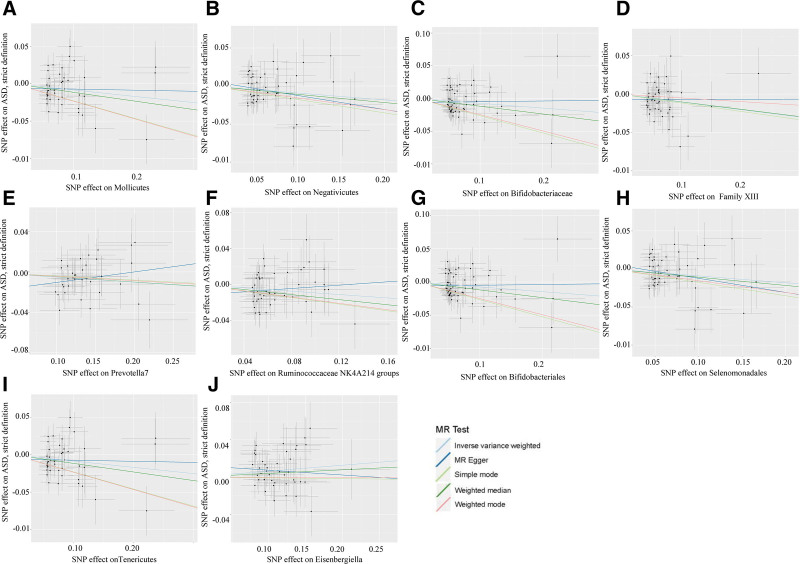
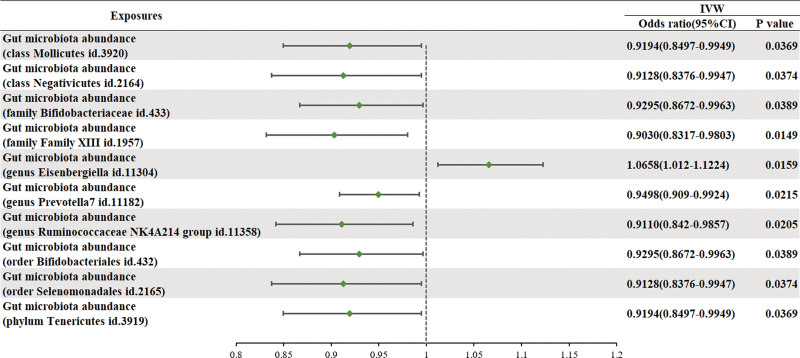
There is increasing evidence that alterations in gut microbiota (GM) composition are associated with autism spectrum disorder (ASD), but no reliable causal relationship has been established. Therefore, a 2-sample Mendelian randomization (MR) study was conducted to reveal a potential causal relationship between GM and ASD. Instrumental variables for 211 GM taxa were obtained from genome-wide association studies (GWAS) and Mendelian randomization studies to estimate their impact on ASD risk in the iPSYCH-PGC GWAS dataset (18,382 ASD cases and 27,969 controls). Inverse variance weighted (IVW) is the primary method for causality analysis, and several sensitivity analyses validate MR results. Among 211 GM taxa, IVW results confirmed that Tenericutes (P value = .0369), Mollicutes (P value = .0369), Negativicutes (P value = .0374), Bifidobacteriales (P value = .0389), Selenomonadales (P value = .0374), Bifidobacteriaceae (P value = .0389), Family XIII (P value = .0149), Prevotella7 (P value = .0215), Ruminococcaceae NK4A214 group (P value = .0205) were potential protective factors for ASD. Eisenbergiella (P value = .0159) was a possible risk factor for ASD. No evidence of heterogeneous, pleiotropic, or outlier single-nucleotide polymorphism was detected. Additionally, further sensitivity analysis verified the robustness of the above results. We confirm a potential causal relationship between certain gut microbes and ASD, providing new insights into how gut microbes mediate ASD. The association between them needs to be further explored and will provide new ideas for the prevention and treatment of ASD.
越来越多的证据表明,肠道微生物群(GM)组成的改变与自闭症谱系障碍(ASD)有关,但尚未建立可靠的因果关系。因此,进行了一项两样本孟德尔随机化(MR)研究,以揭示 GM 与 ASD 之间潜在的因果关系。从全基因组关联研究(GWAS)和孟德尔随机化研究中获得了 211 种 GM 分类群的工具变量,以估计它们对 iPSYCH-PGC GWAS 数据集(18382 例 ASD 病例和 27969 例对照)中 ASD 风险的影响。逆方差加权(IVW)是因果分析的主要方法,几种敏感性分析验证了 MR 结果。在 211 种 GM 分类群中,IVW 结果证实厚壁菌门(P 值=0.0369)、柔膜菌门(P 值=0.0369)、Negativicutes(P 值=0.0374)、双歧杆菌目(P 值=0.0389)、硒单胞菌目(P 值=0.0374)、双歧杆菌科(P 值=0.0389)、XIII 科(P 值=0.0149)、普雷沃氏菌 7 属(P 值=0.0215)、罗氏菌科 NK4A214 群(P 值=0.0205)是 ASD 的潜在保护因素。Eisenbergiella(P 值=0.0159)是 ASD 的一个可能的危险因素。未检测到异质性、多效性或异常单核苷酸多态性的证据。此外,进一步的敏感性分析验证了上述结果的稳健性。我们证实了某些肠道微生物与 ASD 之间存在潜在的因果关系,为肠道微生物如何介导 ASD 提供了新的见解。它们之间的关联需要进一步探索,并将为 ASD 的预防和治疗提供新的思路。